
Before you even think about getting quotes, there’s some critical homework to do. This initial background check on potential roofers is your first and best line of defense. It’s what separates the true professionals from the rest, protecting you from shoddy work, financial headaches, and major liability issues down the road.
Start with the Non-Negotiable Contractor Credentials

Think of it like this: you wouldn't let an unlicensed doctor operate on you, right? The same logic applies to the professional protecting the single most important part of your home. Skipping this step is a gamble you just can't afford to take.
In Salt Lake City and across Utah, legitimate roofing contractors must meet specific state requirements. These aren't just suggestions; they’re the bare minimum. Checking these credentials right away acts as a powerful filter, instantly weeding out any unqualified or shady operators.
H3: First Things First: Is Their State License Active?
In Utah, a roofer needs a state-issued license to operate legally. This isn't just a piece of paper; it means they've met the state's requirements for experience and passed necessary exams. It's the most basic proof of their competence.
Luckily, verifying this is easy. Just head over to the Utah Division of Professional Licensing (DOPL) website. They have a free online search tool where you can look up any contractor by name. If their license is expired, suspended, or you can't find them at all, that's a massive red flag. Cross them off your list and move on.
H3: Don't Skip This: Verify Their Insurance Coverage
This is the big one. Proper insurance protects you, the homeowner, from financial disaster. If a roofer tells you they're "fully insured," don't just take their word for it. Ask to see the Certificate of Insurance (COI) for two specific policies.
- General Liability Insurance: This covers any damage they might cause to your property. If a crew member accidentally drops a hammer through your skylight or backs their truck into your garage door, this policy pays for the repairs. Without it, that cost falls on you.
- Workers' Compensation Insurance: This is non-negotiable. It protects the roofer's employees if they get hurt on your property. If a contractor doesn’t have it and one of their workers falls off your roof, you could be sued for their medical bills and lost wages. It’s a nightmare scenario you can easily avoid.
Hiring a roofer without verifying both types of insurance is a huge risk. A legitimate contractor will gladly provide their certificates. The smart move? Call the insurance agency listed on the certificate to confirm the policies are active and haven't lapsed.
Understanding the best insurance for contractors gives you a better sense of what a well-protected, professional company should carry.
To keep everything organized, use a simple tracking table like this one for each contractor you're considering.
Contractor Credentials at a Glance
| Credential | What to Look For | Why It Matters | How to Verify |
|---|---|---|---|
| State License | An active, current license with the Utah DOPL. | Confirms they are legally allowed to work and have met state competency standards. | Use the free search tool on the Utah DOPL website. |
| General Liability | A valid Certificate of Insurance (COI) with sufficient coverage limits. | Protects your property from accidental damage caused by the contractor or crew. | Request the COI and call the listed insurance agent to confirm it's active. |
| Workers' Comp | A valid Certificate of Insurance (COI). | Protects you from liability if a worker is injured on your property. | Request the COI and call the listed agent to verify the policy is current. |
| BBB Rating | An A or A+ rating with few, if any, unresolved complaints. | Shows a commitment to customer satisfaction and ethical business practices. | Search for the business name on the Better Business Bureau website. |
This simple chart makes it easy to compare your top contenders side-by-side and spot any potential issues before you waste time on a full estimate.
H3: Check Their Professional Standing and Reputation
A contractor's public reputation can tell you a lot about how they do business. The Better Business Bureau (BBB) is an excellent resource for this. An A+ rating, like the one we're proud to have at Superior Home Improvement, signals a long history of taking care of customers.
Look beyond just the letter grade. Read any complaints to see what the issue was and, more importantly, how the company responded. A solid track record shows they stand behind their work. This is vital, as industry data shows unlicensed operators are connected to as many as 20% of all disputes, often leaving homeowners with a mess and no one to hold accountable.
The Interview: Asking the Right Questions to Find the Best Roofer
You've done the initial legwork and have a shortlist of licensed and insured contractors. Now comes the most critical part: the interview. This conversation is about far more than just getting a price. It’s your chance to see how they operate, how they communicate, and how they’ll manage a major construction project on your home.
Think of it this way: their license and insurance are the bare minimum. Their answers to your questions are what will really tell you if you're hiring a true professional or just someone who knows how to swing a hammer. You’re not just buying shingles; you’re entrusting your biggest asset to them.
How Will They Protect Your Home?
A top-notch roofer has a system for everything, especially when it comes to keeping your property from looking like a disaster zone. Vague answers here are a huge red flag. It usually means they don’t have a standard process, which is how expensive mistakes happen.
Kick things off by asking about their day-to-day operations on-site. You're looking for specifics, not hand-waving.
- "What's your plan to protect my landscaping, siding, and windows?" The right answer involves details. They should mention using heavy-duty tarps to cover bushes and AC units, plywood shields for windows and doors, and a clear plan for where the old materials will land.
- "How do you handle cleanup?" A professional crew cleans up throughout the day and does a final sweep before they leave. A must-ask is if they use a magnetic nail sweeper. You don't want to find a stray roofing nail with your car tire or your kid's foot a week later.
- "Where will you stage the materials and the dumpster?" This shows they've thought through the logistics. A good contractor will discuss the best spot with you to minimize disruption to your driveway and daily life.
If they make it sound like these things are no big deal, that’s your cue to move on. A contractor who cares about the details of protecting your property is one who will care about the details on your roof.
What Happens When Things Don't Go to Plan?
Even with the best contractors, surprises can pop up, especially on older Salt Lake City homes. Once those old shingles come off, it’s not uncommon to find hidden water damage, rotted decking, or ventilation issues that weren't visible before. A pro's reaction to this is what separates them from the amateurs.
A seasoned contractor anticipates the unexpected. They won't be rattled; instead, they'll have a clear, straightforward process for dealing with it that keeps you in the driver's seat.
This is where you can really gauge their experience and integrity. Ask some pointed questions about how they handle problems:
- Who is my go-to person during the project? You want a single point of contact—a project manager or a site foreman. Chasing down different people for answers is a recipe for frustration and miscommunication.
- How do you handle unforeseen repairs, like rotten wood? A good contractor will have a line item in their contract for this, like a set price per sheet of plywood. The only acceptable process is: stop work, show you the problem (with pictures!), get your written approval for the extra cost, and then proceed. No exceptions.
- What’s your plan for bad weather? Utah storms can pop up out of nowhere. A good crew needs to have a plan to secure your roof and make it watertight in a hurry if the weather turns.
Their answers here tell you everything about their commitment to customer service. Finding a roofer who communicates clearly and has solid plans for the "what-ifs" is just as important as the quality of their installation. It's the difference between a stressful ordeal and a smooth project with total peace of mind.
Seeing is Believing: How to Check Past Work and Call References
A slick website and a five-star Google rating are great starting points, but they don't tell the whole story. The real proof of a roofer's quality is in the work they've already done. This is your chance to move past the sales pitch and see tangible, real-world results.
First things first, ask to see their portfolio. Don't just flip through glossy photos—look for projects that mirror your own home. If you have a classic brick bungalow in the Avenues or a steep A-frame up in Sandy, you need to see that they've successfully tackled that style before. The challenges of a roof built to handle Park City's heavy snow load are completely different from a roof in the Salt Lake valley, so that specific, local experience really matters.
Looking Beyond the Pretty Pictures
A great portfolio isn't just a highlight reel of new roofs; it’s a testament to their craftsmanship. You have to train your eye to spot the details.
When you're looking at their photos, here’s what to zero in on:
- Clean Lines: Are the shingle lines perfectly straight and uniform? Any crooked or wavy patterns are a dead giveaway of a rushed or amateur job.
- Flashing Detail: Pay close attention to the areas around chimneys, vents, and skylights. These are the weak spots where most leaks start. The metal flashing should look clean, tight, and expertly sealed.
- Overall Tidiness: Do the photos of the finished job show a spotless property? It's a small detail, but it speaks volumes about how much they respect a homeowner's space.
After you've reviewed their photos, ask for the addresses of a few recent jobs. There's no substitute for a quick drive-by. This gives you an unfiltered look at how their work holds up after a few weeks or months and how it actually looks in a real neighborhood, not just in a perfectly staged photo.
A contractor who is genuinely proud of their work will be excited to show it off and connect you with happy customers. If they get defensive or make excuses, that's a massive red flag. It usually means there's something they don't want you to see.
Getting the Real Story from References
Now it's time to make some calls. Get a list of at least three to five recent references. This step is absolutely critical because a five-minute phone call can reveal more than a dozen online reviews ever could. You'll get a feel for their communication, professionalism, and how they handle things when the unexpected happens.
But don't just ask, "So, were you happy with them?" That’s a closed question that gets you a simple "yes" or "no." You need to dig deeper to understand the entire experience.
Try asking these questions instead:
- Did the final bill match the original quote? If there were extra costs, how did they explain and handle them?
- What was the crew like on-site? Were they professional? Did they clean up every day, or was it a constant mess?
- How was the communication throughout the project? Did you feel like you were in the loop, or were you left wondering what was going on?
- Did any problems pop up? How did the contractor step up to solve them?
- This is the most important one: Knowing everything you know now, would you hire them again in a heartbeat?
This approach gets you past a simple satisfaction score and into the nitty-gritty of what it's actually like to work with them. It’s a necessary step in a crowded field. The U.S. roofing industry is projected to hit $76.4 billion by 2025, with over 100,000 different companies all vying for your business. Doing your homework is the only way to ensure you end up with one of the good ones. For more on navigating this landscape, check out these insights from This Old House.
Breaking Down Quotes and Understanding Warranties
Getting a few roofing bids can feel like trying to compare apples, oranges, and maybe a pineapple. With all the different numbers, terms, and materials flying around, it’s easy to just zero in on the lowest price and move on. But trust me, learning how to really read these proposals is probably the most critical part of hiring the right roofer.
Your goal isn't to find the cheapest roof; it's to get the best value for your home in the long run. That rock-bottom price can look pretty tempting, I get it. But more often than not, it's a sign of cut corners, cheap materials, or a lack of insurance—all things that can turn a "deal" into a disaster down the road.
This is where a detailed, itemized quote is a professional's calling card. A vague, one-page estimate is a huge red flag. A pro will give you a complete breakdown of the entire job.
Scrutinizing the Details of a Roofing Quote
Think of a good quote as the blueprint for your project. It should leave absolutely no room for those dreaded "surprises" that inflate the final bill. Don't be shy about insisting on a document that clearly spells everything out. If a contractor gets cagey about providing details, that's your cue to show them the door.
Here’s exactly what you need to look for in every single bid:
- Specific Materials: The quote has to name names. It needs to list the brand and type of shingles, underlayment, and flashing. "Architectural shingles" is too vague—are they GAF Timberline HDZ or Owens Corning Duration? These specifics make a huge difference in performance and warranty coverage.
- Labor Costs: This should be a clear, standalone figure. It shows you what you're paying for a skilled, certified crew that knows what they're doing and won't rush through the installation.
- Tear-Off and Disposal: The cost to remove your old roof and properly dispose of the debris should always be its own line item. A shady operator might conveniently "forget" this, only to hit you with a big disposal fee later.
- Property Protection and Cleanup: Does the contractor mention using tarps to protect your landscaping or a magnetic sweeper to get all the nails? This little detail speaks volumes about their professionalism and respect for your property.
- Permit Fees: The contractor should be the one pulling all the necessary local permits, and that cost should be baked right into the quote.
If you want to get more comfortable with how service providers price their work, this guide on understanding professional service costs is a great resource. It will give you the confidence to ask the right questions and spot a genuinely good value.
This flowchart gives you a quick visual of the vetting process, helping you make sure you're only getting quotes from qualified pros to begin with.
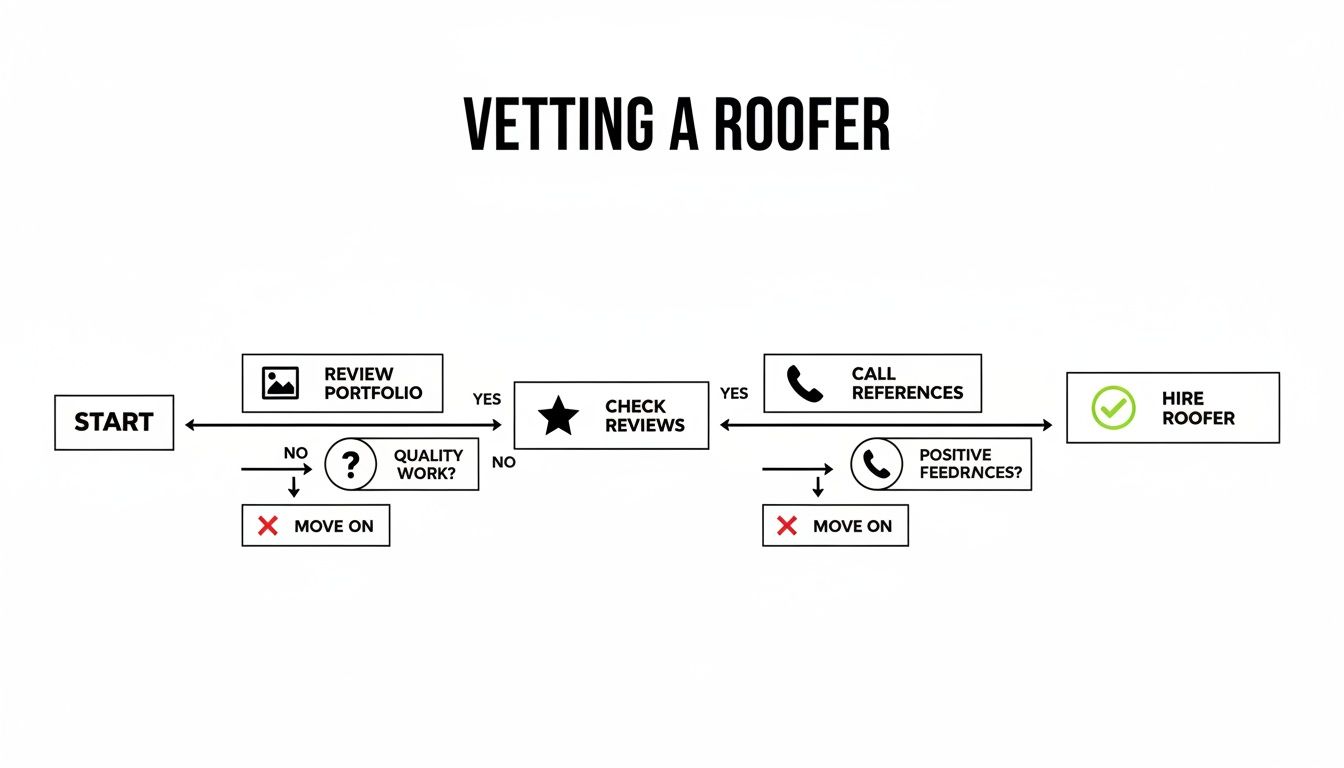
As you can see, checking portfolios, reading reviews, and calling references are the foundational steps you need to take before you even start comparing the numbers on a quote.
Demystifying Roofing Warranties
Figuring out the warranties is just as important as dissecting the quote. A solid warranty is your safety net, but it's easy to get the two main types of coverage mixed up. They aren't the same thing, and knowing the difference is vital to protecting your investment.
A roof is a complete system, and its protection is twofold. You have coverage on the products themselves and separate coverage on the skill used to install them. One without the other leaves a significant gap in your protection.
This is especially critical when you consider that an average roof replacement can cost around $25,840. With the U.S. roofing industry projected to hit $99.8 billion by 2025, there are thousands of companies out there, but not all of them offer robust protection to stand behind their work.
Let's clear up the confusion between the two warranties you'll see.
Comparing Roofing Warranties What You Need to Know
A strong warranty package should cover both the materials and the installation. Here's a table that breaks down the two distinct types of coverage you should expect to see.
| Warranty Type | What It Covers | Typical Duration | Key Considerations |
|---|---|---|---|
| Manufacturer Warranty | Protects against defects in the roofing materials themselves (e.g., shingles that crack or lose granules prematurely). | 25 years to "Lifetime" (often prorated). | This warranty can be voided by improper installation. It only covers the material, not the labor to replace it. |
| Workmanship Warranty | Protects against installation errors, such as improper nailing, faulty flashing, or anything that leads to leaks due to poor technique. | 2 to 10 years (or more). This is provided by your contractor. | This is a direct reflection of the contractor's confidence in their own crew and processes. A longer warranty is a great sign. |
Always, always get the warranty details in writing—no exceptions.
Here at Superior Home Improvement, we stand by our work with a 10-year workmanship warranty. We can offer that because we use certified installers and proven installation techniques. When you pair that with a top-tier manufacturer warranty, you get total peace of mind knowing your Salt Lake City home is protected from every angle.
Spotting Red Flags and Avoiding Scams
Finding the right contractor is as much about spotting the bad ones as it is about identifying the good ones. A shady roofer can turn a simple home repair into an absolute nightmare, costing you time, money, and a whole lot of stress. Learning to see the warning signs is your best defense.
These red flags aren't always dramatic, but once you know what you’re looking for, they stick out like a sore thumb. How a contractor acts during that first meeting and bidding process can tell you everything you need to know, long before they ever touch your roof.
High-Pressure Sales and Deals That Sound Too Good to Be True
This is one of the oldest tricks in the book. A contractor uses high-pressure tactics to create a false sense of urgency, trying to get you to sign on the dotted line before you have time to think. They might say a "special price" is only good for today or claim they have leftover materials from a nearby job they can sell you cheap.
A true professional will give you a clear, detailed quote and respect your need to make a thoughtful decision. If you feel pushed, rushed, or cornered, that’s your cue to walk away.
Be on the lookout for these classic pressure tactics:
- The "Today Only" Special: Any offer that supposedly expires the second they walk out your door.
- Vague Material Discounts: They’ll say they have “extra shingles” but can’t tell you the specific brand, color, or exact quantity.
- Downplaying the Decision: They try to make a major home investment sound like a trivial choice.
These tactics are designed for one reason: to stop you from doing your homework and comparing them to other, more reputable companies.
The Demand for a Huge Down Payment
This is a massive red flag. Yes, a deposit for materials is normal—usually around 10-30% of the total cost. But if a contractor demands a huge percentage of the job upfront, especially in cash, be extremely wary.
A roofer who needs a large cash deposit may be on shaky financial ground, essentially using your money to cover debts from a previous project. In a worst-case scenario, they could just take your money and disappear, leaving you with nothing.
Legitimate, financially stable companies have lines of credit with their suppliers; they don't need a massive chunk of your cash to get started. Never pay more than a reasonable deposit, and absolutely do not pay the final bill until the job is 100% complete and you are happy with the results.
Beware of the "Storm Chasers"
After a big hailstorm or wind event rolls through Utah, you'll see them pop up almost immediately. "Storm chasers" are crews, often from out-of-state, that travel from one disaster area to another, knocking on doors and offering fast, cheap repairs. They play on the anxiety and urgency homeowners feel after their property has been damaged.
The problem is that they're notorious for doing shoddy work with subpar materials. Once they cash your check, they move on to the next town, leaving you with a roof that's bound to fail and a warranty that’s completely worthless.
You can usually spot a storm chaser if you know what to look for:
- Out-of-State License Plates: Take a peek at the plates on their trucks.
- No Local Roots: They won't have a permanent, physical office in the Salt Lake City area.
- Aggressive Door-Knocking: They appear unannounced, often just hours after a storm has passed.
Your best bet is always to hire a local, established contractor like Superior Home Improvement. A local company has a reputation in the community to protect and will be right here to stand behind their warranty for years. They understand Utah's unique climate and building codes, which means you get a roof that's actually built to last.
Answering Your Final Roofing Questions
Even after you've done your homework, a few questions are bound to pop up. That’s completely normal—you're making a major investment in your home, and it’s smart to iron out every detail before signing on the dotted line.
We've been doing this for a long time in Utah, and we hear the same great questions from homeowners over and over again. Getting these last few things cleared up will give you the confidence you need to hire the right crew for the job.
How Many Quotes Should I Really Get?
While there's no magic number, three to five quotes is the sweet spot. Getting just one or two isn't enough to get a real sense of the market. You won't be able to spot a bid that’s way too high or, more importantly, one that's suspiciously low.
Spreading a wider net gives you a clear picture of what a fair price looks like for your specific project. It also lets you compare much more than just the bottom line; you'll see who provides a detailed proposal versus a one-line estimate, who specifies quality materials, and who just feels more professional.
Should I Just Go With the Lowest Bid?
It’s tempting, I get it. But chasing the lowest price for a new roof is almost always a mistake. A rock-bottom bid is a huge red flag that corners are being cut somewhere. It could mean they’re using cheap, off-brand shingles, hiring an inexperienced crew, or—worst of all—skipping out on essential insurance.
Instead of focusing on price alone, look at the overall value. A quality roofer provides a detailed, transparent quote that breaks down the scope of work, names the specific materials they plan to use, and outlines their warranty. That slightly higher price you pay a reputable company is buying you peace of mind and craftsmanship that lasts.
Remember, a roof isn't a purchase; it's a long-term investment. The goal isn't to find the cheapest installation today, but to get the best protection that will keep your home safe for decades.
What’s a Fair Down Payment for a Roofing Job?
A reasonable deposit is a standard part of the process—it lets the contractor secure your materials and lock in your spot on their schedule. Here in Utah, a fair down payment is typically somewhere between 10% and 30% of the total project cost.
This is enough to show you're committed without putting you at major financial risk. Be very wary of any contractor demanding more, especially if they want a huge chunk of it in cash. A financially healthy company has credit with its suppliers and doesn't need 50% upfront to get started. If someone is pressuring you for that much, it's a sign they might be on shaky ground, and it's best to walk away.
What's the Difference Between a Local Roofer and a National Chain?
Big national companies have brand recognition, but there’s a lot to be said for hiring a local, independent contractor, especially with Utah's unique weather.
- Local Smarts: A Salt Lake City roofer knows exactly what our climate throws at a roof—from heavy snow loads that test a roof's structure to intense summer sun that can cook cheap shingles. They know which materials and installation methods actually hold up here.
- Quick to Respond: When a leak pops up or a storm rolls through, a local team is just around the corner. You're not calling a corporate office a thousand miles away; you're calling your neighbor.
- Reputation is Everything: Local businesses live and die by their reputation. They're deeply invested in making sure you’re happy because their next job often comes from a referral from your neighbor.
When you hire a contractor with deep roots in the community, you're getting a team that’s committed to being here for the long haul to stand behind their work.
Ready to talk to a trusted local expert about your roofing project? The team at Superior Home Improvement has been protecting homes across Salt Lake City and Utah for over 50 years. We offer free, no-pressure consultations to help you make a decision with total confidence. Learn more and schedule your appointment at https://www.usasuperior.com.