
If you’re starting to research what new windows might cost, you’ve probably seen a huge range of prices. A good ballpark figure from a window replacement cost estimator shows that a typical project in Salt Lake City averages around $7,355, though most homeowners end up spending somewhere between $3,441 and $11,839.
That breaks down to anywhere from $300 for a basic, no-frills window to over $2,500 for a high-end, custom, energy-efficient model. So, what accounts for that massive gap? Let's dive in.
Understanding Your Window Replacement Costs
Before you even think about grabbing a tape measure, it helps to understand the financial landscape of a window project. The final price you pay isn’t just for the window unit itself. It's a blend of materials, skilled labor, and the specific needs of your home. Think of it less like buying something off the shelf and more like a custom home upgrade.
The numbers can feel a bit daunting at first. While the local average hovers around $7,355, that works out to roughly $750 per window. But remember, that’s just an average. Labor alone can run $100 to $300 per window for a straightforward installation. If your home's existing frames need significant repair or structural changes, that figure can easily climb to $600 or more.
Key Factors Influencing Your Total Window Replacement Cost
So, why did your neighbor’s project cost twice as much as someone else’s down the street? It all comes down to a few key variables that every homeowner needs to weigh. An online window replacement cost estimator can give you a quick snapshot, but understanding the why behind the numbers is what truly puts you in control.
The table below breaks down the main components that will shape your final quote.
| Cost Factor | Description | Impact on Price |
|---|---|---|
| Frame Material | The material of the window frame (vinyl, wood, fiberglass, composite). | High. Vinyl is the most budget-friendly, while wood and fiberglass are premium options with higher price tags. |
| Window Type & Style | The design of the window (double-hung, casement, picture, bay, bow, custom). | High. A standard double-hung is much less expensive than a large, multi-panel bay or bow window. |
| Glass Package | The type of glass used (double-pane, triple-pane, low-E coatings, argon gas fill). | Medium. Upgrading to more energy-efficient glass increases the upfront cost but provides long-term savings. |
| Installation Complexity | The difficulty of the job (same-size replacement vs. creating a new opening, upper-floor access, etc.). | Medium. Complex installations require more time and skill, directly increasing labor costs. |
| Hardware & Finishes | The quality and style of locks, cranks, and finishes (standard white vs. custom colors or metallic finishes). | Low to Medium. Premium hardware can add a surprising amount to the cost of each window. |
| Home's Age & Condition | Whether the existing frames have rot, lead paint is present, or structural repairs are needed. | Varies. Unforeseen issues can add significant labor and material costs to the project. |
Ultimately, your choices in each of these categories will determine whether your project lands on the lower or higher end of the price spectrum.
By getting a handle on these fundamental cost drivers, you can move from a vague idea of expenses to a clear, actionable budget. This knowledge empowers you to make smart decisions that balance your home’s needs with your financial goals.
Choosing the Right Window Materials and Styles
When you start digging into window replacement costs, you’ll quickly find that the material and style you choose will have the biggest impact on your final bill. It’s easy to get lost in all the options, but getting a handle on the key differences in cost, durability, and looks will help you use any window replacement cost estimator with much more confidence.
This isn't just about picking something that looks nice from the curb. It's about finding the best long-term value for your Salt Lake City home, balancing your budget with performance that will last.
Each material brings something different to the table. Vinyl is a huge seller for a reason—it’s affordable and you barely have to touch it. Wood, on the other hand, offers that timeless, high-end look that’s hard to beat in a classic home. Then you have the newer players like fiberglass and composite, which are built for incredible strength and efficiency, making them a fantastic long-term investment.
A Closer Look at Window Frame Materials
The frame is the backbone of your window. It’s what determines the price, sure, but it also dictates how well the window insulates, how much upkeep it’ll need, and whether it can stand up to Utah’s wild weather swings. Let's break down the most common choices you'll see.
Vinyl Frames are the go-to for most homeowners, and it's easy to see why. They're typically the most budget-friendly option, offer great energy efficiency, and don't ask for much more than a wipe-down now and then. The main trade-offs are that color choices can be limited, and for really large window openings, they might not have the same structural muscle as other materials.
Wood Frames have an undeniable beauty and are natural insulators. You can paint or stain them to perfectly match your home's interior and exterior. But that beauty comes with a price—both upfront and in maintenance. They need regular care like sanding and sealing to keep them from rotting or warping, especially with our dry summers and heavy snow.
Fiberglass and Composite Frames are at the premium end of the spectrum. Fiberglass is incredibly tough and barely expands or contracts with temperature shifts, which means your seals stay tighter for longer. Composite frames blend materials like wood fibers and polymers, giving you the handsome look of wood without all the maintenance. Both are energy-saving powerhouses but do require a larger initial investment.
Here’s a piece of advice I always give homeowners: don't just look at the initial price tag. Think about the long game. A slightly more expensive fiberglass window could easily save you hundreds in heating bills and painting costs over its lifetime.
To help you see how these materials stack up, I've put together a quick comparison.
Comparison of Window Frame Materials
This table gives you a side-by-side look at the most popular window frame materials, comparing their average cost per window, energy efficiency, and maintenance needs.
| Material | Average Cost Per Window | Energy Efficiency Rating | Maintenance Level |
|---|---|---|---|
| Vinyl | $400 – $850 | Good to Excellent | Low |
| Wood | $800 – $1,500+ | Excellent | High |
| Fiberglass | $900 – $1,400 | Excellent | Low |
| Composite | $1,000 – $1,800 | Excellent | Low |
Looking at the numbers, you can see the clear trade-offs between upfront cost and long-term performance. A low-maintenance, highly efficient material like fiberglass might cost more initially but provides lasting value.
How Window Style Impacts Your Budget
After the frame material, the style—how the window actually opens and closes—is the next biggest factor driving your cost. It makes sense when you think about it: a simple, fixed window is a lot easier and cheaper to build and install than a big, multi-panel bay window that juts out from your house.
The price climbs with the complexity. More moving parts, more hardware, and more intensive labor all add to the final quote. For instance, classic double-hung windows can average $150 to $650 each, but an elaborate bay window that needs its own structural support can easily run from $900 to $7,100. If you want to see a detailed breakdown, NerdWallet has a great guide comparing costs across different styles.
Here are a few popular styles and what to expect from a cost perspective:
- Double-Hung Windows: A timeless choice. They let you open the window from the top or bottom for great airflow. They're also one of the most common and affordable options out there.
- Casement Windows: These are hinged on one side and crank outward. They seal up incredibly tight and give you a wide-open, unobstructed view. That cranking mechanism makes them a bit pricier than a basic double-hung.
- Sliding Windows: Simple and practical. They glide open horizontally on a track, making them perfect for wide openings or spots where you don't have room for a window to swing out, like next to a deck.
- Picture Windows: These are essentially just large, fixed panes of glass that don't open. They’re unbeatable for framing a great view and flooding a room with light. Since they have no moving parts, they're often cheaper than operable windows of the same size.
- Bay or Bow Windows: These are at the top of the price list for a reason. They're actually a combination of three or more windows angled out from the house, creating a small nook inside and a dramatic look outside. Their complex structure demands more materials and much more skilled labor to install.
How to Measure and Calculate Your Project Costs
Alright, you've got a handle on how different window materials and styles can swing the final price. Now it's time to roll up your sleeves and figure out what this means for your home. This is where we shift from ballpark figures to a personalized estimate. A good window replacement cost estimator always starts with one thing: accurate measurements.
Don't worry, you don't need a contractor's license to get a solid preliminary number. The whole point here is to build a realistic budget so you can walk into conversations with installers feeling confident and informed. Let’s go through the simple steps to measure your windows and then plug those numbers into some real-world pricing scenarios.
Getting Your Measurements Right
Everything hinges on accurate measurements. Being off by even half an inch can mess up your entire estimate. So, grab a tape measure, a notepad, and let's get it done right.
From inside your house, you’ll need to take three simple measurements for each window you’re replacing:
- Width: Measure horizontally across the frame at the top, middle, and bottom. Jot down the smallest of the three numbers. This is a critical step because it ensures your new window will fit, even if the opening isn't perfectly square.
- Height: Do the same thing vertically. Measure from the sill up to the top of the frame on the left, in the middle, and on the right. Again, write down the smallest measurement.
- Depth: Finally, measure how deep the window frame is, from the inside trim to the outside trim. This measurement helps determine whether you need an insert replacement or a full-frame one.
Taking three measurements for width and height might feel a little redundant, but trust me, it’s a pro tip that saves major headaches. Older Salt Lake City homes especially can have openings that have settled over time. Using the smallest dimension is your safety net against ordering a window that’s too big to install.
Calculating Your Material and Labor Estimate
With your measurements ready, you can start building a pretty reliable budget. The basic formula is refreshingly simple:
(Number of Windows x Avg. Cost Per Window) + (Number of Windows x Avg. Labor Cost Per Window) = Total Estimated Cost
Let’s bring this to life with a typical project here in the Salt Lake City area. Say you're looking to replace five standard-sized (36" x 48") double-hung windows.
This is where your choice of material really starts to matter, creating completely different budget paths.
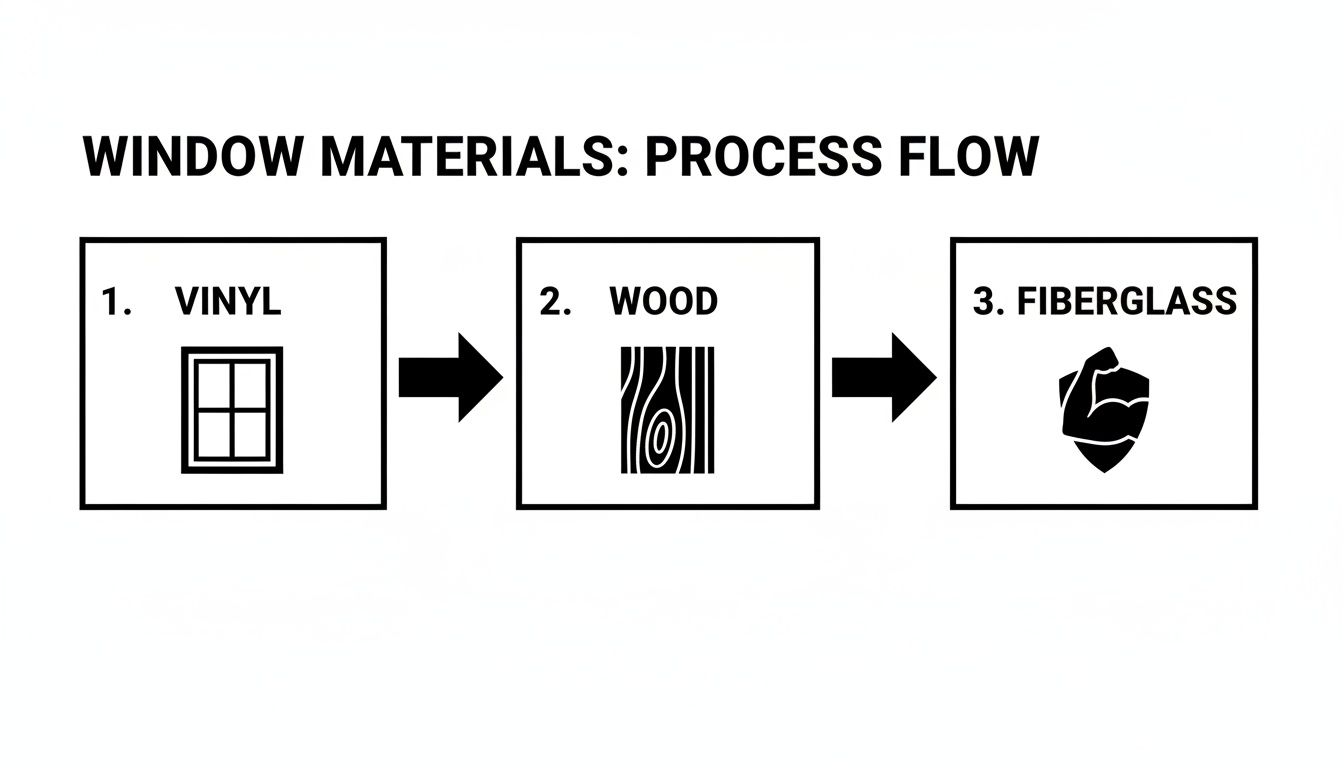
As you can see, the road you take—from budget-friendly vinyl to top-of-the-line fiberglass—is the single biggest factor that will shape your final material costs.
Example Calculation: Budget-Friendly Vinyl Windows
Let's start with the most popular option: high-quality vinyl windows. They offer a fantastic blend of performance and value.
- Material Cost: A good-quality vinyl window often lands around $650.
- Labor Cost: Standard installation in our area typically costs about $150 per window.
Plugging this into our formula for five windows:
- Materials: 5 windows x $650/window = $3,250
- Labor: 5 windows x $150/window = $750
- Total Estimated Project Cost: $4,000
This gives you a solid baseline for a smart, practical home upgrade that won't break the bank.
Example Calculation: Premium Fiberglass Windows
Now, let's crunch the numbers for a premium upgrade to fiberglass. These windows are the workhorses of the industry, known for incredible durability and energy efficiency.
- Material Cost: A premium fiberglass window in the same size could be closer to $1,100.
- Labor Cost: Installation costs usually stay consistent, so we'll stick with $150 per window.
Here’s how that new calculation shakes out:
- Materials: 5 windows x $1,100/window = $5,500
- Labor: 5 windows x $150/window = $750
- Total Estimated Project Cost: $6,250
Just like that, the material choice alone creates a $2,250 difference for the exact same job. This is why running the numbers is so powerful. It turns abstract price ranges into a tangible budget for your project and clearly shows the trade-off between your initial investment and the long-term performance you’re buying. This is exactly what a good window replacement cost estimator should do—give you clarity and realistic expectations.
The ROI of Energy-Efficient Windows
When you’re pricing out new windows, it’s easy to get fixated on the initial number. But thinking about windows only in terms of upfront cost is like judging a car by its paint job—you’re missing the whole engine. A real window replacement cost estimator has to look at the long-term value, and that’s where energy efficiency completely changes the game.
Upgrading your windows isn't just another home expense. It’s one of the smartest investments you can make for your comfort, your home's value, and your wallet.
Think about it this way: those old, drafty windows you have now are like little holes in your piggy bank. In the winter, they let all that expensive heated air sneak right out. Come summer, they invite the scorching Utah sun inside, forcing your AC to work overtime. You’re literally paying to heat and cool the neighborhood.
How Modern Windows Pay You Back
New energy-efficient windows are engineered to be a thermal shield for your home, and that technology translates directly into money saved, month after month.
Here’s the technology that makes it happen:
- Low-E Coatings: This is a super-thin, invisible metallic layer on the glass. It’s brilliant, really. It reflects heat back to its source—so in the winter, it keeps the heat in your house, and in the summer, it keeps the sun’s heat out.
- Argon Gas Fills: We fill the space between the glass panes with argon, an inert, harmless gas. Why? Because argon is way denser than regular air, it’s a terrible conductor of heat. That’s a good thing! It creates a powerful insulating blanket inside your window.
- Triple-Pane Glass: For anyone who wants the absolute best in efficiency, triple-pane windows are the answer. With an extra pane of glass and another layer of insulating gas, they offer incredible thermal performance and a huge reduction in outside noise. It’s a game-changer if you live near a busy Salt Lake City street.
All these features work together to stop the elements from getting in. Your HVAC system can finally take a breather, which means you’ll see a real drop in your energy consumption and your utility bills.
Over the lifespan of your windows, these monthly savings can easily add up to thousands of dollars. Suddenly, a big chunk of that initial installation cost has paid for itself. You aren't just buying windows; you're investing in a more affordable home.
It's More Than Just Energy Savings
Lower utility bills are fantastic, but the return on your investment doesn't stop there. The other benefits add a ton of value that people often forget to factor in.
Look at the big picture. The market for smart, efficient home features is booming. The smart windows sector alone is predicted to jump from $3.6 billion in 2020 to $6.8 billion by 2026. This trend isn't just about fancy tech; it shows that homeowners everywhere are demanding better performance and long-term savings. When you choose quality replacements, you're aligning your home with modern standards. You can explore the full research on global window trends to see just how big this movement is.
Here are the other ways your investment pays off:
- Boosted Home Value: New windows are a huge plus for potential buyers. It's a clear signal that a home is well-maintained and efficient, which can help you get a better price when it’s time to sell.
- UV Protection for Your Stuff: Those Low-E coatings do more than manage heat. They also block up to 99% of the sun's damaging ultraviolet (UV) rays. That means your furniture, wood floors, and artwork are protected from fading.
- A Quieter Home: The same features that insulate against temperature—multiple panes and gas fills—are also amazing at blocking sound. You’ll be surprised at how much calmer and more peaceful your home feels.
When you add it all up—the monthly savings, the higher property value, the protected interiors, and the peace and quiet—the initial number from a window replacement cost estimator starts to look like just one part of a much bigger, smarter financial picture.
Smart Strategies to Lower Your Window Replacement Cost
A full window replacement is a serious investment in your home, but the initial sticker shock doesn't have to be the final price. The good news is that with a bit of smart planning, you can bring that total cost down considerably without cutting corners on quality.
It all comes down to thinking like a contractor and knowing where the real savings are. From timing the project just right to making savvy choices about materials, you have more control over the budget than you might realize. Let's walk through some of the most effective ways I've seen homeowners stretch their dollars further.
Combine and Conquer with Bulk Replacement
One of the best ways to reduce your per-window cost is to tackle multiple windows at once. It might seem counterintuitive since the total project price will be higher, but the cost for each individual window drops significantly.
Think about it from our perspective: the time it takes for our crew to set up, protect your home, and clean up is pretty much the same whether we're doing one window or five. By bundling the job, you get the benefit of our efficiency. We can order materials in bulk and streamline the whole installation process, and we pass those savings directly on to you.
Pro Tip: Replacing windows one by one over several years feels less painful on the wallet upfront, but it almost always costs more in the long run. You're hit with repeat setup fees and miss out on bulk pricing every single time. If you can swing it, consolidating the work is the smarter financial move.
Time Your Project for Off-Season Savings
Like any home improvement service, window installation has its busy seasons. Spring and summer are prime time, and when demand is high, prices naturally follow.
If your timeline is flexible, scheduling your replacement for the off-season—late fall or winter—can be a game-changer for your budget. During these slower months, installation companies are eager to keep their crews working. You’ll often find more competitive pricing and special promotions designed to attract business. Just by planning your project for November instead of June, you could easily see a noticeable drop in your total bill.
Make Smart Choices on Size and Style
Those beautiful, custom-shaped arched or circular windows are stunning, but they come with a premium price tag. If you're focused on your budget, sticking with standard window sizes is one of the easiest ways to cut material costs. Manufacturers mass-produce these common sizes, which makes them far more affordable.
Before you even commit to a full replacement, it's also worth exploring different cost-effective ways to weatherproof windows. Sometimes a few simple fixes can buy you another few years, allowing you more time to save for the bigger project.
Always Get Multiple, Detailed Quotes
This one is non-negotiable: never, ever settle for the first quote you get. You should aim for at least three detailed estimates from reputable, local installers. It’s not just about finding the lowest price; it's about comparing the quality of materials, the warranties offered, and the full scope of work.
When you have those quotes in hand, look past the final number. Here’s what you need to compare side-by-side:
- Window Brand and Model: Are they quoting the exact same product, or is one a lower-grade version?
- Glass Package: Look for specifics on Low-E coatings and gas fills like argon.
- Labor Inclusions: Does the price cover disposal of old windows and finishing the interior trim?
- Warranty Details: Compare the warranty for both the window itself and the installation labor.
Digging into these details empowers you to negotiate effectively and choose the best value for your money, not just the cheapest option.
Getting a Professional and Accurate Quote
So, you’ve run the numbers and have a solid handle on what your window project might cost. That ballpark figure is a great starting point, but now it's time to turn that estimate into a firm, professional quote you can actually work with.
This is where your research meets reality. The detailed estimate you put together is an invaluable tool for talking with contractors. It proves you’ve done your homework and understand what goes into a quality window installation, from the materials to the energy efficiency ratings. Now, let's find a local partner who respects that.
Why a Professional Quote Matters
An online window replacement cost estimator is fantastic for budgeting, but it can’t see the specifics of your home. It doesn't know about that tricky second-story window, any potential minor frame rot hiding under the surface, or the unique building codes right here in Salt Lake City.
A professional on-site evaluation is the only way to catch those details. That's how a good guess becomes a guaranteed price.
At Superior Home Improvement, we see our free, no-obligation consultation as a collaborative planning session, not a sales pitch. We'll be there to take precise measurements, assess your home's unique situation, and really listen to your goals. From there, we build a quote that's both accurate and complete.
We guarantee our pricing upfront. The number you see on your detailed estimate is the price you'll pay—no hidden fees or last-minute charges. It’s our commitment to building trust from the very start.
The Superior Home Improvement Difference
Choosing a contractor isn't just about finding the lowest bid; it's about securing peace of mind. With over 50 years of hands-on experience and a long-standing A+ BBB rating, our reputation is built on doing things the right way.
We also protect your investment with a 10-year workmanship warranty, standing firmly behind every single window we install.
Ready for the next step? Let our experts provide you with a free, detailed quote that turns your plans into a reality. Schedule your consultation with Superior Home Improvement today and see how our commitment to excellence can transform your home.
Common Questions About Window Replacement Costs
Window replacement is a big investment, and naturally, you've got questions. Getting the right answers helps you feel confident about your budget and what to expect. Let's break down some of the most common things we get asked by homeowners just like you.
How Long Does It Take to Replace My Windows?
This really comes down to the size of your project. For most homes, a professional crew can knock out about 5 to 10 window installations in a day or two. It's surprisingly fast once they get going.
The biggest variable, though, is manufacturing lead time. If you're getting custom windows made—which is pretty common—it can take several weeks for them to be built and delivered. A good contractor will give you a clear timeline from the very start, so you'll know exactly when to expect the manufacturing to be done and the installation to begin.
Is It Cheaper to Replace All My Windows at Once?
It might seem counterintuitive because the upfront cost is higher, but yes, replacing all your windows at the same time almost always saves you money in the long run. Think of it like buying in bulk.
Contractors can give you a much better price per window on a whole-house project. Why? Because their labor, setup, and material ordering become way more efficient.
Doing it all at once means you get the disruption over with in one go and start seeing those energy savings everywhere, right away. Staggering the project often means paying more over time for multiple smaller jobs.
What's the Difference Between a Full-Frame and a Pocket Installation?
This is a great question. A pocket installation (sometimes called an insert) is when the new window unit slides right into the existing frame. It's quicker, less invasive, and costs less, but it's only an option if your current frames are in pristine shape with absolutely no rot or damage.
A full-frame replacement, on the other hand, is the whole shebang. We remove everything—the old window, the frame, the trim, and the sill—right down to the studs. It costs more, but it's the right way to do it if there's any question about the condition of the existing frame. This method lets us check for hidden water damage and ensure the new window is perfectly sealed and insulated.
Can I Get Tax Credits or Rebates for New Windows?
Absolutely! The government wants to encourage energy efficiency, so you can often get federal tax credits for installing new ENERGY STAR certified windows. It's a nice way to get some of your investment back.
On top of that, don't forget to check with local utility providers here in the Salt Lake City area. They frequently offer their own rebates for making energy-conscious upgrades. Always ask your installer about current programs—they stay on top of this stuff and can help you find savings you might not have known about.
Ready to get a clear, accurate quote for your home? The team at Superior Home Improvement is here to provide a free, no-obligation consultation. Schedule your free estimate today and let our experts help you plan the perfect window upgrade.