
If your home was built anytime between the early 1900s and the 1980s, there’s a real possibility it has asbestos siding. At its core, this material is a simple mixture of cement and asbestos fibers. As long as it's left alone and in good condition, it’s relatively harmless.
The problem is, the moment that siding gets disturbed, damaged, or starts crumbling with age, it becomes a significant health hazard. Those tiny, toxic fibers can get into the air you breathe, and that’s when the real trouble begins.
The Story of Asbestos House Siding
To really get why asbestos siding is on so many older homes, you have to step back in time. For builders in the early 20th century, finding a material that was durable, fireproof, and cheap felt like hitting the jackpot. Asbestos-cement was that "miracle" product.
Think of it as concrete on steroids. Manufacturers discovered they could mix Portland cement with strong, stringy asbestos minerals to create an incredibly resilient building material. It was inexpensive to make but performed far better than traditional wood siding.
A Miracle Material for Its Time
Once production kicked off around 1910, asbestos siding quickly became the new standard. By the 1920s, its popularity was surging, partly because fire safety groups like the National Board of Fire Underwriters were pushing homeowners to ditch flammable wood shingles. You can learn more about this era by digging into the history of asbestos cement products.
Asbestos siding wasn’t just practical; it was a chameleon. It could be pressed with textures to look just like expensive wood grain, slate, or stone, giving homeowners a high-end appearance for a fraction of the cost.
This blend of affordability and toughness made it the perfect material for the massive post-war housing boom that lasted from the 1940s to the 1970s. Entire subdivisions, in Utah and across America, were built with asbestos siding. It was the fastest, most cost-effective way to put a roof over everyone’s head, and it became a hallmark of modern, low-maintenance living.
Why It Became a Problem
The irony is that the very thing that made asbestos so great—its tough, microscopic fibers—is precisely what makes it so dangerous. For decades, nobody really understood the health risks. The real issue is that the fibers are friable, a term meaning they can easily break free and become airborne when the siding is cut, drilled, sanded, or even just broken.
So, why was it everywhere? It came down to a few key advantages:
- Exceptional Durability: It could handle brutal weather, from blazing summers to icy winters, without rotting or warping like wood.
- Fire Resistance: As a non-combustible material, it gave families an invaluable layer of protection from house fires.
- Low Cost: It was far cheaper to produce and install than brick or wood, making it perfect for the explosion in new housing.
- Pest and Rot Proof: Termites, carpenter ants, and moisture couldn't touch it, which meant fewer repairs for homeowners.
The legacy of this once-celebrated material is complicated. It protected homes for generations, but now it’s a hidden danger that requires careful, professional handling. Understanding this history is the first step toward appreciating why identifying and dealing with asbestos siding correctly is so critical for the health of your family and your community.
How to Spot Asbestos Siding on Your Home
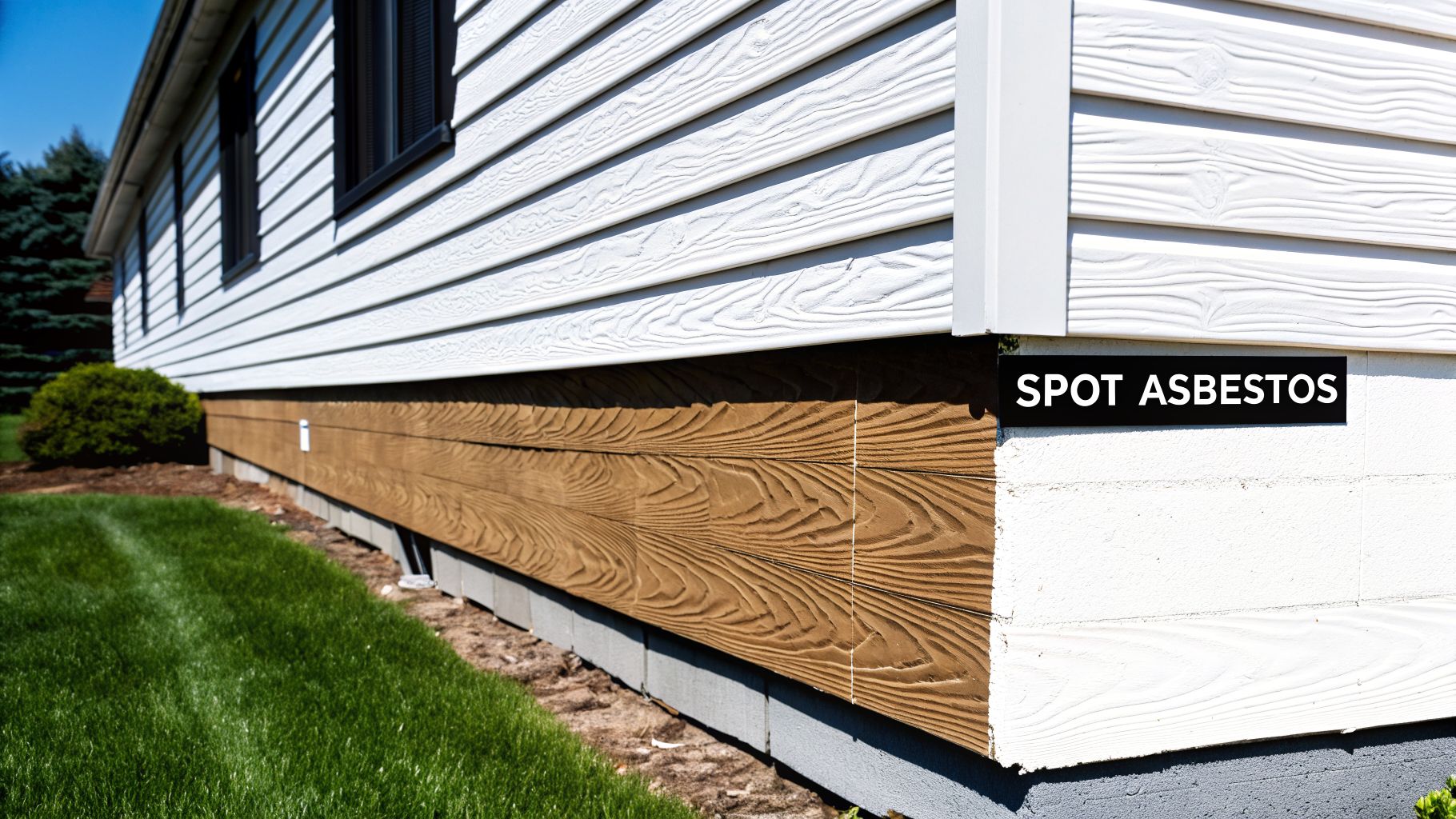
Figuring out if your house is covered in asbestos siding can feel a bit like playing detective. The truth is, you simply can't tell for sure just by looking at it. Instead, you have to gather clues. The more evidence you find, the more likely it is that you should call in a professional for testing.
Your home’s age is, without a doubt, the single biggest clue. If your house was built or had its exterior redone anytime between the 1930s and the 1980s, there’s a good chance asbestos siding was used. It was the material of choice during the post-war building boom because it was incredibly cheap, fire-resistant, and built to last.
Common Visual Characteristics
While the construction date gets you in the ballpark, the siding itself has a few tell-tale signs. Asbestos-cement shingles just look and feel different from modern materials like vinyl or today's fiber cement. As you inspect your home, keep an eye out for these specific traits.
Here are a few of the most common things you might see:
- Shingle-Like Appearance: This siding was almost always made as individual shingles or panels, usually about 12 to 24 inches wide. They were installed in overlapping rows, much like you’d see with classic wood or slate shingles.
- Embossed Textures: To give it a bit more character and mimic more expensive materials, manufacturers would press patterns right into the surface. A faux wood grain is by far the most common texture, but you might also find wavy, pebbled, or even brick-like designs.
- Brittle and Dense Nature: Because it's a cement-based product, asbestos siding is very hard but also quite brittle. If you spot a cracked or chipped corner, the break will look sharp and clean, almost like a piece of broken pottery. It won't bend like vinyl or splinter like wood.
These clues can certainly raise suspicion, but they aren't a final verdict. Many non-asbestos siding products were designed to look similar, so you can never be completely certain based on looks alone.
Asbestos Siding Identification Checklist
To help you organize your findings, run through this simple checklist. The more questions you answer with 'yes', the stronger the case for getting your siding professionally tested.
| Characteristic | Description | Check If 'Yes' |
|---|---|---|
| Home's Construction Date | Was the house built or remodeled between the 1930s and 1980s? | ☐ |
| Material Texture | Does the siding feel exceptionally hard and dense, not hollow like vinyl? | ☐ |
| Shingle or Panel Format | Is the siding composed of individual shingles or panels rather than long planks? | ☐ |
| Surface Pattern | Does it have a pressed-in texture, such as a wood grain or wavy pattern? | ☐ |
| Damage Appearance | Where the siding is broken, are the edges sharp and brittle-looking? | ☐ |
Once you’ve assessed your siding, remember that it's just one piece of the puzzle. Learning about identifying asbestos insulation in your home is also critical, as materials like vermiculite in your attic can present their own risks.
Crucial Takeaway: A visual check is only a preliminary step. Since asbestos fibers are microscopic and have no smell, the only way to be 100% certain is to have a sample analyzed by a certified laboratory.
Whatever you do, please don't try to break off a piece of siding for testing yourself. The simple act of snapping a piece can release dangerous fibers into the air. A certified asbestos professional has the training and equipment to collect a sample safely, giving you an accurate result without putting your family at risk.
The Real Health Risks of Disturbed Asbestos
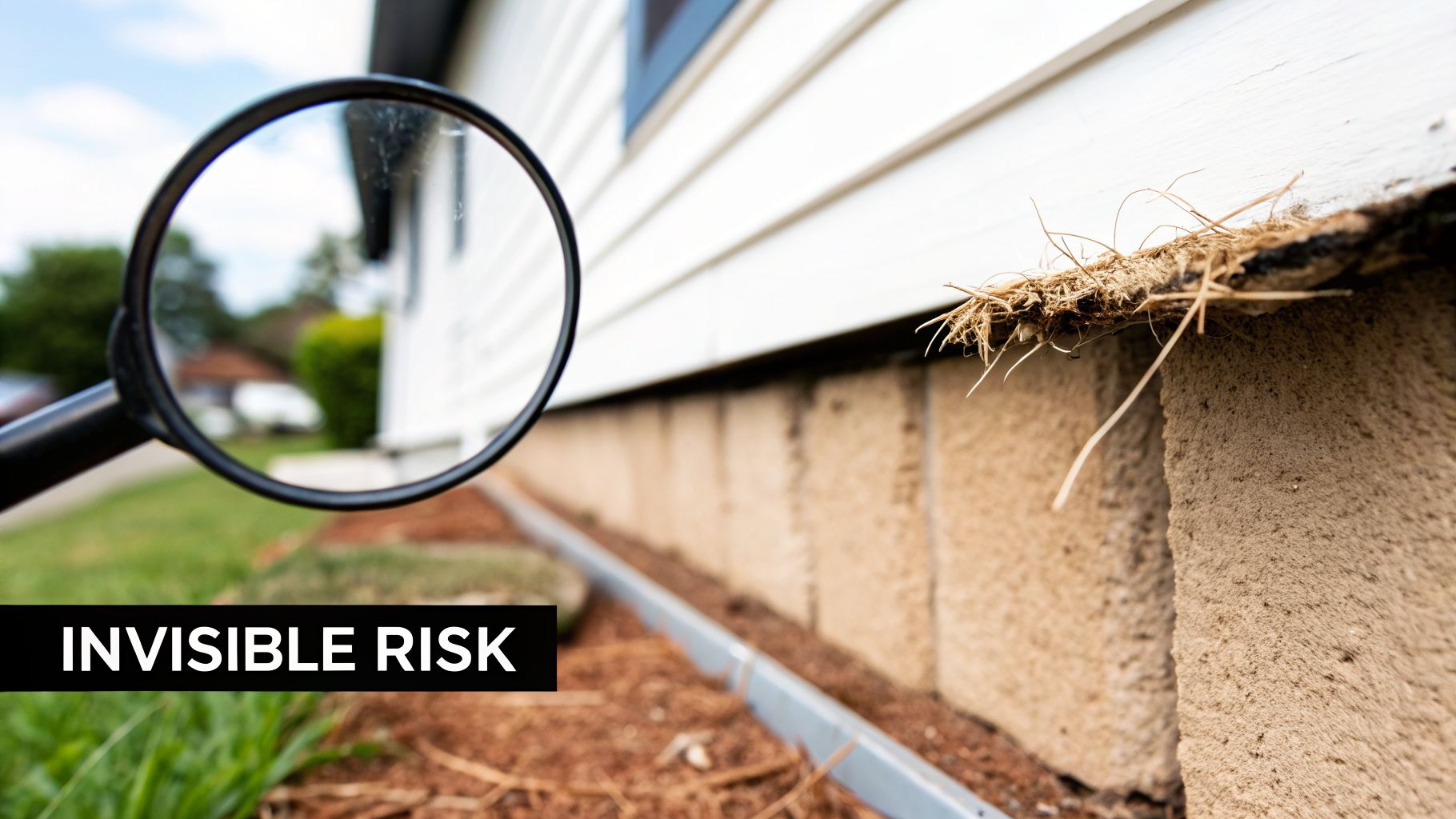
It’s a word that can make any homeowner nervous: asbestos. But when we’re talking about siding, it's crucial to understand where the actual danger is. The health risk isn't about simply having asbestos siding on your home; it’s all about whether that material gets disturbed. As long as the siding is intact and stable, the harmful fibers are locked away safely inside a solid cement matrix, posing a very low risk.
I like to compare it to a porcupine with its quills lying flat—harmless to be around. The danger only comes when you poke it, causing the sharp quills to break free. It’s the same with asbestos siding. When it gets cut, drilled, sanded, or broken, it unleashes microscopic, needle-like fibers into the air.
These invisible fibers are the real hazard. They're so light they can hang in the air for hours or even days, completely undetected by sight or smell.
From Stable Siding to Airborne Hazard
In its original, solid state, your asbestos siding is what experts call non-friable. That's just a technical way of saying it can’t be crumbled or crushed with simple hand pressure. It’s solid and secure. The real trouble starts when that siding gets damaged or starts to deteriorate.
Suddenly, it can become friable—a state where it breaks apart easily and releases those dangerous fibers.
What kind of everyday activities can cause this? You’d be surprised.
- Sanding or scraping old siding to get ready for a new coat of paint.
- Drilling holes to hang a flag, put up house numbers, or install a new light fixture.
- Aggressive pressure washing, which can easily blast away the surface and send fibers flying.
- Cutting shingles or panels during a small repair or a larger renovation.
- Simple impact damage, like a cracked panel from a stray baseball or a fallen tree limb.
Once those fibers are in the air, they behave like invisible shards of glass. The main way people are exposed is by breathing them in. Because the fibers are so sharp and incredibly durable, they can get lodged deep inside the lungs and stay there permanently.
The Long-Term Consequences of Exposure
The human body has no natural way to break down or get rid of these embedded fibers. Over time—often decades—their presence causes constant irritation that leads to scarring, inflammation, and eventually, serious diseases. This incredibly long latency period is what makes asbestos-related illnesses so insidious; symptoms might not show up for 15 to 40 years after the initial exposure.
The real danger isn't living in a home with asbestos siding; it's the uncontrolled release of fibers during demolition, renovation, or due to deterioration. The risk is manageable when left alone but becomes serious the moment the material is disturbed.
There's a reason so many homes from a certain period have this siding. Asbestos use in the U.S. peaked around 1973, when an estimated 804,000 tons of the fiber were used in a single year. You can explore historical asbestos consumption data to see just how widespread it was before regulations clamped down on its use.
This is precisely why you should never attempt a DIY removal. It’s not just dangerous; it can also be illegal depending on where you live. Professionals are required to follow strict safety protocols, like wetting the material down, sealing off the work area, and using specialized vacuums to ensure fibers never get a chance to become airborne. The takeaway for homeowners is clear: when dealing with asbestos house siding, caution and professional help are non-negotiable.
Navigating Professional Removal and Abatement
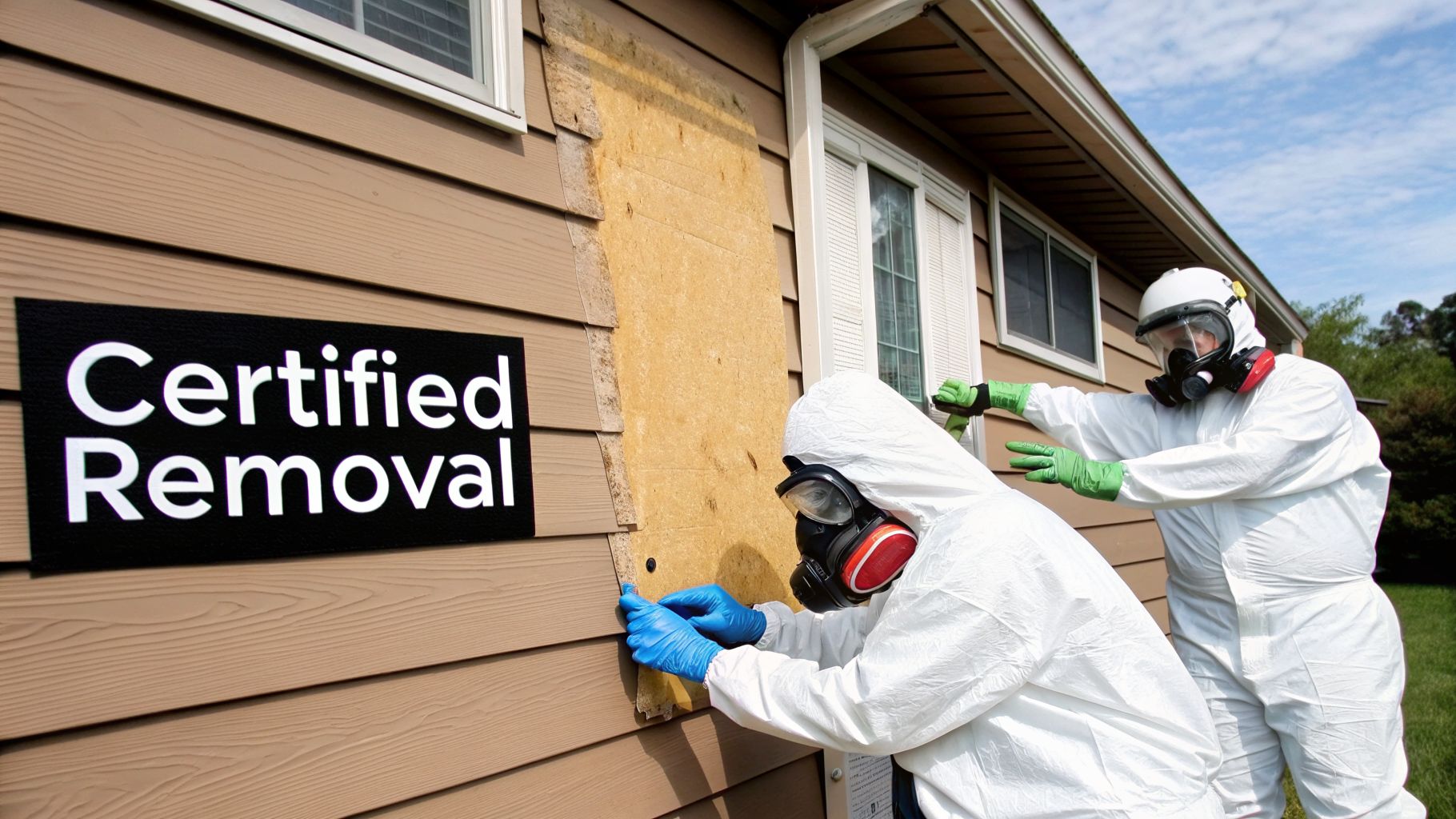
So, the tests came back positive. Your home has asbestos siding. This is the point where you absolutely must put down the tools and step away from any DIY plans. What comes next is a carefully managed process called abatement, and it's a job strictly for certified professionals.
Trying to remove asbestos siding yourself isn't just a bad idea—it's incredibly dangerous and often illegal. Federal, state, and local laws are very clear about how this material must be handled and disposed of, and they aren't things you can learn from a quick online video.
Think of it less like a renovation and more like a surgical procedure for your house. It demands specialized training, high-tech equipment, and a deep understanding of how to contain microscopic fibers. These are fibers that can easily contaminate your home, your yard, and the surrounding neighborhood if handled improperly.
Asbestos in older homes is a widespread problem. In fact, one study found asbestos in about 95% of the abandoned residential buildings they sampled, with siding being a common culprit. The danger spikes the moment someone tries to cut, break, or otherwise damage asbestos cement, which releases those hazardous fibers into the air. If you own an older home, you can see why professional remediation is such a critical step. You can dig into the full research on asbestos in residential dwellings to learn more.
The Professional Abatement Process
When a certified abatement team arrives on site, they aren’t just there to rip siding off the wall. They follow a strict, multi-step protocol designed to prevent a single fiber from escaping. It's a science of total containment.
Here’s what you can expect a professional removal to look like:
- Creating a Containment Zone: First, the crew establishes a regulated work area. They'll use heavy-duty plastic sheeting to seal off the immediate vicinity and post clear warning signs. This barrier ensures that any stray fibers are trapped within the zone, keeping the rest of your property and your neighbors safe.
- Personal Protective Equipment (PPE): You’ll see every worker dressed in full-body disposable coveralls, gloves, and—most importantly—specialized respirators. This isn't for show; it's essential gear that protects them from breathing in any fibers that might come loose.
- Wetting the Siding: This is one of the most important parts of the whole process. Technicians constantly spray the siding with a wetting agent (a mix of water and a surfactant) before and during removal. This simple step makes the material damp, weighing down the dust and fibers so they can't become airborne.
The core principle of safe abatement is control. By wetting the material and sealing the area, professionals transform a potential hazard into a manageable substance, ensuring fibers stay put rather than floating freely in the air.
Meticulous Removal and Disposal
With the site prepped and secure, the actual removal begins. This is a delicate operation, not a demolition job. You won’t see any hammers or pry bars being used recklessly. The goal is to remove each shingle or panel while keeping it as intact as possible.
The final steps are just as disciplined:
- Careful Handling: Technicians work methodically to detach each piece of siding, avoiding any action that might cause it to crack, crumble, or break.
- Specialized Cleanup: After the siding is down, the entire work area gets a deep clean with HEPA (High-Efficiency Particulate Air) vacuums. These aren't your average shop vacs; they are powerful enough to capture microscopic asbestos particles that are completely invisible.
- Secure Disposal: Finally, all the removed siding and contaminated materials—right down to the plastic sheeting and old PPE—are double-bagged in specially labeled, leak-proof containers. From there, the waste is hauled to a licensed landfill that is certified to accept asbestos, all in accordance with state and federal laws.
Hiring a certified asbestos abatement contractor is more than just a smart choice; it's the only way to guarantee the job is done safely and legally. It’s how you protect your family’s health and gain true peace of mind.
Choosing Your New High-Performance Siding
Once the old asbestos siding is gone, you get to the rewarding part: choosing what comes next. This is more than just a repair job; it’s a chance to completely redefine your home’s exterior, boost its curb appeal, and make a serious dent in your energy bills.
Think of it this way: while paying for professional abatement is a necessary safety step, the new siding you choose is an investment that pays you back. The right material can transform your home's look while actively saving you money every month.
Upgrading to a Thermal Blanket
One of the biggest wins when replacing old siding is the opportunity to wrap your home in modern insulation. Almost every siding replacement project today includes installing a house wrap, and often, a layer of rigid foam insulation underneath the siding itself. Together, these materials act like a high-tech thermal blanket.
This new "blanket" creates a continuous barrier that stops air leaks and keeps moisture out. It prevents drafts, helps maintain a steady indoor temperature, and takes a huge load off your furnace and air conditioner. The payoff is a more comfortable home and lower energy costs all year round.
Of course, budgeting for this upgrade means understanding all the costs involved. Factoring in the Canadian Cost of Asbestos Removal alongside the new siding ensures you have a clear financial picture for the entire project, from safety to stunning new exterior.
Comparing Modern Siding Options
Today's siding materials are safer, stronger, and more efficient than anything from the past. Your decision will likely come down to your budget, how much maintenance you're willing to do, and the look you want to achieve.
Let’s look at some of the most popular replacement choices. The following table breaks down how they stack up against each other in the areas that matter most to homeowners.
Comparing Modern Siding Replacement Options
| Siding Material | Durability | Maintenance Level | Energy Efficiency | Aesthetic Options |
|---|---|---|---|---|
| Fiber Cement | Highly resistant to fire, rot, pests, and impact. | Low | Good, can be improved with insulated underlayment. | Mimics wood, stucco, or smooth panels. Paintable. |
| Insulated Vinyl | Good resistance to impact; won't rot or corrode. | Very Low | High, due to the integrated rigid foam insulation. | Wide range of colors and profiles. Color is baked in. |
| Composite | Extremely resistant to impact, moisture, fading. | Virtually None | Excellent, especially with integrated foam backing. | Premium, highly realistic wood grain and deep colors. |
As you can see, each material offers a compelling set of benefits. What works for a classic colonial might be different from the best choice for a modern ranch, so it's worth weighing these factors against your home's specific needs and your personal style.
A Closer Look at the Contenders
Here’s a little more detail on what makes each of these materials a great option.
Fiber Cement Siding: This is essentially the modern, safe successor to asbestos-cement siding, using strong cellulose fibers for reinforcement instead of asbestos. It's incredibly tough—it won’t burn, rot, or get eaten by insects. A fresh coat of paint is needed every 10-15 years, but beyond that, it’s built to last.
Insulated Vinyl Siding: Forget the flimsy, cheap-looking vinyl of the past. Modern insulated vinyl has a rigid foam backing that adds R-value (a measure of insulation) and makes the panels much tougher. It’s a cost-effective way to get great energy performance and is virtually maintenance-free, just needing a wash now and then.
Composite Siding: Sitting at the premium end of the market, engineered materials like polymer or composite wood siding are designed for maximum performance. They offer the most authentic wood look without any of the maintenance headaches and are exceptionally resistant to just about everything, from hail to fading.
Choosing your new siding is the final and most exciting step. By picking a modern, high-performance material, you’re not just fixing a problem—you’re making a smart investment that will protect and beautify your home for decades.
Your Action Plan for a Safer Home
Okay, so you think you might have asbestos siding. The first thing to do is take a deep breath. Finding out is one thing, but knowing how to handle it is what really matters. With a clear, step-by-step approach, you can methodically address the issue and turn a potential headache into a valuable home upgrade.
The single most important rule is this: do not disturb the material yourself. As long as asbestos-containing materials are intact and in good condition, they generally don't pose a significant risk. The danger begins when those materials are broken, sawed, drilled, or sanded, which releases harmful fibers into the air. Your job is to be the project manager, not the demolition crew. You'll observe, coordinate, and hire the right people to handle the physical work safely.
A Simple 4-Step Plan
It's easy to feel overwhelmed, but you can tackle this with a straightforward plan. Here’s a roadmap to get you from that initial suspicion to a beautiful, safe new exterior.
Start with a Hands-Off Visual Check: Walk around your property and look at the siding from a distance. Does it have that classic shingle-like texture or a stamped, fake wood-grain pattern? Look for brittle-looking cracks or chips, especially around the corners. Remember, homes built before the 1980s are the most likely candidates for this type of siding.
Bring in a Pro for Testing: If your visual check raises any red flags, it's time to call in a certified asbestos inspector. This is not a DIY job. They have the proper safety gear and training to take a small sample without putting you or your family at risk. The sample goes to a lab, and the results will tell you definitively whether you're dealing with asbestos.
Get Quotes for Removal and Replacement: A positive test means your next calls are to licensed asbestos abatement contractors. When you get quotes, make sure they are detailed and cover the entire process: setting up containment zones, the safe removal itself, and proper, lawful disposal. Many homeowners find it easier to work with a single contractor who can handle both the asbestos abatement and the new siding installation.
Choose Your New Siding: Now for the fun part. Once the hazard is professionally removed, you get to give your home a major facelift. You can choose from modern, durable materials like fiber cement or insulated vinyl. This isn't just about looks—new siding acts like a "thermal blanket" for your house, which can make a real difference in your energy bills and overall comfort.
When you let certified experts handle the process, dealing with asbestos siding just becomes a well-managed home improvement project. It’s a smart investment in your home’s safety, curb appeal, and long-term value.
Ultimately, don't let the word "asbestos" send you into a panic. Instead, see it as a trigger to make a smart upgrade. By following this plan and working with qualified professionals, you can confidently solve the problem and give your home the safe, durable, and beautiful exterior it deserves. The peace of mind you'll get is worth every penny.
Your Top Questions About Asbestos Siding, Answered
As a home improvement professional, I hear a lot of the same questions from homeowners when they discover their house has asbestos siding. It's completely understandable to have concerns, so let's walk through the most common ones with clear, straightforward answers.
Is It Safe to Live in a House with Asbestos Siding?
This is usually the very first question, and the short answer is: yes, it generally is. The key is that asbestos-cement siding is non-friable, which is a technical way of saying the dangerous fibers are locked tightly within a solid, cement-like material. As long as that siding is in good condition—not crumbling, cracked, or broken—it poses a very low risk.
The danger comes into play only when the material is disturbed. Think cutting, drilling, sanding, or breaking the shingles. Those actions can release microscopic fibers into the air, which is what you want to avoid. So, if your siding is intact, you don't need to panic. But you do need a plan for professional handling when it's time for repairs or replacement.
Can I Just Paint Over My Asbestos Siding?
Painting over asbestos siding is a common and safe practice, often referred to as encapsulation. It's an excellent temporary measure for siding that's in stable condition. A good coat of paint effectively seals the surface, adding a protective layer that helps prevent further degradation and any potential fiber release.
Just remember, this is a stop-gap, not a permanent fix. Painting doesn't remove the asbestos. The hazard is still there, just underneath the paint. Any future work that involves cutting or disturbing the siding will still require full asbestos safety protocols. For a true long-term solution that also boosts your home's value and energy efficiency, complete replacement is always the better route.
This whole decision-making process can feel overwhelming, but it's simpler than you might think. We've broken it down into a basic action plan.
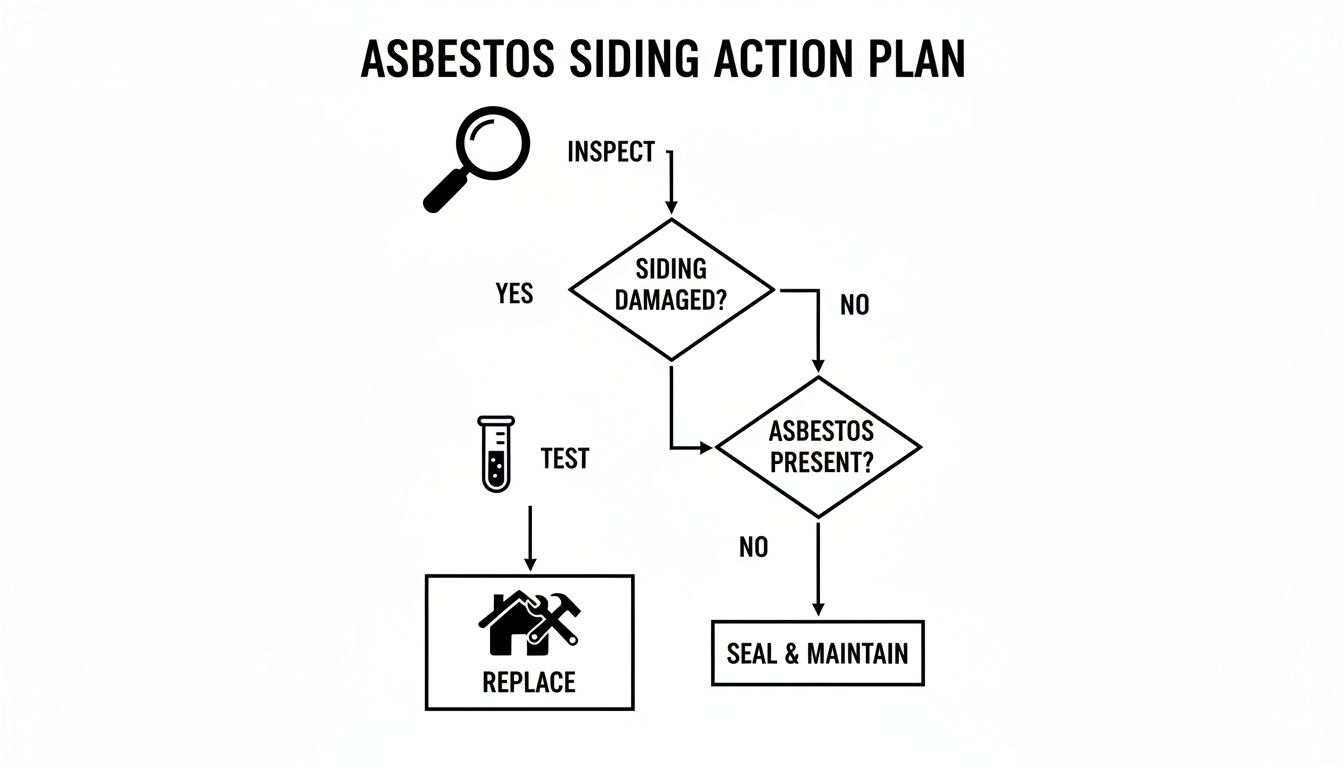
As you can see, the path forward starts with a simple inspection and leads to a safe, final outcome for your home.
How Much Does Siding Removal and Replacement Cost?
The cost is one of the biggest variables, and it really depends on your specific situation. The size of your house, local disposal fees, the type of new siding you select, and the complexity of the job all play a major role. Asbestos abatement is a specialized skill, and it adds a specific line item to the overall project budget that you wouldn't have with other siding materials.
The only way to get a real number for your project is to have a certified contractor provide a detailed estimate. A reputable pro will give you a comprehensive quote that covers everything—the safe removal and disposal of the old siding and the complete installation of the new.
Getting a professional quote ensures you have a clear financial roadmap and won't run into any surprise costs down the road.
When you're ready to move forward and transform your home's exterior safely, the certified experts at Superior Home Improvement are here to help. We offer detailed consultations and transparent estimates to guide you through every step of the process. To schedule your free estimate, visit us online and take the first step toward a safer, more beautiful home.