
On average, a professional attic insulation project in Utah will cost between $1,000 and $3,000. Most homeowners find their project lands somewhere around the $2,100 mark. When you look at the long-term savings on heating and cooling, it's one of the smartest energy-efficiency upgrades you can make.
What Is the Real Cost to Insulate an Attic in Utah?
Figuring out the cost to insulate your attic is a bit like planning a road trip. You know you want to get to your destination—a more comfortable, energy-efficient home—but the final price tag really depends on the specifics of your journey. There isn't one single, fixed number; it's an investment, and several key factors will shape the total.
For those of us living in Utah, dealing with our freezing winters and hot, dry summers, good attic insulation isn't just a nice-to-have. It's essential. Think of it as a high-performance jacket for your house. It keeps the expensive heat you pay for from escaping in the winter and acts as a shield against the intense summer sun. The result is a home that stays comfortable year-round without breaking your energy budget.
Understanding What Drives the Final Price
So, what actually goes into that final number on an estimate? Before you start getting quotes, it helps to know the main components that will determine your cost.
- Insulation Material: The biggest variable is the type of insulation you choose. Options like fiberglass, cellulose, and spray foam all come with different price points and performance benefits.
- Attic Size: This one’s straightforward—the bigger your attic, the more material and labor are needed to get the job done right.
- Required R-Value: R-value is just a way to measure how well insulation resists heat flow. For Utah's demanding climate, you want to aim for an R-value between R-49 and R-60 to see real results.
These factors all combine to create your project's final cost. As more people focus on making their homes energy-efficient, we've seen pricing stabilize. Most standard installations now fall between $1 to $3 per square foot.
To give you a clearer picture, let's look at a common 1,000-square-foot attic, which is typical for many homes around Salt Lake City. Based on that range, a full project would land you squarely between $1,000 and $3,000. You can discover more insights about attic insulation market trends to see how these costs have evolved.
To make it even simpler, here’s a quick breakdown of what you might expect for common attic sizes here in Utah.
Estimated Attic Insulation Costs in Utah for 2026
This table gives a ballpark idea of total project costs, including materials and professional installation, for different attic footprints.
| Attic Size (Square Feet) | Average Cost Range |
|---|---|
| 800 sq. ft. | $800 – $2,400 |
| 1,000 sq. ft. | $1,000 – $3,000 |
| 1,200 sq. ft. | $1,200 – $3,600 |
| 1,500 sq. ft. | $1,500 – $4,500 |
Remember, these are just estimates. The final price can shift based on the specific material you choose and other factors we’ll cover next.
A properly insulated attic is your home's first line of defense against Utah's tough weather. When you invest up there, your furnace and AC don't have to work nearly as hard, which saves you money and reduces wear and tear on your system.
Once you understand what goes into the price, you're in a much better position to compare quotes and make a smart decision that will protect your home—and your wallet—for years to come.
Decoding Your Attic Insulation Quote
When you get an attic insulation quote, it can look like a lot of numbers and industry terms. But it all really comes down to two main things: the materials you’re buying and the labor to get it installed correctly.
It’s a bit like getting your house painted. You’re not just paying for the cans of paint; you’re paying for the painter’s skill to prep the walls, tape the edges, and apply a perfect coat that will last for years. Your insulation quote is the same—it’s a combination of the product itself and the professional expertise that makes it work. A good quote will break this down for you so you can see exactly where your money is going.
The Cost of Materials
This is the most straightforward part of the quote. The cost of materials depends almost entirely on which type of insulation you choose for your attic. Each has a different price point and delivers a different R-value (its ability to resist heat flow).
Here’s a quick rundown of the common choices:
- Fiberglass Insulation: This is the one you probably picture—those pink or yellow rolls (batts) or the fluffy loose-fill version. Made of fine glass fibers, it’s a reliable and budget-friendly option, typically running $1.50 to $3.50 per square foot for the complete installation.
- Cellulose Insulation: Made from recycled paper and treated to be fire-resistant, cellulose is a fantastic loose-fill insulation. It’s blown into place and does an excellent job of snaking into all the little nooks and crannies. It's also an eco-friendly choice and is usually priced right in line with fiberglass.
- Spray Foam Insulation: This is the premium player in the insulation world. It's applied as a liquid that expands on contact, creating an airtight seal that locks out drafts while providing incredible thermal performance. Because it has the highest R-value per inch and acts as an air barrier, it has a higher upfront cost, often between $4.00 and $8.00+ per square foot.
These factors—the size of your space, the type of material, and the R-value you need—all work together to determine the final material cost.
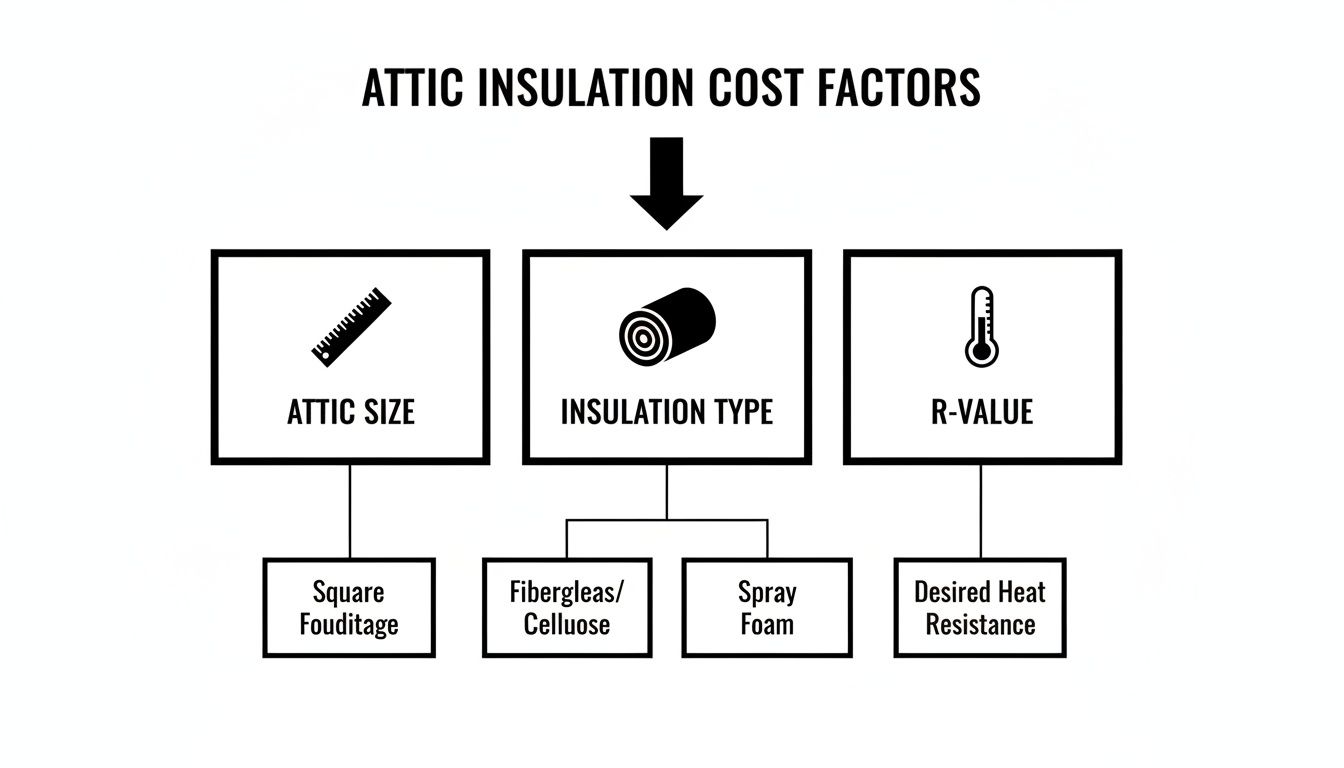
As you can see, attic size sets the stage, but your choice of insulation and the R-value needed for our Utah climate really dial in the final material investment.
The Value of Professional Labor
The labor cost on your quote is so much more than just the hours someone spends in your attic. This part of the bill covers all the critical steps that ensure your new insulation actually performs as it should and protects your home in the process. Think of the labor charge as your investment in quality control.
So, what are you really paying for?
- Meticulous Site Preparation: A pro team won’t just stomp through your house. They’ll carefully lay down tarps and plastic sheeting to protect your floors and furniture from the front door all the way to the attic hatch. It's all about keeping your home clean.
- Crucial Air Sealing: I can't stress this enough. Before any new insulation goes in, a good crew will find and seal all the small air leaks around light fixtures, plumbing pipes, electrical wiring, and the attic access itself. Skipping this step is like buying a top-of-the-line winter coat but leaving it unzipped. The insulation just won’t be as effective.
- Expert Installation: Pros use specialized blowing machines and techniques to install insulation to a precise, uniform depth. This ensures you get the R-value you’re paying for across the entire attic, without weak spots. They’ll also install baffles to keep soffit vents clear, maintaining the proper airflow your attic needs to stay healthy.
- Thorough Cleanup and Disposal: When the job is done, the crew packs up all their gear, removes the protective coverings, and vacuums up any dust. They leave your home looking just like it did when they arrived and will handle the disposal of any old, dirty insulation they removed.
When you see "labor" on a quote, think "performance guarantee." You're paying for the skill and attention to detail that turns a pile of insulation into a high-performance thermal shield for your home, ensuring your investment pays off in energy savings for years.
What Goes Into Your Final Insulation Cost?
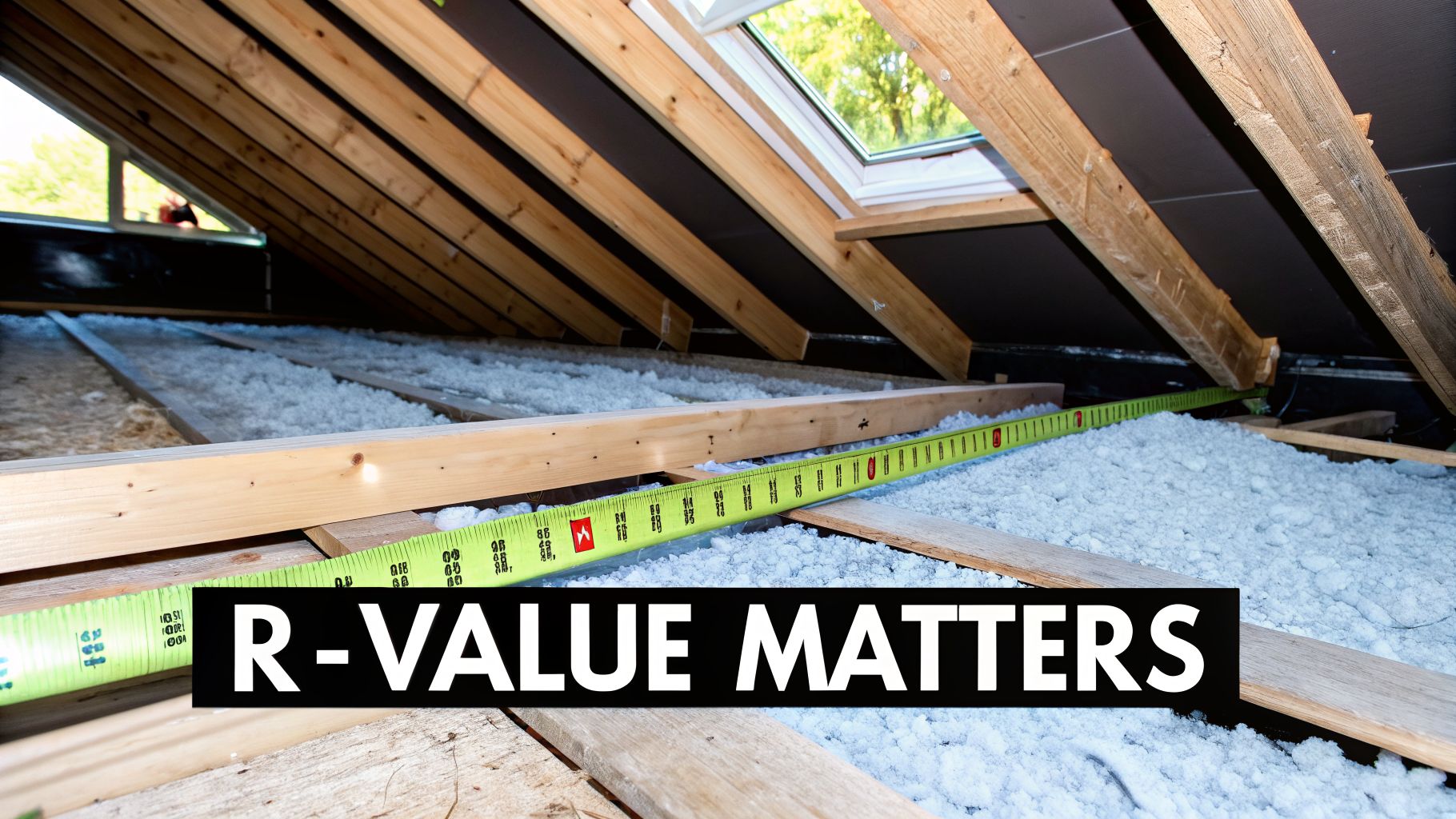
When you start gathering quotes for an attic insulation project, you’ll probably see a wide range of prices. It’s not random guesswork from contractors. The final price is a direct result of a few key factors specific to your home. Getting a handle on these will help you understand exactly what you’re paying for when you look at an estimate.
The two things that move the needle most are the square footage of your attic and the R-value your home needs to stay comfortable in our Utah climate. From there, a few other details can tweak the final number, but these two are the big ones that determine the baseline for materials and labor.
Attic Size and Project Scale
It probably won't surprise you that the size of your attic is the most basic starting point. A bigger attic simply needs more material and more time for our crew to install it correctly.
But the math isn't always a straight line. We often see economies of scale on larger jobs. For instance, a tiny 300-square-foot attic might run you anywhere from $300 to $900. A more typical 1,000-square-foot space, on the other hand, usually falls between $1,000 and $3,000. The cost per square foot can actually go down as the job gets bigger because of efficiencies we gain on-site. You can read more about how project scale affects insulation costs and see how local labor rates, which are about $1.00 to $2.00 per square foot here in Utah, play into the total.
The Importance of R-Value
Think of R-value like the SPF of sunscreen for your house. The higher the number, the better it is at resisting heat flow—keeping your conditioned air in and the outside air out. For those of us in Utah dealing with freezing winters and blazing summers, hitting the right R-value isn't just a suggestion; it's essential for real savings and comfort.
- Climate Zone Requirements: The U.S. Department of Energy puts most of Utah in a climate zone that requires serious insulation.
- Recommended R-Value: For attics here, we're always aiming for a target between R-49 and R-60.
- Material Depth: To get that R-value, the insulation has to be a certain depth. For popular blown-in fiberglass, that means installing a blanket about 16-18 inches deep to reach an R-49.
A house that only has a few inches of old, flattened insulation will need a lot more new material to hit that target than a home that’s already partway there. This difference is a major factor in your final material cost.
Old Insulation Removal
So, what do we do if you already have insulation up there? If it's clean, dry, and not contaminated by pests or mold, we can often blow new insulation right on top. This is called "capping," and it's a great, cost-effective way to boost your overall R-value.
However, if the old stuff is damp, moldy, or has been a home for critters, it has to go. This is non-negotiable for the health of your home and for the new insulation to do its job. Removal is a labor-intensive job that requires special high-powered vacuums and proper disposal, which adds to the project total.
Trying to put new insulation over old, compromised material is like building a house on a rotten foundation. For the new insulation to work and to protect your home's air quality, you have to start with a clean slate.
Attic Accessibility and Ventilation Work
Finally, a couple of practical things can affect the labor part of your quote.
- Attic Accessibility: A wide-open attic with high ceilings and a big access hatch is a breeze to work in. On the other hand, attics with low-slung roofs, tight crawl spaces, and lots of ductwork to navigate take more time and careful maneuvering. That extra time and care can add to the labor cost.
- Ventilation: Proper attic ventilation is your home's first line of defense against moisture and ice dams. A professional crew will make sure your soffit vents aren't buried by insulation, usually by installing baffles to keep airways clear. If we find your ventilation is poor, fixing it might become part of the job—adding to the scope but protecting your home for years to come.
Calculating Your Return on Investment and Energy Savings
It's easy to focus on the upfront cost of a project like attic insulation. But that's only looking at one side of the coin. The real story isn't about what you spend—it's about what you get back. Think of it less as a home expense and more as one of the smartest upgrades you can make, an investment that starts putting money back in your pocket from the very first month.
When your attic is poorly insulated, your HVAC system is constantly fighting a losing battle. All that expensive heat you generate in the winter rises and slips right out through the roof. Come summer, the intense Utah sun bakes your attic space, radiating heat down into your living areas and forcing your AC to run nonstop. A proper insulation upgrade stops this frustrating cycle cold. It creates a powerful thermal boundary that keeps your conditioned air where it belongs.
The Immediate Financial Payback
The first and most obvious return you'll see is a serious drop in your monthly energy bills. For most homeowners in Utah, we're not talking about a few dollars here and there. This is a significant savings that adds up fast.
A properly insulated attic can cut your home's heating and cooling energy use by 15% to 40%. For the average family, that easily translates into hundreds of dollars saved every single year.
That kind of direct payback means the project literally pays for itself over time, making it one of the highest-ROI improvements you can tackle. Unlike a purely cosmetic upgrade, this one actively contributes to your household budget.
Finding Rebates and Tax Credits in Utah
Your ROI gets even better once you start looking into local and federal incentives. Both utility companies and the government want you to make your home more energy-efficient, and they're willing to help you pay for it. This can slash your net cost dramatically.
- Utility Rebates: Companies like Dominion Energy and Rocky Mountain Power often have programs that offer cash back to customers for improving their home's insulation. It helps them reduce peak demand on the grid.
- Federal Tax Credits: Don't forget to look at federal programs. The government frequently provides tax credits for energy-efficient home improvements, which can cover a portion of your total project cost—materials and labor included.
These programs do change, so it's always smart to check their websites directly or chat with a tax professional to get the latest details. A few minutes of research here can shave a big chunk off your initial investment.
The Hidden Returns Beyond Your Energy Bill
Lower energy bills are great, but that's just the beginning. The "hidden" benefits are where you'll find even more long-term value and a real improvement in your day-to-day life.
1. A More Comfortable Home
A well-insulated attic finally gets rid of those stubborn hot spots in upstairs bedrooms during the summer. It also eliminates the chilly drafts that seem to pop up every winter. Your home’s temperature stays much more stable and consistent, making the whole house a more pleasant place to be, all year round.
2. A Longer Life for Your HVAC System
When your home holds onto conditioned air, your furnace and air conditioner simply don't have to work as hard. They run for shorter cycles and less often. That reduced strain means less wear and tear on your most expensive equipment, leading to fewer repair calls and a much longer lifespan for the whole system.
3. A Boost in Property Value
Let's face it: energy efficiency is a huge selling point. Homebuyers are looking for homes with low utility bills and proven comfort. Documented upgrades like new attic insulation make your home far more attractive on the market and can directly increase its resale value.
4. Protection for Your Home's Structure
Proper insulation does more than save energy; it protects your house. When combined with good attic ventilation, it helps keep your roof deck cold in the winter. This is the key to stopping the dangerous melt-and-refreeze cycle that creates destructive ice dams. In fact, it's one of the most proven strategies for ice dam prevention in climates like ours.
When you add it all up—the energy savings, the rebates, and these powerful hidden benefits—the question isn't whether you can afford to insulate your attic. It's whether you can afford not to.
DIY vs. Professional Installation: What's the Real Cost?
It’s always tempting to look at the labor line on an insulation quote and think, "I could save a bundle doing this myself." A weekend spent in the attic seems like a fair trade for keeping a good chunk of cash in your pocket. But when you really start to unpack it, the true cost of a DIY attic insulation project goes far beyond the price of materials on a hardware store receipt.
On the surface, the math looks simple. You're not paying a professional crew, so you immediately pocket the $1.00 to $2.00 per square foot that typically covers labor here in Utah. For a 1,000-square-foot attic, that feels like an instant win of $1,000 to $2,000. That’s a compelling number, but it’s only half the story.
Uncovering the Hidden Costs of DIY
The solo route comes with its own price tag, and it's paid in both dollars and time. These are the expenses that often catch homeowners by surprise and can quickly shrink those initial savings.
- Equipment Rental: To install blown-in insulation correctly, you can’t just dump bags up there. You need a commercial-grade blowing machine, and renting one from a big-box store adds a daily fee right off the bat.
- Safety Gear: An attic is not a friendly work environment. You’ll need proper personal protective equipment (PPE)—a high-quality respirator mask, goggles, gloves, and a full-body suit are non-negotiable to protect yourself from irritating airborne fibers.
- Your Time and Sweat Equity: Let's be honest, your time is valuable. A DIY job can swallow an entire weekend, if not more, especially if it’s your first time. It’s a dirty, physically demanding job, often spent hunched over in a cramped, sweltering, or freezing space.
Beyond these upfront costs, the single biggest risk with a DIY install is getting it wrong. This is where a "cheaper" project can become incredibly expensive down the road.
The most expensive insulation is the kind that doesn't work. A DIY job that misses crucial steps might save you money on day one but will cost you every month on your energy bills for years to come.
The Critical Risks of Improper Installation
Professional installers aren't just laborers; they're technicians applying building science to make sure your whole attic system performs as it should. Overlooking these details is what leads to major headaches.
One of the most common DIY blunders is creating an uneven layer of insulation. This leads to "thermal bridges" or cold spots where heat pours out, completely undermining the R-value you were trying to achieve. Another frequent mistake is accidentally blocking soffit vents. Without proper airflow, moisture gets trapped, which is a perfect recipe for mold, mildew, and even rot in your roof's structure.
Worse yet, most DIY projects skip the most important prep work: air sealing. A pro will meticulously seal every gap and crack around pipes, vents, and light fixtures before any insulation goes down. Without this step, air leaks will continue to sabotage your home's efficiency, making your brand-new insulation blanket far less effective. The goal isn’t just to add insulation; it's to create a complete thermal barrier. To truly maximize savings, you have to see the bigger picture of home energy use, which includes exploring other effective strategies to reduce electricity bills.
The Long-Term Value of a Professional
When you hire a professional crew, you’re shifting your investment from a simple task to a guaranteed result. You're paying for expertise, efficiency, and most importantly, peace of mind.
Here’s what you get when a pro handles the job:
- Guaranteed R-Value: An expert ensures a consistent, uniform depth across the entire attic. You get every bit of the R-value you paid for, with no weak spots.
- Proper Ventilation: They know exactly how to install baffles and protect vents, safeguarding your home from costly moisture damage.
- Comprehensive Air Sealing: This critical step is standard procedure for any reputable installer, ensuring your investment delivers maximum energy savings.
- Workmanship Warranty: A company like Superior Home Improvement stands behind their work. If there's an issue, they come back and fix it. No questions asked.
Once you weigh the hidden costs, the back-breaking labor, and the serious risks of a DIY job against the guaranteed performance and warranty of a professional installation, the true value becomes crystal clear. The cost of a professional job is an investment in getting it done right—the first time.
How to Get an Accurate Insulation Estimate for Your Home
Getting insulation quotes can feel like you’re trying to compare apples to oranges. You now know that upgrading your attic insulation is one of the smartest investments for your home’s comfort and energy bills. But the final price tag depends on a lot of variables—your attic's size, the materials you choose, the target R-value—which is why a professional assessment is so important.
So, how do you get a quote you can actually trust? The key is knowing what goes into a proper estimate. A little preparation turns you into an educated buyer, ensuring you get a fair price for a job done right.
Preparing for Your Consultation
The best consultations are a two-way street. To help a contractor give you a truly accurate quote, it’s helpful to do a little homework on your own home first.
Before they arrive, jot down a few notes on:
- Your Goals: Are you trying to slash your heating and cooling costs? Or is your main goal to finally get rid of those freezing bedrooms in the winter and that sweltering upstairs in the summer? Maybe it's both.
- Problem Areas: Point out any specific frustrations. Do you deal with ice dams every winter? Is your A/C running nonstop just to keep the second floor bearable? Tell them exactly what you’re experiencing.
- Your Budget: Having a rough budget in mind isn’t about haggling; it’s about guiding the conversation. It helps the expert recommend the most effective solutions that won't break the bank.
A real pro won't just pull out a tape measure and be done in five minutes. They'll get into the attic to look for air leaks, check your ventilation, and assess the condition of your current insulation.
Key Questions to Ask Any Contractor
When an estimator is in your home, it’s your chance to see if they know their stuff. The quality of their answers tells you everything about the quality of their work.
Make sure you ask these five critical questions:
- Do you air seal the attic before adding insulation? The answer needs to be a firm "yes." Blowing insulation over air leaks is like putting on a winter coat with the zipper wide open. It just doesn't work.
- What R-value are you aiming for, and why? For a home in Utah, the contractor should be talking about R-49 to R-60. They should also be able to explain how the depth of the specific material they’re proposing achieves that target.
- How will you protect my attic's ventilation? Listen for words like "baffles" or "soffit vents." A good crew makes sure insulation doesn’t block airflow, which is crucial for preventing moisture and ice dams.
- Do I need my old insulation removed? Sometimes it's fine to insulate over existing material. But if your old insulation is moldy, wet, or full of pests, a reputable contractor will insist on removal for health and safety reasons.
- What does your workmanship warranty cover? Any company worth its salt will stand behind its installation. A company like Superior Home Improvement provides a clear, written warranty so you know you're covered.
An estimate isn't just a price on a piece of paper—it's the contractor's complete game plan for your home. A detailed, itemized quote shows you they've thought through every step of the project to deliver results they can guarantee.
Making the right choice starts with getting a clear, no-pressure estimate from someone you can trust. Schedule your free consultation with Superior Home Improvement today. Our team will give you a detailed quote tailored specifically to your home, so you can move forward with total confidence.
Frequently Asked Questions About Attic Insulation Costs
Even with all the numbers laid out, you probably still have a few questions floating around. That’s perfectly normal. Let's walk through some of the most common things we hear from homeowners right here in Utah.
How Do I Know if My Attic Needs More Insulation?
Here’s a quick trick I tell homeowners: just pop your head up into the attic and take a look. If you can clearly see the wooden floor joists, your home is almost certainly under-insulated. You're looking at a huge opportunity to boost your home's efficiency.
For Utah's wild four-season climate, we're aiming for an R-value between R-49 and R-60. Think of it as a deep, uninterrupted blanket of insulation, usually somewhere between 13 and 22 inches thick, depending on the material. A pro can get an exact measurement during an inspection to see where you stand and what it will take to get you to that optimal level.
Do I Have to Remove My Old Insulation First?
Not always, and that’s often great news for your project budget. If your current insulation is dry, free from mold, and hasn't been turned into a home by pests, we can typically blow new insulation right on top. This is a common practice called "capping," and it's a very cost-effective way to hit your R-value target.
However, if that old insulation is damp, compacted, or shows any signs of pest contamination, it absolutely has to come out. This is a non-negotiable step to protect your home's air quality and make sure the new insulation can do its job properly.
An experienced technician will be able to assess the old material on-site and recommend the safest and most effective approach for your home.
How Long Does an Attic Insulation Project Take to Complete?
One of the best things about upgrading your attic insulation is how fast and non-intrusive it is. For the vast majority of homes in Utah, a professional crew can get the entire job done in a single day.
The project might take a little longer if there's significant prep work involved, like removing old, contaminated insulation. Any good contractor will give you a clear, reliable timeline right along with your estimate, so there are no surprises from start to finish.
Are There Rebates for Attic Insulation in Utah?
Yes! Many Utah homeowners can cut their final cost by taking advantage of some great rebates and tax credits. These programs are specifically designed to reward you for making your home more energy-efficient.
- Utility Rebates: Companies like Dominion Energy and Rocky Mountain Power often have rebate programs for homeowners who add attic insulation.
- Federal Tax Credits: The federal government also provides tax credits for qualifying home energy improvements.
Keep in mind that these programs can change from year to year. It's always smart to check directly with your utility provider or a tax professional to get the most up-to-date information.
Ready to transform your home’s comfort and slash your energy bills? Superior Home Improvement is here to help. Schedule your free, no-obligation expert consultation to receive a detailed and accurate estimate tailored to your home's specific needs and learn more about our Energy Conservation Program. Get started at https://www.usasuperior.com.