
You’re usually not asking this question out of curiosity. You’re asking because something happened.
A branch landed up there. A leak stain showed up on the ceiling. Holiday lights need to come down. Maybe you just want to check whether that new metal roof can handle foot traffic.
The honest answer is yes, you can walk on a metal roof. But that does not mean you always should, and it definitely does not mean every step is safe for you or harmless to the roof.
A metal roof is built to carry load. The International Building Code requires roofs to support a minimum concentrated live load of 300 pounds for normal foot traffic, and Angi notes that wet metal can reduce traction by up to 70%, with over 50% of roofing injuries tied to slip and fall hazards according to OSHA reporting cited there (Angi on walking on metal roofs). That gap is what homeowners need to understand. A roof may be structurally capable of supporting you while still being a bad place to stand.
In Utah, the question gets more practical. Snow, ice, dust, bright sun, and big temperature swings change how a metal panel behaves and how your boots grip it. A roof that feels manageable on a dry summer afternoon can become risky after a cold morning, a wind event, or a stretch of freeze-thaw weather.
From a contractor’s perspective, there are three separate questions:
- Can the roof support your weight
- Can you walk it without slipping
- Can you do it without damaging panels, seams, or warranty coverage
Those are not the same thing.
The Short Answer and The Important Details
If you need the shortest possible version, it’s this. Yes, but only under the right conditions, on the right roof type, and with the right foot placement and safety gear.
Homeowners often assume metal is automatically strong because it’s metal. That part is only half true. The panel profile, the thickness, the support underneath, the roof pitch, and the weather all matter. A standing seam roof over solid decking behaves differently than a thinner exposed-fastener panel over wider spans. One may tolerate careful maintenance access well. The other may dent fast if you step in the wrong place.
Walking on it and walking on it safely are different
A lot of roof damage happens because people climb up for a “quick look.” They move too casually, step in unsupported areas, or go up when the roof still has dew, dust, or a thin layer of frost.
Practical rule: If you are guessing where to step, you are not ready to be on the roof.
Metal roofing also carries a long-service-life expectation. Many systems can last 50 years or more, while asphalt shingles often last 20 to 30 years before becoming brittle, according to the verified data tied to Angi. That long lifespan is one reason homeowners choose metal in Utah. The roof is an investment in durability, weather resistance, and energy performance. You do not want to shorten that advantage by creating avoidable dents, seam stress, or coating damage.
What matters most before you step up
Before anyone sets foot on a metal roof, I look at four things first:
Roof design
Panel style and support layout tell you where weight belongs.Surface condition
Dry and clean is one thing. Wet, dusty, icy, or debris-covered is another.Pitch
Even a sound roof becomes much less forgiving as the slope increases.Reason for access
Grabbing a blown-off vent cap is different from doing repetitive maintenance around chimney flashing or HVAC equipment.
If you keep reading, the main goal is simple. Protect your footing, protect the panel, and protect the long-term value of the roof.
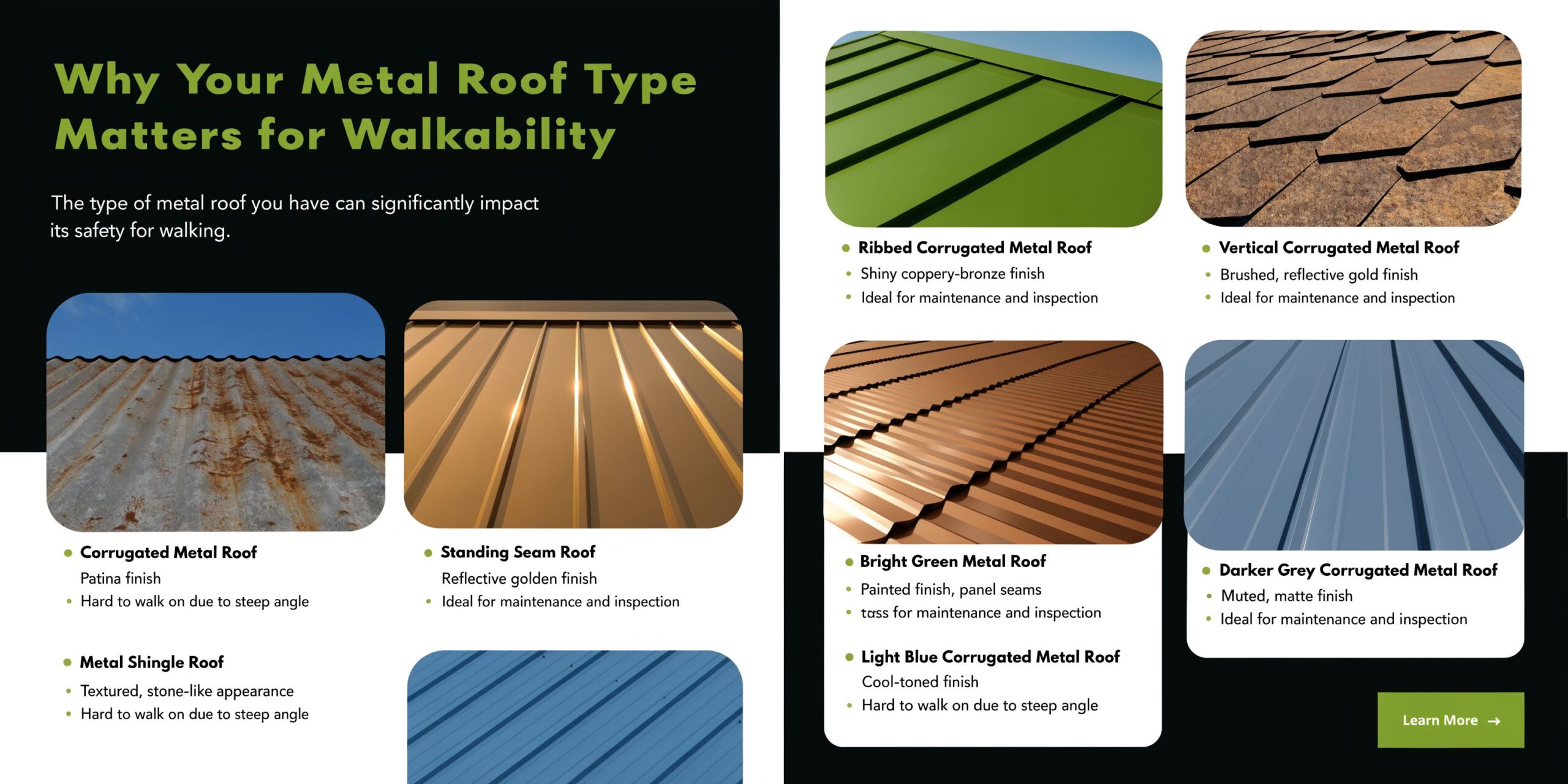
Why Your Metal Roof Type Matters for Walkability
Some metal roofs are easier to walk than others because they move weight differently. Think of the panel like a bridge deck. If your foot lands where the structure is designed to carry load, the roof feels stable. If your foot lands in a span with less support underneath, that same panel can flex, crease, or dent.
Standing seam roofs
Standing seam is the profile many homeowners picture first. It has raised vertical seams and concealed fastening. On a well-installed system, these roofs can handle maintenance traffic better than many people expect, especially when they’re installed over solid decking.
But “better” does not mean carefree. The raised seam is not an invitation to step anywhere you want. You still need to place weight where the panel is supported and avoid twisting your foot across seams.
Corrugated and exposed-fastener panels
Corrugated and similar exposed-fastener panels show up on homes, shops, detached garages, and outbuildings across Utah. These profiles can be durable, but they can also be less forgiving if the span between supports is wider or the panel gauge is thinner.
The common homeowner mistake is stepping on the high rib because it feels like the strongest point. In many systems, that is exactly where you do not want concentrated weight unless the structure underneath supports it.
PBR panels and foot placement
PBR panels are a good example of why panel profile matters. The safest walking path is not based on what looks strongest from the ground. It is based on how the panel transfers load to the framing below.
Mid-Florida Metal Roofing explains that for PBR panels, flat-footed steps on the lower flats near supports reduce dent risk by 70% compared to stepping on ribs (how to walk on a metal roof safely). That is useful because it gives homeowners a concrete rule. Step near support. Stay flat-footed. Do not bounce, twist, or stride across unsupported areas.
How to identify what you have
If you are not sure what kind of roof is on your house, start with visible clues:
| Roof feature | What it usually suggests | Walkability takeaway |
|---|---|---|
| Tall vertical seams | Standing seam | Often more forgiving, but still requires disciplined foot placement |
| Visible screws across the panel face | Exposed-fastener system | More caution needed around fasteners and unsupported spans |
| Wide flat sections between ribs | Panel with lower flats | Step placement becomes much more important |
| Attached garage or porch roof with open framing below | Possible wider support spacing | Higher dent risk if you guess where to step |
Gauge matters too, but most homeowners won’t know it by sight alone. If the roof feels “tinny,” flexes under pressure, or spans over open framing rather than solid decking, the margin for error is smaller.
Trade reality: The roof type does not just affect whether you can walk it. It affects whether one bad step becomes cosmetic damage, a seam problem, or a leak path later.
6 Factors That Make Walking on Metal Roofs Dangerous
A metal roof can be perfectly solid and still be a poor surface to walk. Risk builds from a combination of conditions, not one single issue.
1. Roof pitch changes everything
A shallow roof may allow careful movement with proper footwear. A steeper roof punishes mistakes immediately.
On steeper sections, your body naturally shifts downhill. That increases the chance of sliding, overreaching, or planting your foot hard where the panel does not want the load. Homeowners often underestimate this because the roof looks less steep from the ground than it feels at the eave line.
2. Weather in Utah is not just rain
General roofing advice usually warns against wet conditions. That’s correct, but Utah adds a few wrinkles.
In arid climates like Utah, dust storms create traction problems that general guidance often misses. The same goes for freeze-thaw cycles in Salt Lake City, which can affect panel expansion and seam integrity in ways different from humid coastal climates (regional guidance on walking metal roofing).
That matters in real life. Fine dust can behave like a dry lubricant on a smooth panel. Morning frost can form in thin patches that are hard to spot. Snowmelt can refreeze at edges and around penetrations. Bright sun can dry one section while another remains slick in shade.
3. Debris does not need to be heavy to be dangerous
A few pine needles, cottonwood fluff, leaves trapped at a valley, or loose grit after a windstorm can change how a boot sole grips the panel.
This is common on Front Range and Wasatch-facing properties where wind pushes debris into roof transitions. The roof may look clean from the ladder and still have enough loose material to cause a slip or force a bad step.
4. Age and prior wear reduce your margin for error
Older metal roofs often remain serviceable for a long time, but that does not mean every panel remains equally resilient under foot traffic.
Fastener movement, minor panel deformation, seam wear, faded coatings, and previous service access all matter. A roof that has already been trafficked around a chimney, satellite mount, or vent stack may have local weak spots or cosmetic distortion that make footing less predictable.
A short demonstration helps homeowners see why movement control matters:
5. Surface finish affects traction
Some finishes feel chalkier or more textured. Others are smoother and slicker. You cannot assume all painted or coated panels behave the same way under a boot sole.
A glossy finish, accumulated residue, or UV-aged surface can change how your foot reacts, especially on a cold morning. In Utah, high sun exposure and temperature swings can age exposed surfaces differently over time, so the same roof may not feel the same in year fifteen as it did in year two.
6. Loose fasteners and seam issues create surprise movement
A homeowner may focus on slipping and ignore structural cues. That is a mistake.
If a fastener has backed out, a clip is stressed, or a seam has shifted, the panel may move more than expected when loaded. That sudden give causes panic steps. Panic steps are when dents, slips, and twisted ankles happen.
Quick decision check before access
Do not go up if any of these are true:
- The panel is wet or frosty and you cannot guarantee full dryness
- You see dust, pine needles, or storm residue across the walking path
- The roof is steep enough that you would need one hand for balance
- You notice waviness, lifted seams, or backed-out fasteners
- You do not know where supports are under the panel
The Hidden Risks Damaging Your Roof and Warranty
The biggest problem with DIY roof access is that the damage is often not dramatic at first. You may come down thinking everything went fine. Then a panel shows a soft dent line in afternoon light, a seam starts taking stress, or a scratch exposes the finish to weather.
Injury risk is only half the story
Homeowners usually think about falling first, and they should. A slip on metal does not leave much room to recover.
But the roof itself carries financial risk too. Improper foot traffic can damage panels, stress seams, and create repair bills that are far larger than people expect. APC Roofing cites average repair costs of $5,000 to $15,000 for dented panels or seam damage, notes that this issue affects 25% of homeowner claims, and says 80% of U.S. insurance carriers exclude foot-traffic damage (why walking on a metal roof is not always a great idea).
What damage looks like
Some problems are obvious. Others are subtle.
- Dented flats: These are common when someone steps between supports or lands hard near an unsupported area.
- Oil canning appearance: A panel may show visible waviness after foot traffic stresses it.
- Scuffed finish: A gritty sole can abrade the protective surface.
- Seam distortion: Twisting across a standing seam can create stress where the system is meant to stay tight.
- Leak pathways: A disturbed seam or deformed panel can let water behave differently during storms.
A homeowner might see one dent and think it is cosmetic. In practice, roofing systems fail at details. Once a panel no longer sheds water exactly as intended, small defects matter more.
Key takeaway: The risk is not just “Will I fall?” It is also “Will this step create a repair I do not notice until weather exposes it?”
Warranty language matters
Manufacturers and installers pay close attention to whether damage came from product failure or outside impact. Improper foot traffic can put you on the wrong side of that distinction fast.
That matters for long-term warranty protection and for workmanship coverage tied to installation details. If someone untrained walks the roof, steps in the wrong place, and creates panel or seam damage, the paper trail becomes much harder for the homeowner.
For that reason alone, many homeowners are better served by keeping roof access limited, documented, and intentional rather than casual.
Your Guide to Safe Roof Access and Essential Gear
A Utah homeowner usually gets tempted onto a metal roof for the same reasons. A downspout is backing up. A vent looks loose after wind. Snow slid off one slope but still hangs on the north side. That is when rushed decisions turn into falls, dents, or warranty trouble.
Treat roof access like planned maintenance. If the answer can be found from the ground, keep your boots off the panels and protect the roof system that is helping your home shed heat, reflect UV, and hold up through snow season.
Start with a ground-level inspection
Begin at the perimeter of the home. Check eaves, valleys, skylights, chimney flashing, vent penetrations, and any area where dust, needles, or storm debris collect. In Utah, dry summer dust can act like ball bearings under a boot, and winter shade can hold frost on one roof plane long after the driveway looks clear.
Use binoculars if you have them. A phone camera with zoom helps too. If you are trying to decide whether it is smarter to inspect, repair, or pay for a professional visit, this guide to roof inspection cost gives useful context before you climb.
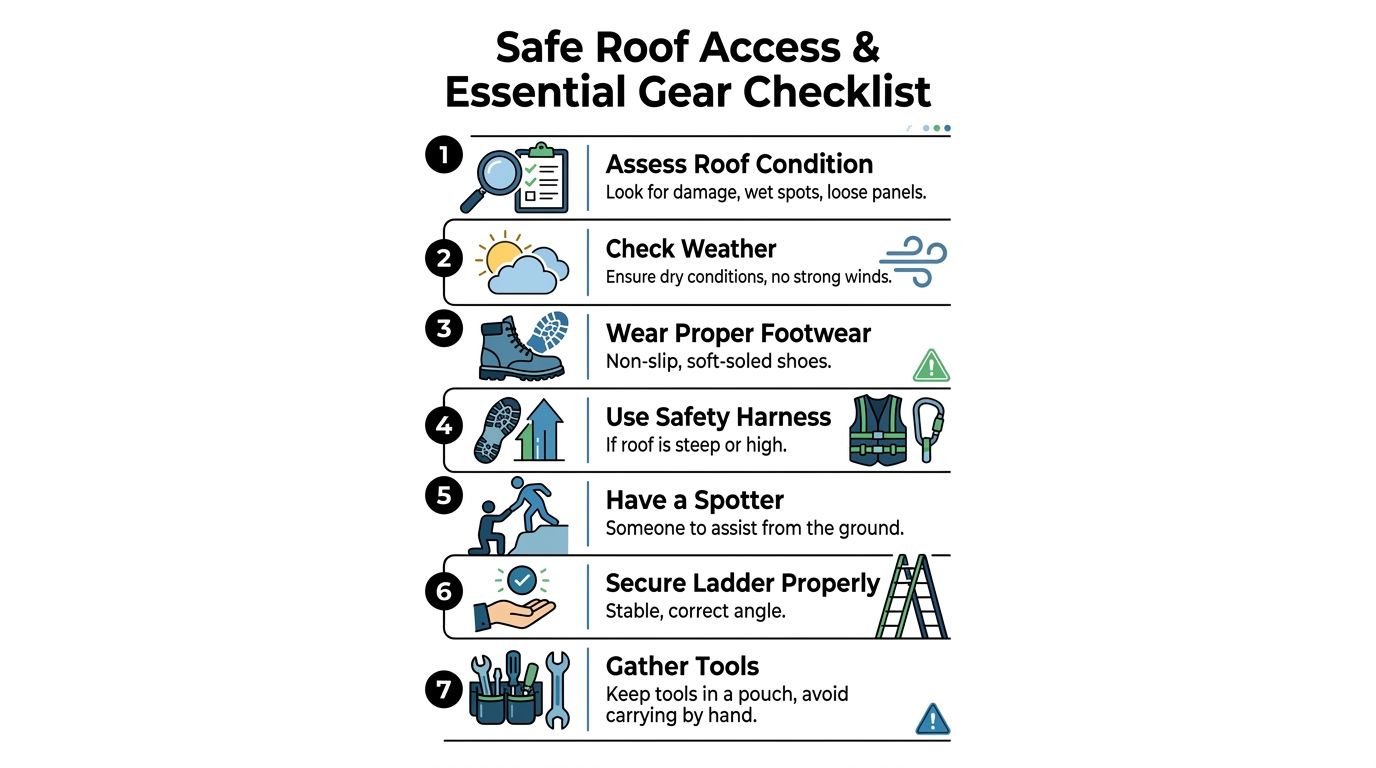
Check the weather next. Wait for a fully dry surface. No dew, no frost, no meltwater, no wind strong enough to shift your balance at the ladder.
Gear that matters
The right basics do.
- Soft rubber-soled boots with clean soles help you keep contact without grinding grit into the finish.
- A properly set ladder matters before anything else. Stable footing at the ground and secure placement at the eave prevent bad starts.
- A small tool pouch keeps both hands free while climbing and stepping.
- A second person on the ground adds oversight and can respond if you slip or need help.
- A harness and correct anchor point are the right call on steeper roofs or any roof where a slide would carry you to the edge.
If you do not own fall protection or do not know how to anchor it into structure, stop there. Guessing with safety gear is no better than guessing with foot placement.
How to move without damaging the roof
Movement should be slow, balanced, and deliberate.
Foot placement
Set each foot down flat and in the right location for the panel profile. On many metal roofs, that means stepping where the load transfers best to the structure below, not drifting across unsupported sections. Standing seam roofs need extra care because twisting across the seam can stress parts of the system designed to stay aligned and watertight.
Short steps are better. So is a planned route. Wandering around to "take a quick look" is how panels get marked up and homeowners lose track of where support is.
Body position
Keep your weight centered. Bend your knees slightly and face the direction you are traveling whenever possible. Do not carry loose tools in your hands, and do not make quick side steps on slope.
I tell homeowners the same thing we tell crews. If your confidence drops, come down. Utah roofs can change fast from one section to another. A south-facing panel may feel dry and warm while the shaded side still has a slick film you cannot see from the ladder.
Frequency of access
Even correct foot traffic adds wear over time. Repeated trips by HVAC techs, satellite installers, solar crews, or chimney service companies can create avoidable stress in the same travel line.
If your home has equipment that requires service, set one access path and make sure every contractor follows it. That protects the finish, reduces the chance of panel distortion, and helps preserve the workmanship warranty tied to how the roof was installed.
A simple pre-walk checklist
Run through this before your first foot leaves the ladder.
Surface is dry
No frost, dew, meltwater, or loose debris.Your route is clear
You know where you plan to step and where you will turn around.Your footwear is clean
Soft rubber soles, no mud, no gravel stuck in the tread.The ladder is secure
Stable at the base and positioned correctly at the roof edge.Your hands stay free
Tools are in a pouch, not carried loose.Another adult is present
Someone is there to steady the ladder and respond if needed.You have a stop point
If wind picks up, footing feels wrong, or the roof surface is not what you expected, come down immediately.
Know When to Call a Roofing Professional in Utah
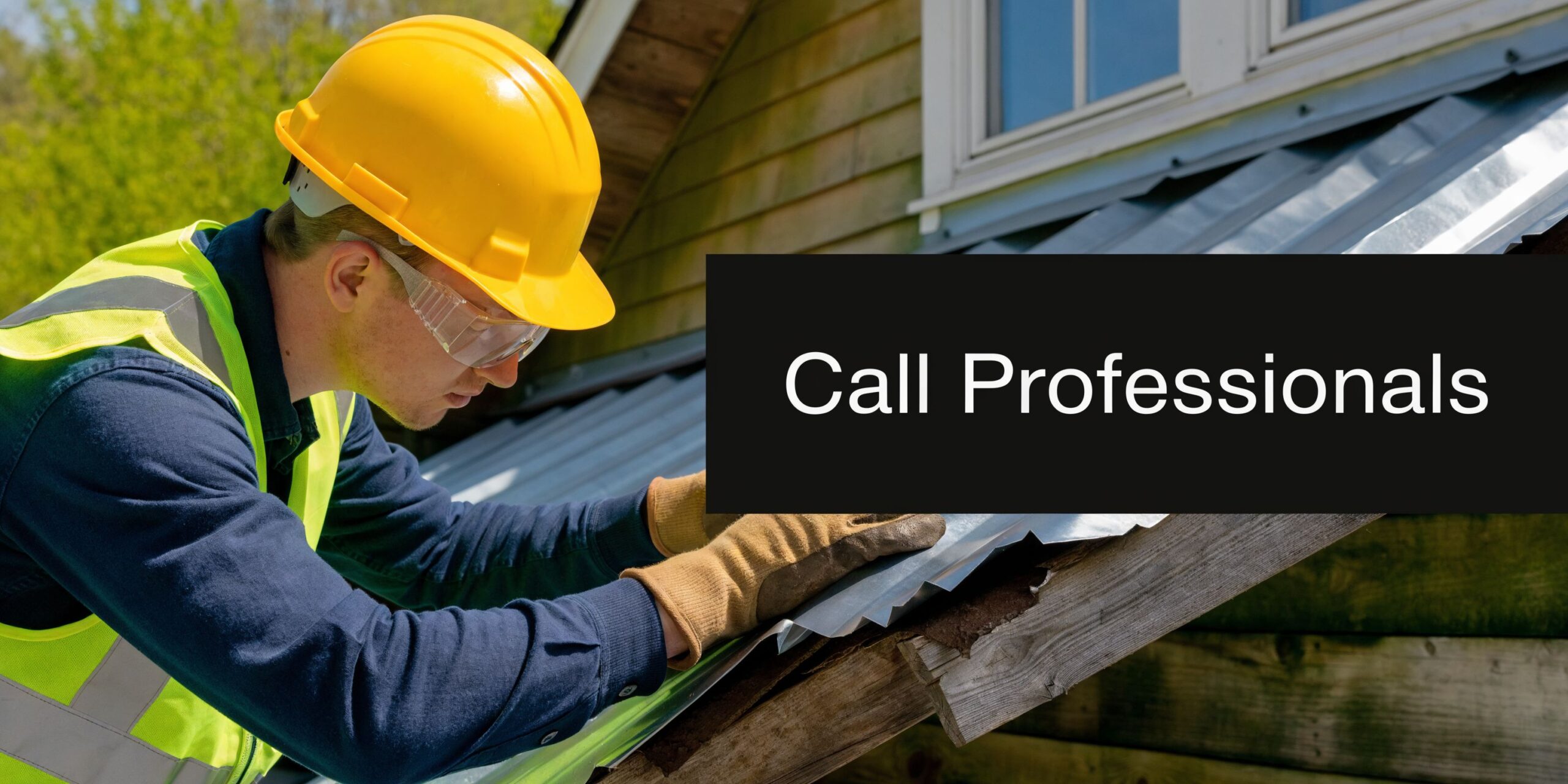
Some roofs should not be a DIY project at all. If the pitch is steep, the panel condition is uncertain, the weather is questionable, or the task requires more than a quick visual check, it is time to hand the job off.
Situations that call for professional access
A professional inspection makes sense when:
- You see a stain indoors and need leak tracing rather than a surface glance
- The roof has storm exposure and you are checking seams, fasteners, or impact marks
- Snow, ice, or dust are in play and footing is unpredictable
- The roof is older or shows movement around penetrations, valleys, or panel runs
- The task involves repeated service access from HVAC, solar, chimney, or satellite work
That is especially true in Utah, where roof conditions can change quickly from one side of the home to the other. South-facing slopes may dry fast. North-facing sections can hold frost or snow longer. Wind exposure can leave one area clean and another area dusty and slick.
Why homeowners usually save money by not guessing
Professional access is not just about safety. It is about documentation, damage prevention, and preserving the value of the roof system.
If you are comparing whether to climb up yourself or schedule a formal evaluation, it helps to understand what homeowners typically weigh when reviewing roof inspection cost. The useful takeaway is not a universal number. It is that inspection cost is usually minor compared with the cost of avoidable repairs, denied claims, or warranty disputes.
A contractor can identify whether the issue is panel damage, seam stress, fastener movement, flashing failure, or just surface debris. Those distinctions matter. They determine whether the roof needs repair, maintenance, or no foot traffic at all.
The practical answer for most homeowners
If you are retrieving a toy, checking a stain, or looking at one suspicious spot, the temptation is to go up once and get it done. That is understandable.
But most homeowners do not know panel support layout, safe stepping zones, or how to evaluate seam stress on sight. On a metal roof, that knowledge gap is where accidents and damage begin.
For Utah homes, the safest approach is simple. Use the ground for inspection whenever possible. Use a ladder only when necessary. Use the roof surface only when the conditions, panel type, and safety setup all line up in your favor. If they do not, call a roofer.
If you want a professional opinion before anyone steps onto your roof, contact Superior Home Improvement for a consultation. A trained inspection can help you avoid unnecessary risk, protect your metal roof’s long-term performance, and keep workmanship and manufacturer coverage on solid ground.