
You’re probably looking at one of two problems right now.
Either the house is telling you it is time. The windows leak cold air, the roof is nearing the end, the siding looks tired, and the utility bill keeps reminding you that patchwork fixes are not solving anything.
Or you already know what you want. Better comfort, lower energy waste, fewer repairs, stronger resale appeal. The problem is the price tag. A serious exterior project in Utah is not casual spending, and most homeowners do not want to make a rushed borrowing decision just to get the work started.
That is the right instinct.
Financing home improvement projects should never be treated like grabbing easy money. It should be treated like choosing the right tool for a high-value job. The wrong loan can turn a smart upgrade into a drag on your budget. The right one can help you protect the house, lower monthly waste, and spread the cost in a way that fits life.
Your Guide to Financing Energy-Efficient Home Upgrades in Utah
A lot of Utah homeowners hit the same wall. Winter exposes the drafty rooms. Summer exposes the windows that bake the house by noon. Then a contractor gives you a quote for replacement windows, roofing, or siding, and the first reaction is usually the same: that’s more than I wanted to pay at once.
That does not mean the project is a bad idea. It means you need to look at it the way an experienced homeowner does. Not as a splurge, but as a long-term house decision.

Utah homeowners are already doing exactly that. Utah leads the nation in home improvement loan activity, with homeowners taking out 17.0 loans per 1,000 owner-occupied households, according to Construction Coverage’s analysis of Home Mortgage Disclosure Act data. That matters because it shows financing is not unusual here. It is a normal part of how people handle weather resistance, comfort, and energy-focused upgrades in a fast-growing state.
Why financing can be the smart move
If your roof is aging, waiting can make the project more expensive. If your windows are bleeding heat, every season you delay is another season of paying for wasted energy and living with less comfort.
Good financing does three things:
- Protects cash flow: You keep reserves for emergencies instead of draining savings.
- Lets you do the full fix: You avoid cheap partial work that does not really solve the problem.
- Matches cost to lifespan: A long-lasting improvement gets paid over time, not in one painful hit.
Tip: If a project improves comfort, weather protection, and energy use at the same time, judge it by total household impact, not just the invoice.
The mistake I see most often is homeowners financing the wrong way, not financing at all. They put a large project on the wrong product, then spend years paying for convenience. You want the opposite. Low friction upfront, sensible repayment, and a result that makes the house better every month you live in it.
Comparing Your Primary Home Improvement Financing Options
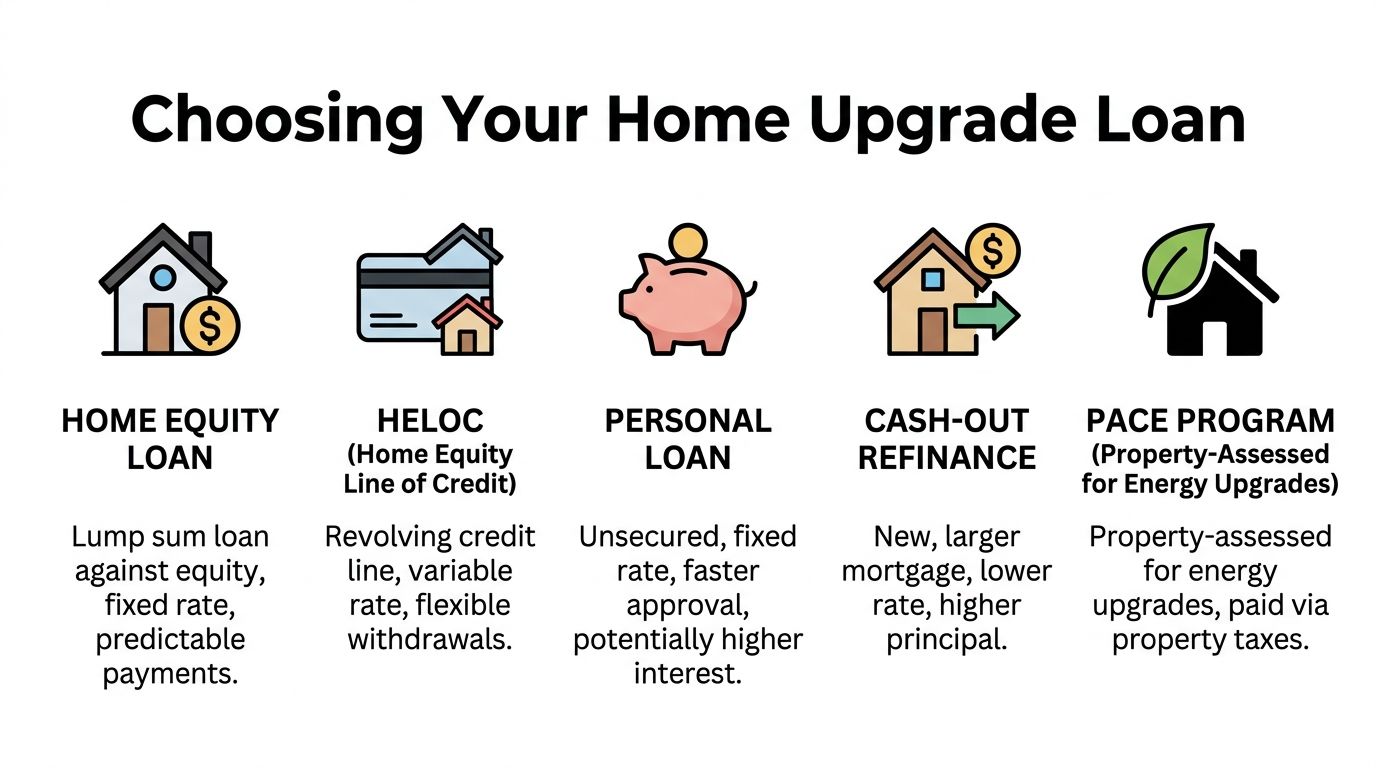
The financing market is crowded, and lenders love jargon. Keep it simple. Most homeowners are really choosing between a few core options, each built for a different kind of project and risk tolerance.
Across the U.S., homeowners spent about $827 billion on home improvements from 2021 to mid-2023, a 33% increase from the prior two-year period, and NerdWallet reports that while many used savings, larger projects often pushed homeowners toward home equity products or contractor financing. That tracks with what I see in Utah. Small repairs are often paid directly. Bigger exterior upgrades usually need a more deliberate financing structure.
Home equity loan
Think of a home equity loan as a second mortgage with a fixed amount and predictable payments.
You borrow a lump sum against the equity you already built in the house. The payment is usually fixed, which makes budgeting easier for one-time projects like a full roof replacement or complete window package.
Best fit: One defined project with a clear contractor estimate.
Pros
- Predictable payment: Good for homeowners who want stability.
- Strong fit for major work: You get the money upfront and use it for the project as planned.
- Usually more sensible than revolving debt for large work: Especially when the scope is fixed.
Cons
- Your house secures the loan: Miss payments and the risk is serious.
- Less flexible than a credit line: Not ideal if your project scope may expand.
- Closing process can be slower than unsecured options: Plan ahead.
HELOC
A HELOC, or home equity line of credit, works more like a credit line backed by your home.
You draw funds as needed, which can be useful if the project may happen in phases. A HELOC can make sense for homeowners doing windows now and siding later, or for property owners with a broader rolling improvement plan.
Best fit: Flexible projects with uncertain timing or staged spending.
What I like about HELOCs is flexibility. What I do not like is that some homeowners confuse flexibility with safety. If the payment can change, your budget can get squeezed at the wrong time.
Personal loan
A personal loan is unsecured. You do not pledge the house as collateral.
That makes it attractive for newer owners with limited equity or people who do not want their home tied to the financing. Approval can also be faster than equity-based lending.
Best fit: Mid-sized projects, urgent repairs, or borrowers without enough equity.
A personal loan is often the cleanest option when the project matters but the home equity route is not available or not worth the hassle. The tradeoff is straightforward. Less collateral for the lender usually means less favorable pricing for the borrower.
Contractor financing
Contractor financing is often the most practical path when speed matters and the contractor has a strong lending network.
This option usually shows up right at the kitchen table or in the sales consultation. You review project pricing and financing choices together instead of chasing a bank first. That convenience can be valuable, especially for time-sensitive work.
Best fit: Homeowners who want an efficient process and a project-specific lending path.
There is one caution here. Convenience is not the same thing as a good deal. Read the agreement carefully. Some offers are excellent. Some only look excellent because the monthly payment is stretched or a promotion hides the true cost later.
Credit cards
For serious exterior work, I rarely recommend credit cards unless you are covering a very small portion of the project and have a clear payoff plan.
They are easy. They are fast. They are also one of the easiest ways to overpay for a home improvement if the balance lingers.
Best fit: Small add-ons, not major windows, roofing, or siding work.
Cash-out refinance
A cash-out refinance replaces your current mortgage with a larger one and lets you take the difference in cash for the project.
This can be appealing if the mortgage terms make sense for your bigger financial picture, but it is a broader move than a simple project loan. You are not just financing home improvement projects. You are changing your primary mortgage structure.
Best fit: Homeowners already considering a full mortgage reset.
A quick comparison table
| Financing Type | Typical Interest Rate (2026) | Loan Amount | Repayment Term | Best For |
|---|---|---|---|---|
| Home Equity Loan | Varies by lender and borrower | Usually larger project amounts tied to available equity | Often longer-term | One-time major project with clear scope |
| HELOC | Varies by lender and borrower | Flexible draw amount based on equity | Revolving draw period plus repayment period | Staged projects or uncertain scope |
| Personal Loan | Varies by lender and borrower | Usually smaller than equity-based products | Fixed monthly term | Faster funding without using home equity |
| Contractor Financing | Varies by lender program and borrower | Project-based | Varies by offer | Convenience and fast project start |
| Credit Cards | Varies widely by card terms | Lower practical limit for this use | Revolving | Small balances paid off quickly |
My blunt recommendation
For large exterior work, start by looking at equity-based borrowing if you have enough equity and stable income. Homeowners often save money by using your home's equity for major expenses when the project is substantial and the repayment plan is disciplined.
Then compare that against contractor financing and one strong personal loan quote. Do not compare ten offers. Compare the right three. Too many homeowners drown in options and end up making a rushed decision anyway.
Key takeaway: Match the loan to the project scope. Fixed-scope jobs pair well with fixed funding. Flexible projects pair better with flexible funding.
Uncovering Specialized Grants Rebates and Local Programs
Most homeowners stop at the bank. That is a mistake.
The best financing plan for an energy-efficient project often combines standard borrowing with incentives, rebates, or specialty programs. This is especially true in Utah, where heating and cooling demands make exterior upgrades more than cosmetic work.
Green financing is growing, but many homeowners do not optimize their incentives
A major trend for 2025 to 2026 is the rise of specialized green financing, yet many homeowners still do not know how to stack federal incentives, Utah rebates, and point-of-sale contractor offers. FinMkt notes this gap directly, including Utah state rebates up to $5,000 post-2025 for qualifying situations.
That matters because the order of operations affects your actual cost.
A lot of homeowners ask the wrong question first. They ask, “What’s the payment?” The better question is, “What offsets can I apply before I decide on the payment structure?”
The stack that usually makes sense
For an energy-focused project, I recommend reviewing financing in this order:
- Contractor estimate first: You need a detailed written scope. Without that, you are guessing.
- Federal incentive review: Check which parts of the project may qualify.
- Utah rebate review: Look for current state-level energy programs and pre-approval rules.
- Utility rebate check: Some upgrades may interact with utility efficiency programs.
- Loan comparison last: Finance only what is left after the realistic offsets.
That last step matters. Do not finance dollars you may not need to finance.
PACE and similar specialty structures
Some homeowners also look at PACE-style financing, where repayment is tied to property taxes rather than a standard installment loan.
This can work for certain energy improvements, but read every line. PACE is different from a normal loan. The repayment mechanism, transfer issues at sale, and qualification structure can all change how the project feels later. If you do not understand how the obligation follows the property, pause until you do.
CDFIs and nonprofit paths for underserved homeowners
If you do not have much equity, do not assume you are out of options.
Community Development Financial Institutions, or CDFIs, can be important for homeowners who recently bought and have little equity, and for some property managers handling multi-family improvements. These paths are often overlooked because big banks dominate the conversation, not because alternatives do not exist.
A primary issue is legwork. You may need to call more than one organization, verify eligibility rules, and confirm whether the funds can be used for the exact scope you need. But that effort can be worth it if traditional equity products are not realistic for your situation.
Tip: Ask every program the same four questions. What projects qualify, what documents are required, whether pre-approval is needed, and how funds are disbursed.
My recommendation for Utah homeowners
If you are planning windows, roofing, or siding with an efficiency angle, do not choose the loan first. Build the full funding stack first.
That means written estimate, incentive check, rebate check, and then financing. Homeowners who reverse that order often borrow too much or choose the wrong term because they never built a complete cost picture.
How to Choose the Right Financing for Your Project
Choosing a loan is not about finding the “best” product in general. It is about finding the best product for your exact project, your timeline, and your risk tolerance.

The cleanest decision framework starts with five filters.
Start with these five filters
Project size
Bigger professional projects often pair better with home-secured borrowing. The strongest data point on this comes from Harvard’s Joint Center for Housing Studies. Projects financed with home-secured credit average $10,622 in expenditure, which is over five times larger than projects funded with credit cards or unsecured loans, according to the JCHS report.
That does not mean you should always use equity. It means homeowners naturally shift there when the work is substantial and professionally installed.
Project urgency
A failing roof is different from a planned efficiency upgrade.
If water intrusion is possible, speed matters more than optimization. You still want a fair deal, but you cannot spend weeks chasing the perfect structure while the house gets damaged.
Equity position
If you have solid equity, equity-based options deserve a hard look.
If you recently bought the home or pulled cash for another reason, unsecured options, contractor financing, and CDFI-style paths become more relevant.
Payment predictability
Some homeowners sleep better with a fixed payment. Good. Choose fixed if variable payments will bother you every month.
Other homeowners want flexibility because the project may evolve. In that case, a line of credit may fit better, but only if you can handle payment movement and stay disciplined with draws.
Exit plan
How long are you keeping the home?
If this is your long-term house, comfort and efficiency carry more weight. If this is a short hold or flip, speed, marketability, and total cost of capital usually matter more than payment comfort.
Scenario one, the emergency roof replacement
The roof is at the end. Leaks are possible. Waiting is not wise.
In that case, I would usually prioritize:
- Fast approval
- Clear contractor scope
- Fixed payment if possible
- No overcomplicated structure
A personal loan or contractor financing can make sense if speed is the priority and equity lending would slow the job down. If equity financing is available quickly and the terms are strong, that can still win. But for emergencies, time carries real value.
Scenario two, the planned energy-efficiency overhaul
This homeowner has time to plan. They want new windows, upgraded siding, maybe roofing too. Their goal is lower waste, better comfort, and stronger long-term value.
Disciplined financing for home improvement projects pays off in this situation.
I would usually tell this homeowner to:
- Get the full project scoped in writing.
- Check every applicable efficiency incentive and rebate.
- Compare a home equity loan against a HELOC and one contractor financing option.
- Focus on total cost, not just monthly payment.
- Use realistic utility savings and lifespan thinking when deciding term length.
A planned project deserves a planned loan.
Here’s a useful explainer if you want a quick visual overview before comparing lenders:
Scenario three, the curb appeal flip
This borrower is a property investor or flipper. They care about speed, resale appeal, weather resistance, and not tying up too much cash.
That usually points to a shorter decision horizon. The loan has to support the hold period, not just the project. Investors should be especially careful with variable-rate products if timing is uncertain.
Key takeaway: Homeowners live with payments. Investors live with timelines. Choose accordingly.
My decision rule
If the project is large, planned, and tied to the long-term performance of the house, look hard at home-secured options first.
If the project is urgent or you lack equity, compare personal and contractor financing next.
If the project is small, avoid turning convenience into expensive revolving debt.
That simple rule will keep many homeowners from experiencing difficulties.
Get Your Finances Ready for a Loan Application
Once you know the likely financing path, get your file clean before you apply. At this stage, borrowers either make the process easy or create their own delays.
Gather the documents lenders want
Most lenders will want a practical paper trail, not your life story.
Have these ready:
- Income documents: Recent pay stubs, W-2s, or tax returns if needed.
- Property details: Mortgage statement, insurance information, and basic property records.
- Project estimate: A detailed written bid from the contractor, not a vague verbal number.
- ID and contact details: Keep them current and consistent across applications.
The written estimate matters more than homeowners expect. Lenders want to know what work is being done, by whom, and for how much.
Check your credit before a lender does
Pull your credit, review it for errors, and clean up anything inaccurate before you apply. If you need a practical refresher, this guide on how to improve your credit score is a useful place to start.
Do not obsess over perfection. Focus on obvious problems you can fix quickly, such as reporting errors, old balances that should show paid, or avoidable new credit activity right before applying.
Do not assume home equity is your only path
Many Utah homeowners still overlook financing beyond equity-based products. That matters because 30% of recent buyers lack equity, and BECU’s overview notes that alternatives such as CDFIs can matter for homeowners with limited equity and for property managers improving multi-family units.
If you bought recently, ask broader questions:
- Can this lender approve unsecured project financing?
- Does the contractor work with project lenders?
- Are there local nonprofit or CDFI options for my type of property?
Keep your application behavior boring
This is not the time to open store cards, finance furniture, or move money around without a clear reason.
Tip: The strongest loan applications are boring. Stable income, clean documents, clear project scope, and no last-minute financial surprises.
That alone can save you a lot of friction.
Partnering with Superior for a Smart Investment
The contractor you choose affects financing more than most homeowners realize.
Lenders and financing partners like clean, well-documented projects. Homeowners like them too. A detailed estimate, clearly defined scope, realistic timeline, and strong workmanship protections all make the decision easier because the project looks like a real investment, not a vague wish list.
Why the contractor changes the math
A reputable contractor does more than install windows, roofing, or siding.
They help define the scope correctly from the start. That reduces surprise changes, helps lenders understand what is being funded, and gives the homeowner a more honest basis for comparing financing options.
When the work is tied to energy performance, the contractor’s documentation becomes even more valuable. If the project includes a written energy-savings guarantee, that gives the homeowner a concrete way to think about monthly impact instead of focusing only on the payment.
What makes this a stronger investment decision
Superior Home Improvement is based in Salt Lake City and focuses on energy-efficient windows, roofing, and siding. The company brings extensive industry experience, a strong BBB rating, and an extensive workmanship warranty. Those details matter because homeowners are not just buying materials. They are buying installation quality, durability, and accountability.
The strongest part of the financial case is Superior’s Energy Conservation Program, which guarantees in writing up to a 40% reduction in energy expenditures for qualifying projects. That changes the financing conversation.
Instead of asking only, “Can I afford this payment?” the better question becomes, “How much of this payment is offset by lower monthly waste and better home performance?”
My recommendation
If you are financing a major exterior upgrade, insist on three things before signing:
- A detailed written estimate
- Clear warranty terms
- A realistic energy-performance discussion
Superior stands out here. Homeowners can get a free consultation, a detailed estimate, and a project plan built around long-term performance rather than just upfront price. When you combine durable materials, certified installation, and a written energy-savings framework, the loan starts to look less like debt for consumption and more like capital for a house that performs better.
Frequently Asked Questions About Project Financing
What if I have bad credit
Start with reality, not denial.
If your credit is rough, your best move is to widen the search beyond standard bank products. Ask about contractor financing, credit-union personal loans, and CDFI-style programs if equity is limited. You may not get the most attractive terms, but you can still find workable paths if the project is necessary and the budget is grounded in a real estimate.
Can I finance a project on a home I just bought
Yes, but the options may shift.
Recent buyers often have little equity, so equity-based borrowing may not be the cleanest path yet. In that situation, unsecured loans, contractor financing, and certain community-focused lenders can be more realistic than forcing a HELOC conversation too early.
What if the final project cost comes in higher than the estimate
Handle that before work starts, not after.
Ask the contractor how change orders are priced, when they must be approved, and whether your financing can absorb adjustments. If the project is likely to evolve, a flexible financing structure may fit better than a rigid lump-sum product. If the scope is fixed, protect yourself with a highly detailed contract.
Should I wait for rates to fall
Usually, no. Not if the house needs the work now.
Waiting can make sense for optional projects. It makes less sense when the roof is failing, the windows are wasting energy every season, or the siding is allowing moisture risk. A delayed repair can cost more than an imperfect rate.
Is financing worth it for energy-efficient upgrades
Often, yes, if the project is real and the contractor is credible.
Energy-efficient upgrades are easier to justify than purely cosmetic work because they can improve comfort, durability, and monthly operating costs at the same time. The key is avoiding sloppy financing. Use incentives first, keep the term sensible, and do not borrow through the easiest product if it is also the most expensive.
If you want a contractor that can help you evaluate both the project and the financial logic behind it, talk to Superior Home Improvement. Their Salt Lake City team offers free consultations, detailed estimates, energy-efficient exterior solutions, and a written path toward lower utility costs so you can make a financing decision with confidence.