
You might be looking at your house right now and seeing two things at once. The first is the look you want. Warm wood grain, real texture, a home that fits Utah's mountain light and older neighborhoods. The second is the maintenance you're tired of. Paint that peels on the sunny side, swelling near the roofline, boards that don't age evenly after snow, ice, and dry summer heat.
That tension is why so many Utah homeowners ask about fiber cement siding that looks like wood. It promises the character of painted or stained wood without signing up for the same cycle of scraping, patching, repainting, and replacing damaged boards. In a climate like ours, that difference matters.
The Enduring Appeal of Wood Siding Without the Work
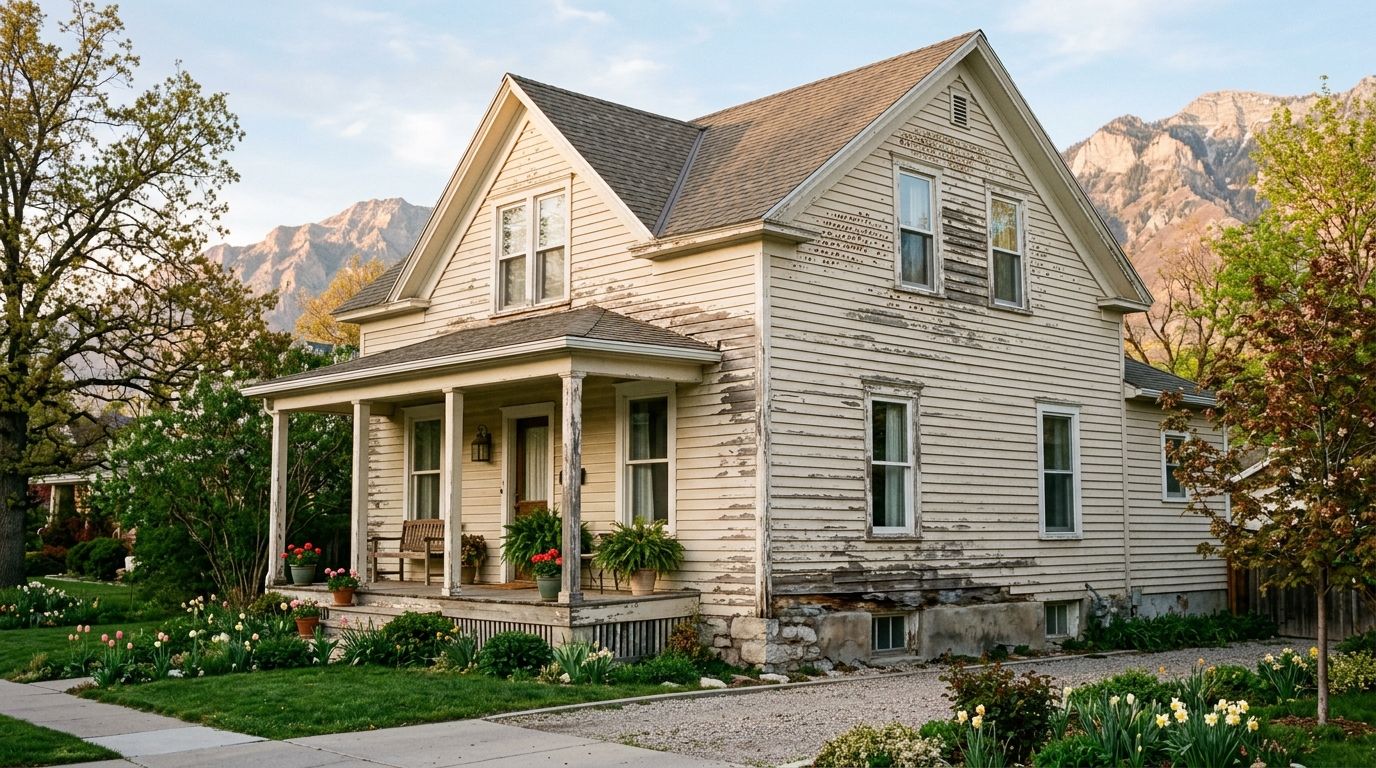
A lot of Utah homes wear wood well, at least at first. A craftsman in Salt Lake, a mountain home near Park City, a farmhouse-style exterior in Utah County. Fresh wood siding has depth and shadow that vinyl rarely matches. It looks natural because it is natural.
Then the seasons go to work on it.
South- and west-facing walls take intense high-altitude sun. Snow piles up, melts, and splashes back. Trim corners stay wet longer than they should. Birds peck at soft spots. Homeowners end up fixing the same areas again and again, even when they stay ahead on paint.
That's where fiber cement siding that looks like wood has earned its place. It gives homeowners the visual warmth they want, but in a cladding designed for harder use. According to James Hardie's overview of fiber cement siding, fiber cement emerged as a modern construction product in the late 19th century, while its current wood-look form came later through manufacturing advances that made embossed grain patterns, factory finishes, and siding plank profiles more refined. The material is typically made from portland cement, cellulose fibers, sand, and water, and the same source notes that it's now widely used as a durable exterior cladding that can mimic wood grain while offering higher resistance to fire and moisture than natural lumber. James Hardie also states that its fiber cement products are noncombustible and/or carry a Class A fire rating when tested to ASTM E84.
Why that matters in Utah
Utah homeowners usually aren't choosing siding for one season. They need something that can handle dry summers, cold winters, sun exposure, and moisture events without constant intervention.
Wood can still be the right choice for someone committed to upkeep and authentic material. But for most homeowners, the attraction of fiber cement is simple:
- It keeps the wood aesthetic. Grain, shadow lines, and traditional profiles still look right on classic homes.
- It cuts down on recurring repair work. Rot-prone spots and moisture-sensitive areas become less of a headache.
- It improves peace of mind. Fire performance matters more than ever in many exterior material conversations.
Practical rule: If you love the look of wood but hate owning its maintenance calendar, fiber cement is usually the first material worth pricing seriously.
What homeowners often get wrong
The mistake is thinking all wood-look siding looks fake up close. Older products sometimes did. Current fiber cement products are a different category. The better lines don't just copy the color of wood. They recreate plank texture, edge detail, and profile depth in a way that reads correctly on the wall.
That doesn't mean every product or every installation looks convincing. It means the material itself is capable of a very believable result when the right profile, finish, and installer come together.
From Cement and Fiber to Realistic Wood Grain
Most homeowners hear “cement” and picture something flat and plain. That's not what modern wood-look fiber cement is. The better way to think about it is a dense, reinforced siding material that gets its final character from how it's formed and finished.
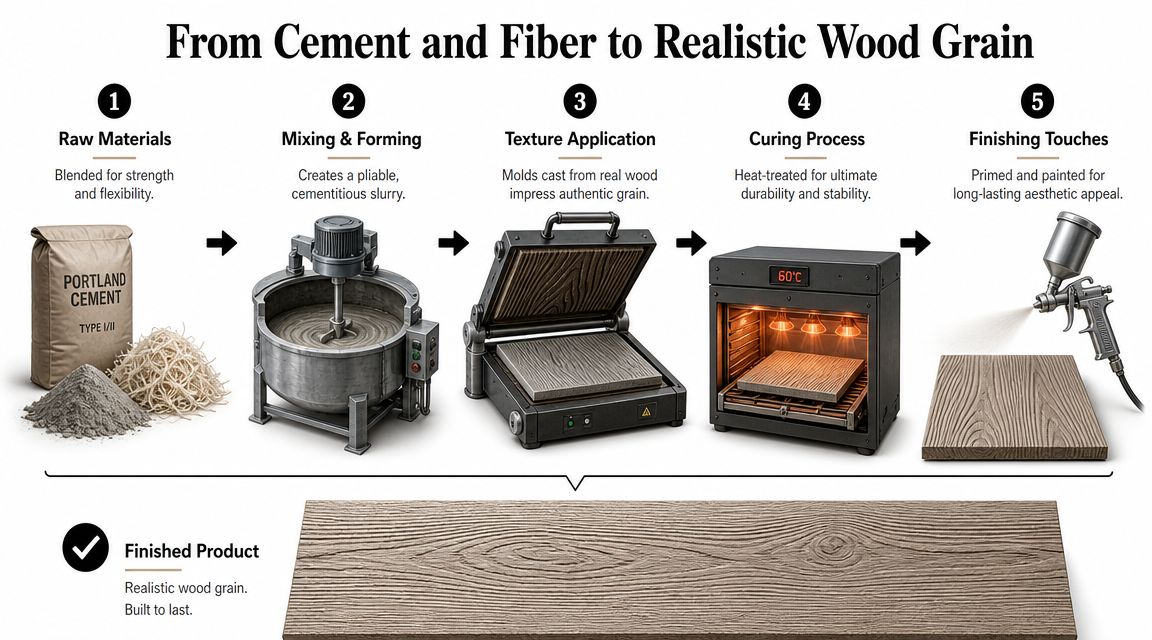
A useful analogy is a high-tech waffle iron. The mix starts as a workable material. Then manufacturers press it with detailed molds that carry the texture of real wood. Once it cures, that grain isn't just printed on the surface. It's built into the face of the siding.
What the material is made of
According to this overview of faux-real fiber cement siding, wood-look fiber cement is typically made from portland cement, silica sand or fly ash, cellulose fibers, and water. That cellulose matters because it reinforces the cement matrix and helps manufacturers press or emboss deeper grain textures while keeping the panel dimensionally stable.
That same source notes why homeowners care about the formula in practical terms. The product is engineered to mimic cedar or redwood visually, but unlike wood it is non-combustible, termite-resistant, and far less prone to rot when installed correctly.
How the grain becomes believable
Realistic wood grain comes from manufacturing precision, not from marketing language. The siding has to carry enough depth and irregularity to catch light like wood does. Flat, repetitive texture reads fake fast, especially in strong Utah sun.
A few things create a more convincing result:
- Embossing depth makes the grain visible from the curb, not just from a foot away.
- Consistent plank edges keep courses looking crisp instead of wavy.
- Factory finishing gives better uniformity when homeowners want a painted or stained-wood appearance.
Some products look acceptable in a brochure and underwhelming on an actual wall. Always ask to see a full installed panel or a nearby completed home, not just a hand sample.
The main style categories
Fiber cement isn't one look. It's a family of looks. Most homeowners in Utah end up choosing among these forms:
Lap siding
This is the classic horizontal plank often pictured first. It works on bungalows, ramblers, colonials, and newer farmhouse-style homes. If your goal is “traditional wood house, but lower headache,” lap siding is usually the starting point.
Shakes and shingles
These add more texture and work well on gables, dormers, and accent walls. They're useful when a home needs visual relief above the main siding line or when you want a cottage or mountain-lodge feel without real cedar upkeep.
Board and batten
Vertical board-and-batten gives a cleaner, more architectural look. It fits modern farmhouse designs, newer builds, and remodels where homeowners want stronger vertical lines and less of a conventional suburban appearance.
Major manufacturers also offer wood-look fiber cement in lap siding, shakes, shingles, panels, and board-and-batten formats, often with factory finishes and longer substrate and finish warranty structures, as noted in the same source above.
Comparing Your Siding Options for Utah Homes
If you're narrowing down siding for a Utah home, the main comparison usually comes down to fiber cement, natural wood, and vinyl. Each one can work. Each one has trade-offs. The right pick depends on what matters most to you after the install, not just on bid day.
| Feature | Fiber Cement | Natural Wood | Vinyl |
|---|---|---|---|
| Wood-like appearance | Strong, especially in quality wood-grain profiles | Best for pure material authenticity | Usually the least convincing up close |
| Upfront cost position | Higher than vinyl, often competitive with premium wood selections | Varies widely by species, grade, and finish | Usually the budget entry point |
| Fire resistance | Strong category advantage | Weaker than fiber cement | Weaker than fiber cement |
| Moisture tolerance | Better than wood when installed correctly | Vulnerable if maintenance slips | Can resist moisture, but detailing and product quality matter |
| Freeze-thaw performance | Good when properly installed with correct clearances and flashing | Can move, crack, or absorb moisture over time | Can become brittle or distort depending on exposure and product |
| UV exposure in Utah sun | Generally holds appearance well with quality finish systems | Paint and stain maintenance tends to come sooner | Color and surface appearance can age unevenly |
| Maintenance demands | Lower than wood | Highest of the three | Lower day-to-day maintenance |
| Curb appeal depth | Substantial, architectural look | Richest natural character | Lighter visual weight |
Fiber cement versus wood
Wood still wins on one point. It is wood. For some homeowners, that ends the debate.
But Utah's climate is hard on materials that need a steady maintenance rhythm. Snow sitting against lower walls, roof runoff, sunny exposures, and sharp temperature swings expose weak spots fast. Wood can perform well, but only when homeowners stay disciplined about paint, caulk, sealing, and repair.
Fiber cement is the compromise that often feels less like a compromise once it's installed. It keeps much of the visual effect people want from wood, while reducing the recurring fight against moisture damage, insects, and fire concerns.
Fiber cement versus vinyl
Vinyl usually wins the first-price conversation. It loses ground when homeowners care about substance, realism, and long-term appearance.
On many Utah homes, vinyl can look too light and too uniform. It also doesn't create the same shadow lines or tactile depth as fiber cement. In neighborhoods with mountain architecture, painted brick, stone accents, or heavier trim packages, fiber cement often fits the home better.
That doesn't mean vinyl is a bad product. It means vinyl makes the most sense when budget is the top priority and the homeowner is comfortable with its visual limitations.
What Utah homeowners should weigh first
If I were helping a homeowner sort through options for this climate, I'd focus on four questions:
- How much sun does the house get? South and west walls tell the truth about finish performance.
- Where does snow and water sit? Bottom edges, roof intersections, and chimney areas matter.
- How important is fire resistance? This becomes more relevant near open land and foothill communities.
- Do you want the lowest price now, or fewer siding problems later? That answer usually narrows the field quickly.
For Utah homes, fiber cement often lands in the middle of the Venn diagram. Better curb appeal and substance than vinyl, less upkeep pressure than wood.
Understanding the Lifetime Value of Fiber Cement Siding
Fiber cement usually isn't the cheapest estimate on the table. Homeowners notice that right away, and they should. This is a mid-to-high-range siding purchase, not an impulse upgrade.
The more useful question is whether it stays expensive after you've owned it for years.
Where fiber cement sits in the market
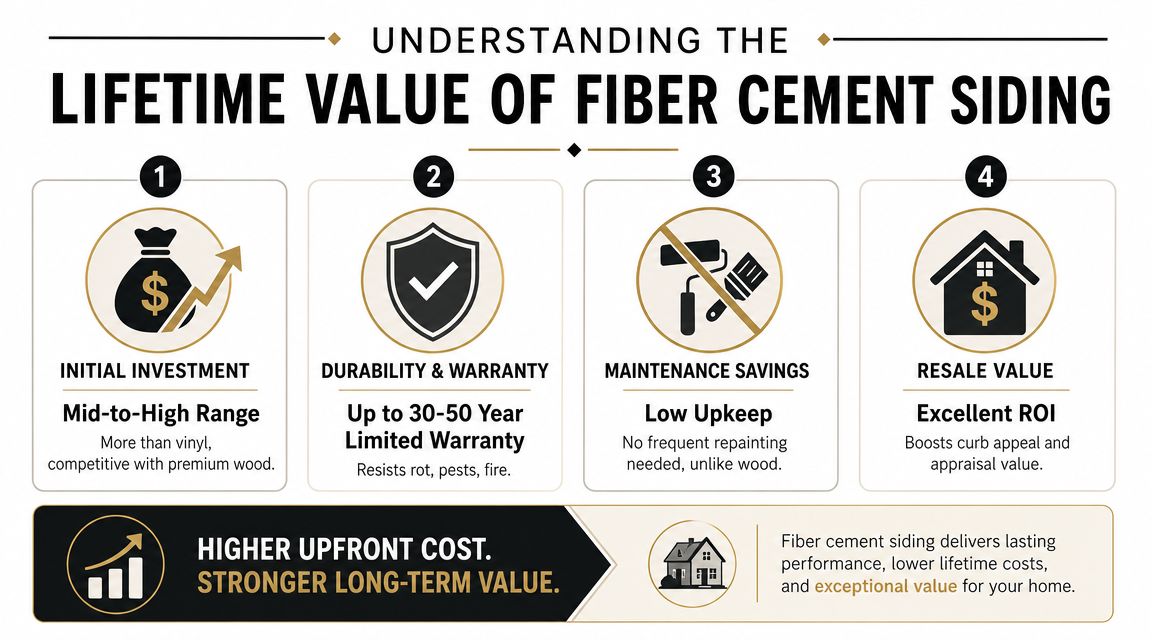
According to Nichiha's VintageWood product page, fiber cement generally costs less than brick, synthetic stucco, and some wood siding options, while being more expensive than vinyl. That's a useful way to frame it. It's not bargain siding, but it also isn't reserved only for luxury projects.
The same source reflects a big reason homeowners choose it in the first place. Long service life and low maintenance sit at the center of its value, especially because it can reduce lifecycle costs tied to repainting, rot repair, and pest treatment that natural wood often brings with it.
What costs tend to disappear
You can't evaluate fiber cement fairly by looking only at material and labor. You have to compare it with the maintenance path of the alternative.
With wood, homeowners often spend time and money on things like:
- Repainting cycles on exposed elevations
- Trim and siding repairs where moisture lingers
- Pest-related fixes when insects target vulnerable wood components
- Spot replacement in high-splash or high-shade areas
Fiber cement doesn't make every exterior cost vanish. Caulk, paint touch-up, and inspections still matter. But the maintenance list usually gets shorter and more predictable.
Why Utah makes lifetime value easier to understand
Utah homes reveal weak materials over time. Strong sun fades finishes. Snow and ice expose moisture management mistakes. Dry air and seasonal shifts stress joints and transitions. When siding handles those conditions with fewer interventions, homeowners feel the value in a practical way, not just on paper.
That's also why some homeowners choose products through a local contractor such as Superior Home Improvement, which offers wood-grain fiber cement siding in textured profiles and factory-finish options selected for Utah conditions. The product itself matters, but matching the right profile and finish to the site matters just as much.
A better way to budget for siding
Instead of asking, “What's the cheapest installed number?” ask these:
- What am I likely to spend maintaining the alternative?
- How often will I need to paint or repair it?
- Will it still look right on my house after years of Utah weather?
- Am I buying curb appeal for now, or cladding for the long haul?
Homeowners who ask those questions usually see fiber cement more clearly. It's not cheap siding. It's siding that often makes better financial sense once ownership begins.
Why Professional Installation Is Non-Negotiable
Fiber cement is a good material. It is not a forgiving one.
If wood is craft-sensitive, fiber cement is detail-sensitive. The product can look great and hold up well, but only when the installer respects clearances, flashing, fastening patterns, cutting methods, and water management. Most failures I've seen in the field weren't product failures first. They were installation failures.
Why this isn't a normal DIY siding job
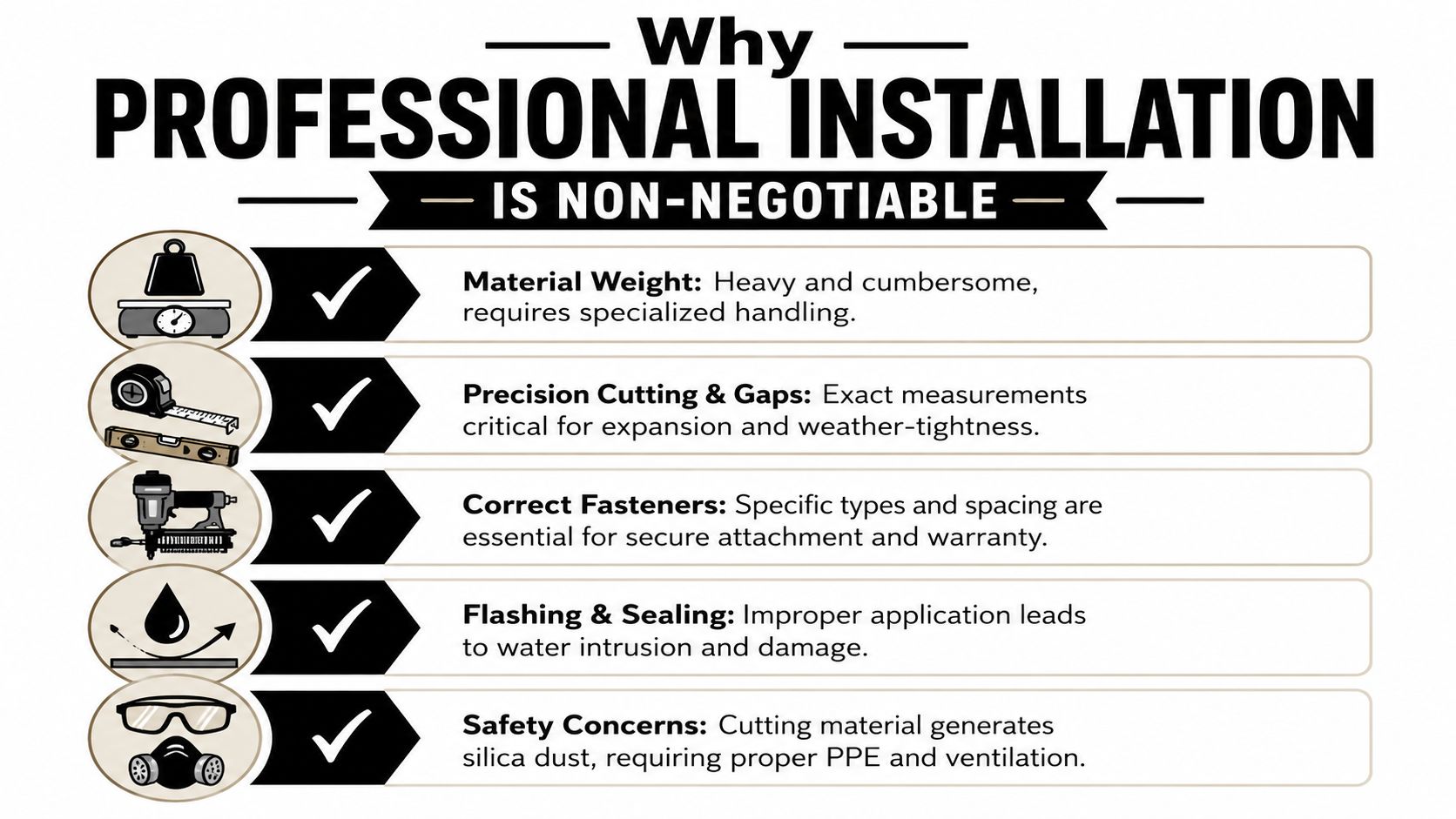
Fiber cement is heavy. That changes how crews carry it, stage it, and fasten it. The boards can also chip or break if they're mishandled, especially around cuts and edges.
Then there's dust control. Cutting fiber cement creates silica dust, which means the crew needs the right tools, the right protective equipment, and the discipline to keep the site safe.
The biggest risk is water, not the board
Most homeowners focus on the siding face. Installers focus on what happens behind it.
If flashing is sloppy around windows, doors, butt joints, rooflines, or penetrations, the wall can take on moisture long before the siding itself shows obvious trouble. In Utah, freeze-thaw cycles make that even more serious. Water gets where it shouldn't, temperatures drop, materials move, and the problem grows.
A neat finish line doesn't prove a correct install. Ask how the crew handles kickout flashing, window flashing, clearances above roofing and grade, and moisture transitions before you care about caulk color.
To see what that looks like in practice, this short installation video gives homeowners a useful visual reference:
What to look for in a Utah installer
A qualified installer should be able to answer product and climate questions without hand-waving. Look for a contractor who can show you local work, not just a national brand brochure.
Use this checklist:
- Manufacturer familiarity: They should know the installation requirements for the exact product line being proposed.
- Local climate experience: Ask how they handle snow exposure, splashback zones, and sun-heavy elevations in Utah.
- Licensing and insurance: Basic, but absolutely required. Don't skip it.
- Flashing details: Ask them to walk you through windows, doors, roof intersections, and ledger areas.
- Site cleanliness and cutting practices: Fiber cement dust and debris need to be controlled professionally.
- Completed local projects: A nearby job tells you more than a showroom sample.
What doesn't work
The wrong hire usually sounds confident but vague. They talk mostly about color, timelines, and “making it look sharp.” They don't volunteer details about drainage plane integrity, expansion gaps, joint treatment, or how they'll protect vulnerable transition points.
That's the crew to avoid.
Protecting Your Investment with Warranties and Proper Care
Homeowners often hear “long warranty” and assume that means every part of the siding is covered the same way for the same amount of time. That's usually not how siding warranties work.
The first thing to understand is the difference between the substrate and the finish. The substrate is the siding material itself. The finish is the factory-applied color or coating. Those are separate promises, and homeowners should read them as separate promises.
Read the warranty in two parts
When you review product literature, ask the contractor to point out:
- What covers the board itself and what kinds of failure it addresses
- What covers the factory finish and what that finish warranty excludes
- What installation requirements must be followed to keep coverage valid
- What maintenance the homeowner is still expected to perform
That last point matters. Low maintenance doesn't mean no maintenance.
A simple yearly care routine
Fiber cement doesn't need the kind of upkeep wood does, but it still benefits from basic attention. In Utah, dust, irrigation overspray, and snow-related splashback are common realities.
A practical annual routine looks like this:
- Inspect the exterior once a year. Check caulk lines, lower-wall areas, roof intersections, and spots near decks or steps.
- Wash gently. Use a hose and soft brush to remove dirt buildup. Don't treat the siding like concrete and blast it aggressively.
- Keep plants and soil off the wall. Bushes, vines, mulch, and soil piled too high can create avoidable trouble.
- Watch sprinklers. Repeated spray on siding and trim is one of the most common preventable issues on any exterior.
Low-maintenance siding still needs a homeowner who notices problems early. Annual attention beats deferred repair every time.
What good care accomplishes
Basic care preserves appearance, but it also helps you catch minor sealant or clearance issues before they become wall issues, which is a major advantage. Fiber cement is durable, but durability always performs better when someone keeps water moving away from the house and keeps contact points clean.
Questions to Ask Your Siding Contractor
The best siding consultation usually isn't the one with the longest sales pitch. It's the one where the contractor gives direct answers to direct questions. If you're meeting with installers about fiber cement siding that looks like wood, these are the questions worth asking before you sign anything.
Which brand and product line are you recommending for my home, and why
A good answer should connect the recommendation to your home's architecture, exposure, and goals. “This is what we always use” isn't enough.
How will you handle flashing around windows, doors, rooflines, and penetrations
This question tells you quickly whether the contractor thinks like an exterior specialist or just a siding salesperson. You want specifics about water management, not general promises about sealing everything up.
What clearances will you maintain above grade, roofing, decks, and hard surfaces
Good installers know that siding performance depends on spacing and separation. If the answer is fuzzy, that's a warning sign.
Who is doing the installation
Ask whether the crew is in-house or subcontracted, who supervises the work, and who handles punch-list items. The quality of the actual crew matters more than the polish of the estimate.
Can you show me completed local projects with similar profiles or colors
Photos help. Seeing a local install is better. You'll learn more from one real wall in Utah light than from a stack of printed samples.
How do you manage cleanup and protect landscaping
This matters more than people think. Exterior work affects planting beds, walkways, irrigation, and debris control. If you want a helpful framework for vetting contractors on the property-care side, these essential tips for hiring a landscaper apply surprisingly well to siding projects too, especially when you're judging communication, cleanup standards, and respect for the site.
What does a good answer sound like
Good answers are specific, calm, and easy to follow. The contractor should be able to explain the process in plain language, point to local examples, and describe how they prevent water problems before they happen. If the conversation stays vague, keep looking.
If you're considering fiber cement siding that looks like wood for a Utah home, Superior Home Improvement offers consultations for siding, roofing, windows, and other exterior upgrades designed around local climate demands. A detailed estimate and product discussion can help you compare profiles, finishes, and installation details before you commit.