
You usually start looking into fiber cement siding replacement after your house gives you a reason. Maybe the south-facing wall looks chalky and tired. Maybe a few boards near a roofline keep taking paint badly. Maybe you've already paid for one caulking repair too many and you're starting to wonder whether the problem is the siding, the trim, or something hidden behind both.
That question matters a lot in Salt Lake City and across Utah. Our homes deal with intense sun, wind-driven storms, and regular freeze-thaw cycling. Those conditions punish weak details. Siding doesn't fail only because it gets old. It fails when water gets in, sealant opens up, trim starts to move, and the wall assembly stops managing moisture the way it should.
Homeowners often come in asking for a price on new siding. What they really need is a clear explanation of what happens during tear-off, what a proper wall rebuild looks like, and whether fiber cement is the right fit for their house. That's the practical side of this job, and it's where good outcomes are decided.
Why Smart Homeowners Are Choosing Fiber Cement Siding
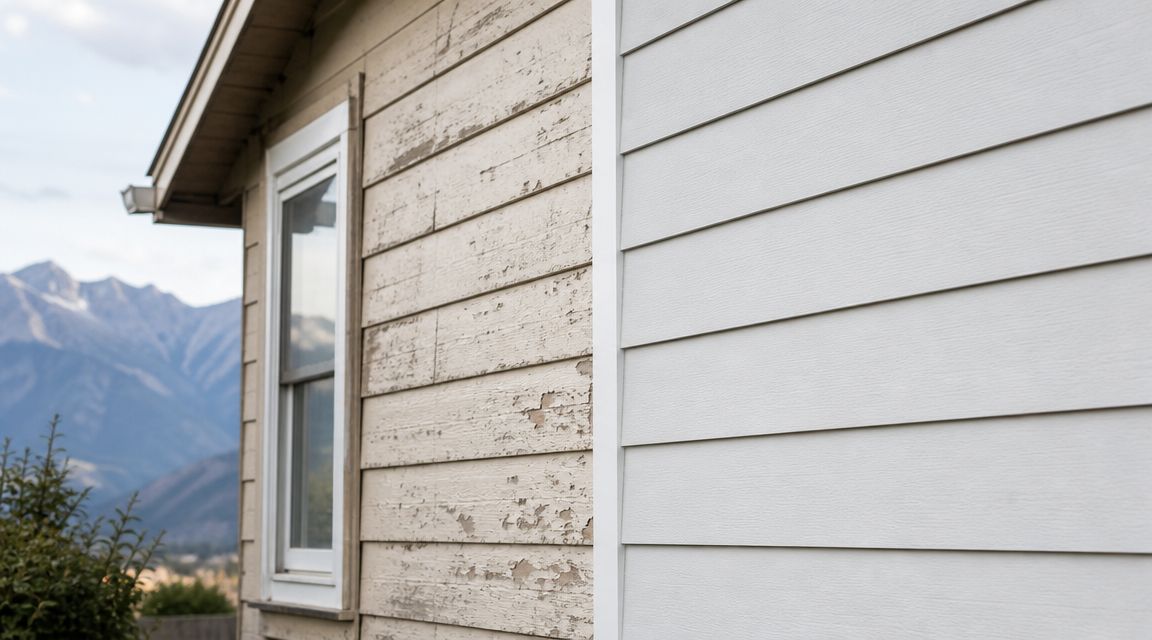
A lot of Utah siding replacements start the same way. A homeowner walks the perimeter and sees a house that looks acceptable from the curb, but up close the story changes. Paint is burning off faster on the south and west walls. Bottom edges are soft or split. Window trim has been recaulked more than once, and the same joints keep reopening after another winter.
That pattern usually points to more than worn paint. On older Utah homes, tear-off often exposes swollen sheathing, missing kick-out flashing, housewrap details that were never lapped correctly, or repairs around windows and doors that were covered instead of fixed. Homeowners who choose fiber cement are often trying to solve both problems at once. They want a durable finished exterior, and they want the wall behind it rebuilt the right way.
Why it fits Utah homes
Fiber cement is a good match for this climate because Utah is hard on exterior materials. Freeze-thaw cycles punish edges and joints that hold moisture. High UV exposure fades finishes and dries out sealants. Seasonal wind pushes dust and weather into weak transitions around trim, roofs, and penetrations.
Homeowners usually choose it for a few practical reasons:
- It handles weather exposure well. It feels solid on the wall and holds up better than lighter products that can look tired fast in strong sun and wind.
- It gives better fire resistance than wood-based siding. That matters more now in many parts of Utah.
- It does not create the same maintenance cycle as wood. You still need paint, caulk maintenance, and inspections, but you are not signing up for the same rot and insect concerns.
- It keeps a painted, substantial look. Many homeowners want the appearance of painted wood siding without the same vulnerability at every cut edge and butt joint.
There is a trade-off. Fiber cement is heavier, more labor-intensive to install, and less forgiving of sloppy workmanship. If the crew misses flashing details, skimps on clearances, or installs it over bad substrate, the product will not save the job. A good result depends on what happens before the new boards go up.
That is why experienced homeowners often end up here. They are not only buying new siding. They are buying a full exterior reset, including tear-off, inspection, repairs where needed, and installation details that can stand up to Utah weather for years.
What Is Fiber Cement and How Does It Protect Your Home
Fiber cement is a cementitious composite made from sand, cement, and cellulose fibers. Think of the cellulose fibers as the part that helps hold the board together under stress, the same way reinforcement helps concrete perform better as a system. The result is a dense, rigid siding product that handles exposure well and keeps a stable appearance over time.
That composition is a big part of why contractors use it on homes where the owner wants a more durable exterior skin. It doesn't attract termites the way wood can. It resists rot better than wood-based claddings. It also handles UV exposure well, which matters in Utah where sunlight is intense for long stretches of the year.
What it does well
The biggest strengths are straightforward:
- Fire performance. Fiber cement is noncombustible and is associated with Class-A fire performance.
- Rot resistance. The material itself isn't the kind of food source that moisture-related decay feeds on.
- Termite resistance. Insect concerns aren't eliminated everywhere in a wall assembly, but the siding itself isn't the attraction.
- UV stability. It holds its look more reliably than materials that tend to become brittle, chalky, or visibly tired under heavy sun.
What it does not do
Many homeowners receive inaccurate information. Fiber cement is not an insulation upgrade by itself. Its insulation value is R-0.15 according to this technical overview of fiber cement siding. That's very low.
If your goal is better comfort or lower utility use, the essential work happens behind the cladding. A good replacement project looks at air sealing, weather-resistive barrier continuity, and, where appropriate, continuous insulation.
Fiber cement protects the house as an exterior cladding. It does not replace the need for a correctly built wall assembly behind it.
How it protects a Utah house in real life
On a Utah home, the protection story usually comes down to two things. First, the board itself stands up well to sun, pests, and general wear. Second, and more important, it creates a durable finished layer over a properly rebuilt water-management system.
That second part matters more than most sales pitches admit. If a contractor treats fiber cement siding replacement like a simple cosmetic swap, the home can still have the same leak paths it had before. Good siding doesn't fix sloppy flashing. Good siding doesn't fix a failed drainage plane. Good siding doesn't fix missing clearances.
When fiber cement performs well, it's because the material and the wall prep are working together.
Comparing Siding Materials for Utah's Climate
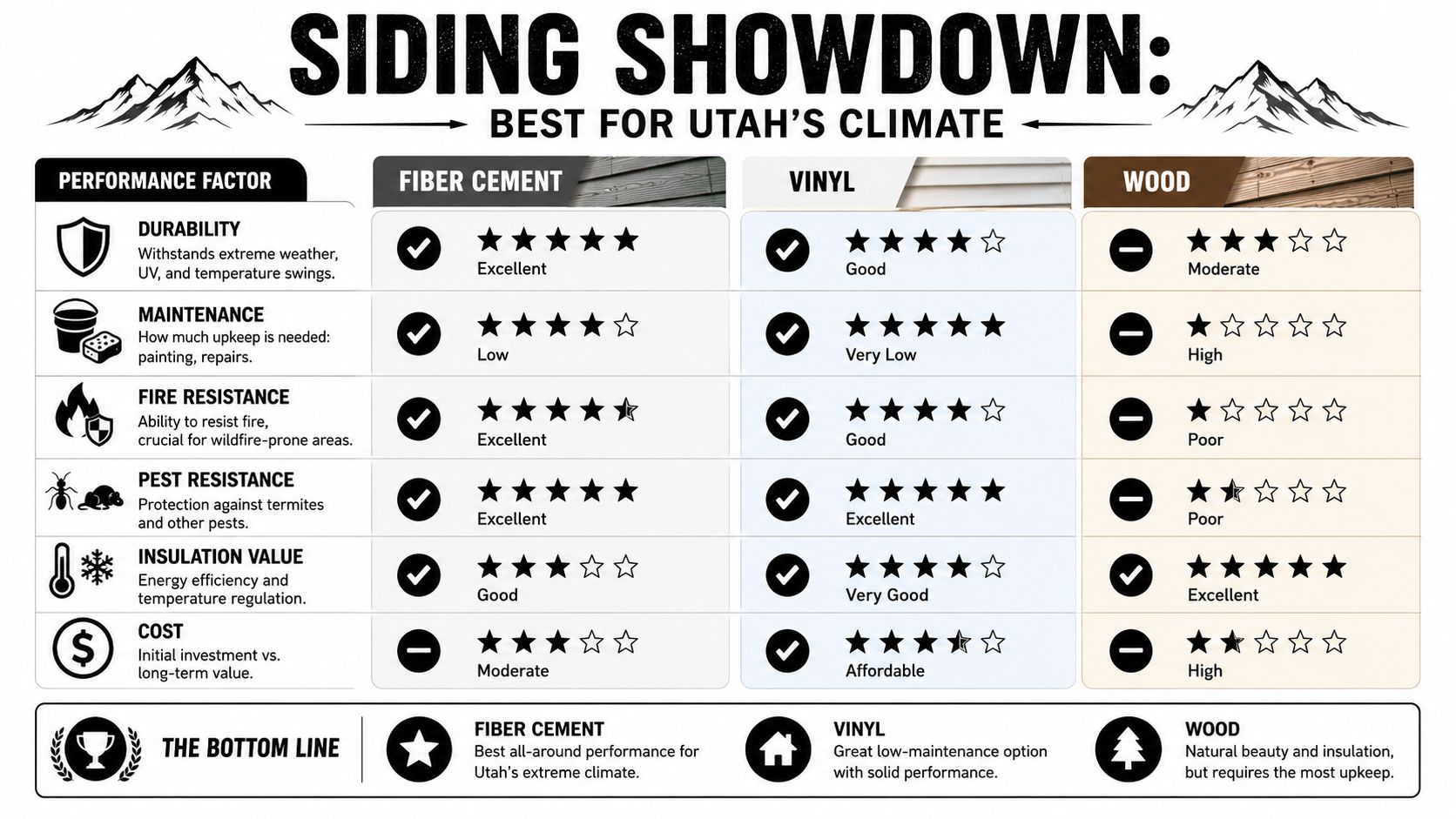
Utah doesn't give siding an easy assignment. High UV exposure dries out finishes. Wind pushes rain where it shouldn't go. Freeze-thaw cycles punish edges, joints, and weak caulking. Hail can turn a small material weakness into visible damage fast.
That's why the right comparison isn't just price or color options. It's how each material behaves after years of sun, winter moisture, and seasonal movement.
Siding material comparison for Utah homes
| Material | Average Cost (Installed) | Durability & Lifespan | Maintenance | Utah Climate Performance |
|---|---|---|---|---|
| Fiber cement | About $5.00 to $14.50 per square foot in industry references, with a more recent national estimate of $8.92 to $14.69 per square foot | Dense, rigid, durable when properly installed over a sound wall system | Moderate. Caulk, paint, and detail maintenance still matter | Strong fit for UV, fire exposure, and long-term exterior wear |
| Vinyl | Qualitatively lower-cost than fiber cement in many markets | Can perform well, but depends heavily on installation and impact exposure | Lower routine upkeep | Can be a practical choice, but heat movement and storm damage trade-offs matter |
| Wood | Qualitatively varies by species and finish system | Attractive, but more vulnerable to moisture and repeated maintenance cycles | Higher maintenance | Looks great when maintained, but Utah sun and moisture cycles are hard on it |
| Stucco | Qualitatively varies by system and wall design | Common in Utah and can last well when detailed correctly | Maintenance often centers on crack management and moisture control | Good local fit in many cases, but repairs can be invasive when failures develop |
Where each one wins and loses
Fiber cement is usually the strongest all-around choice when a homeowner wants a premium exterior with strong fire resistance and better stability in harsh sun. It also works well for homes where wood-look aesthetics matter.
Vinyl appeals to homeowners who want simpler maintenance and lower upfront cost. The trade-off is that it's a lighter cladding with different performance characteristics in heat, wind, and impact situations.
Wood still has a look many people love, especially on older or more traditional homes. But Utah is hard on wood. UV exposure, finish breakdown, and moisture entry at vulnerable joints create a maintenance cycle some homeowners get tired of.
Stucco belongs in the conversation because it's common in this region. It can be a solid system on the right house, but when water gets behind it or cracking becomes recurring, the repair path isn't always simple.
For homeowners who are also weighing exterior materials beyond siding, articles on comparing cedar and treated wood fences can be useful because they frame the same larger issue: appearance, upkeep, and climate exposure rarely point to the same answer.
My contractor view on the choice
If you plan to stay in the home and you care about a durable finish, crisp lines, and stronger fire performance, fiber cement usually earns a serious look. If your top priority is the lowest-maintenance ownership experience, another material may fit better.
The mistake is picking the product before thinking through the assembly. In Utah, the material matters. The flashing details matter more.
Calculating Your Fiber Cement Siding Replacement Cost and ROI
A homeowner in Salt Lake often starts with one question: what is this really going to cost? That is the right place to start, but the number on the proposal only means something if you know what happens after tear-off. On older Utah homes, the siding itself is only part of the job. The wall condition behind it can change the price in a hurry.
Fiber cement replacement usually lands in the mid-to-high range of exterior cladding projects. The final cost depends on board style, trim package, labor, access, and how much repair work shows up once the old siding comes off. If one bid is far below the others, I would expect a gap somewhere in the scope, usually flashing, sheathing repair, trim replacement, or disposal.
What actually drives the price
Square footage matters, but it is not the whole story. Two homes with the same wall area can price very differently if one has simple elevations and the other has dormers, tall gables, stacked windows, and tight roof intersections.
A solid estimate usually accounts for:
- House shape and height. More corners, second-story work, and steep access all add labor.
- Tear-off and disposal. Old siding has to come off cleanly so the crew can inspect the wall and rebuild details correctly.
- Trim and finish carpentry. Window trim, frieze boards, fascia tie-ins, outside corners, and garage door surrounds take time.
- Moisture management details. New house wrap, flashings, kick-out corrections, and proper integration at windows and doors affect both price and long-term performance.
- Substrate repairs. Rotten trim, swollen sheathing, missing blocking, and failed weather barrier sections are common on older homes in this market.
Utah climate adds a layer many online cost guides miss. Freeze-thaw cycles punish walls that already have small water-entry points. High UV breaks down exposed sealants and paint over time. Wind pushes dust and moisture into weak joints. If a contractor prices your project like a simple cosmetic swap, that number may not hold.
Tear-off is where budgets get tested
This is the part homeowners need explained before they sign.
Once the old cladding is off, the crew can finally see whether the wall assembly is sound. On a lot of older homes along the Wasatch Front, we find window head flashing that was never installed correctly, house wrap cut and patched around openings, and sheathing damage at roof-to-wall lines or below leaking windows. Those are not add-ons invented midway through the job. They are existing problems the old siding was covering.
That is why a good proposal spells out how hidden damage is handled. Some contractors include a repair allowance. Others price repairs by sheet, by linear foot, or by time and materials. Any of those approaches can work if they are clear up front.
Cheap quotes usually stay cheap by keeping that part vague.
How to think about ROI
Return on investment is not only a resale calculation. It also includes what you stop paying for. A properly installed fiber cement system can reduce repaint cycles compared with wood, limit recurring patch jobs around failed trim, and lower the odds that small water issues turn into larger wall repairs.
Resale still matters. Buyers notice exterior condition before they notice many interior upgrades. Clean lines, sound trim, straight courses, and crisp window details signal that the house has been maintained. Worn siding, heavy caulk lines, and swelling at butt joints signal future work.
If you are getting the house ready for market, siding works best as part of the full exterior presentation. Some sellers pair replacement planning with cleanup items and services from Sparkle Tech Window Washing because curb appeal is cumulative, not isolated to one project.
What a smart budget looks like
Ask for a base price, then ask what could change it. That second question matters more.
Use these questions when you compare bids:
- What is included at windows, doors, rooflines, and bottom-of-wall terminations?
- Is new weather-resistive barrier and flashing work included, or only siding and trim?
- How are damaged sheathing, framing, or trim repairs priced if tear-off exposes them?
- Who handles paint, caulking locations, and manufacturer-required clearances?
- What will the finished wall assembly look like at transitions, not just in the field of the wall?
A good fiber cement bid should read like a wall repair and cladding project, not a materials list. That is how homeowners in Utah avoid the common mistake of choosing the lowest number first, then paying for the actual work after the house is already open.
Your Step-by-Step Fiber Cement Siding Project Timeline
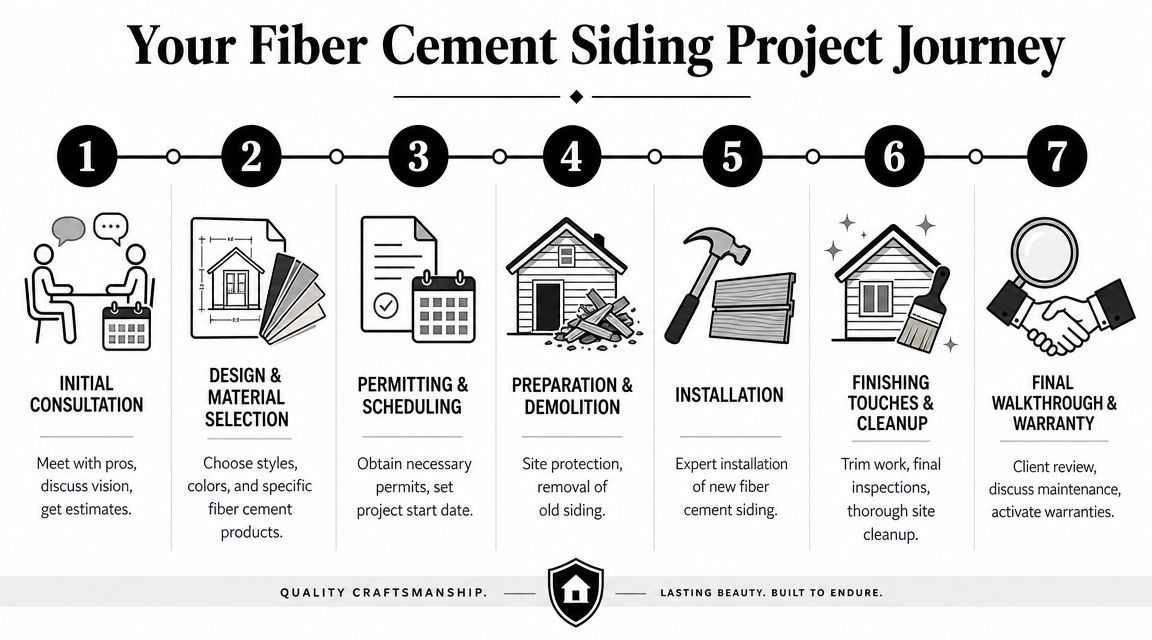
The part homeowners don't see before the job starts is the part that determines whether the project lasts. A proper fiber cement siding replacement is not just hanging new boards. Installation standards require verifying stud layout, rebuilding a continuous drainage plane with flashing and house wrap, and leaving proper gaps for sealant, as explained in this installation-focused video on fiber cement replacement details.
Before the first board comes off
The project should start with an on-site review of the existing house. A good contractor looks at more than color and profile. They look at window trim condition, roof-to-wall intersections, grade clearances, kick-out areas, deck attachments, and any signs that water has been getting where it shouldn't.
Then come material choices, scheduling, and permits where required. This planning stage is where good crews prevent avoidable surprises.
Tear-off is the truth stage
Once the old siding comes off, the wall reveals the full story, commonly exposing what the old exterior had been hiding:
- Failed or missing flashing around windows, doors, and roof intersections
- Worn-out or damaged house wrap
- Soft or stained sheathing
- Trim areas that have been repeatedly caulked instead of rebuilt correctly
In older Utah homes, roof runoff and snow melt are common troublemakers. One small failure at a roof-to-wall junction can leave a long trail of damage below it.
Here's a good visual overview of a siding installation process homeowners often find helpful before work starts:
Rebuilding the wall correctly
After tear-off and inspection, the crew should repair damaged substrate as needed and restore the wall's water-management layers. During these steps, many of the most important details happen.
- Stud layout gets verified. Panels and trim details need solid fastening locations.
- The drainage plane gets rebuilt. New house wrap or equivalent weather-resistive barrier is integrated correctly.
- Flashing gets installed where water travels. Windows, doors, horizontal transitions, penetrations, and rooflines all need intentional detailing.
- Problem trim gets replaced, not disguised. Rotten or swollen trim should not stay buried behind fresh siding.
The wall lasts because water gets directed out. The siding only finishes that strategy.
Installing the fiber cement
Once the wall is ready, the actual cladding goes on. This part still requires precision. Panels or shingles need to terminate on studs. Joints need to be staggered so they don't align vertically. Proper gaps must be left at trim and butt joints so sealant can do its job and movement doesn't force the assembly open.
That's a major reason fiber cement jobs can look similar from the street but perform very differently over time. A neat-looking install can still fail if the joint layout, flashing integration, or clearances were wrong.
Final details and walkthrough
At the end, the contractor should inspect caulked joints, trim transitions, cut edges, fastener treatment, and overall finish consistency. Cleanup matters too. So does the final walkthrough.
If you're evaluating local companies for this kind of work, Superior Home Improvement is one Utah-based option that handles siding replacement as part of broader exterior remodeling. What matters most is that whichever contractor you choose can clearly explain tear-off findings, WRB scope, flashing details, and how they build for local weather instead of only discussing the finished color.
Recognizing the Signs Your Home Needs New Siding
A lot of Utah homeowners call after one wall starts looking rough and assume the fix is limited to that area. Sometimes they are right. In older homes along the Wasatch Front, that first visible problem often points to a bigger issue behind the cladding, especially around window heads, roof-to-wall intersections, and lower wall sections that take snow splash and sun.
The useful question is not whether a board looks bad. The useful question is whether the wall assembly is still shedding water the way it should.
Signs that suggest more than a simple repair
A small, isolated impact crack can often be repaired. These patterns deserve a closer look because they usually mean the failure is repeatable, not cosmetic:
- Staining below windows, belly bands, or rooflines
- Trim that stays swollen, split, or soft near the bottom edges
- One elevation that keeps needing paint long before the others
- Loose boards or movement at joints during windy weather
- Interior drywall stains or a musty smell near an exterior wall
- Repairs that looked fine for a season, then showed the same problem again
That last one matters. If the same area keeps failing, the water entry point is often above or beside the visible damage.
Why these problems show up faster in Utah
Utah weather is hard on siding details. Snow sits, melts, and refreezes. Wind pushes water into weak joints. High UV exposure dries out sealants and beats up south- and west-facing walls.
I see this on older homes where the siding itself gets blamed, but the problem is incomplete flashing or wall sections that were never detailed well in the first place. Tear-off is where that becomes clear. Once the old cladding is off, you may find darkened sheathing, brittle housewrap, missing kickout flashing, or patched areas around windows that never got rebuilt correctly.
When replacement makes more sense than ongoing patchwork
Replacement is usually the honest recommendation when damage shows up in several areas, the home has a history of recurring leaks, or previous repairs have only bought short-term relief. At that point, spending money on scattered patches can keep the house looking acceptable while the wall underneath gets worse.
A good contractor should be able to tell you which category your home falls into. Localized damage is one thing. A wall system with repeated water-entry points is another.
What a good evaluation looks like is straightforward. The contractor checks the failed areas, looks above them for the water path, and explains what may need to be opened during tear-off. If someone bids full replacement without talking about substrate repairs or flashing corrections, or promises a small patch without explaining why the issue is isolated, keep asking questions.
A Homeowner's Checklist for Hiring a Siding Contractor in Utah
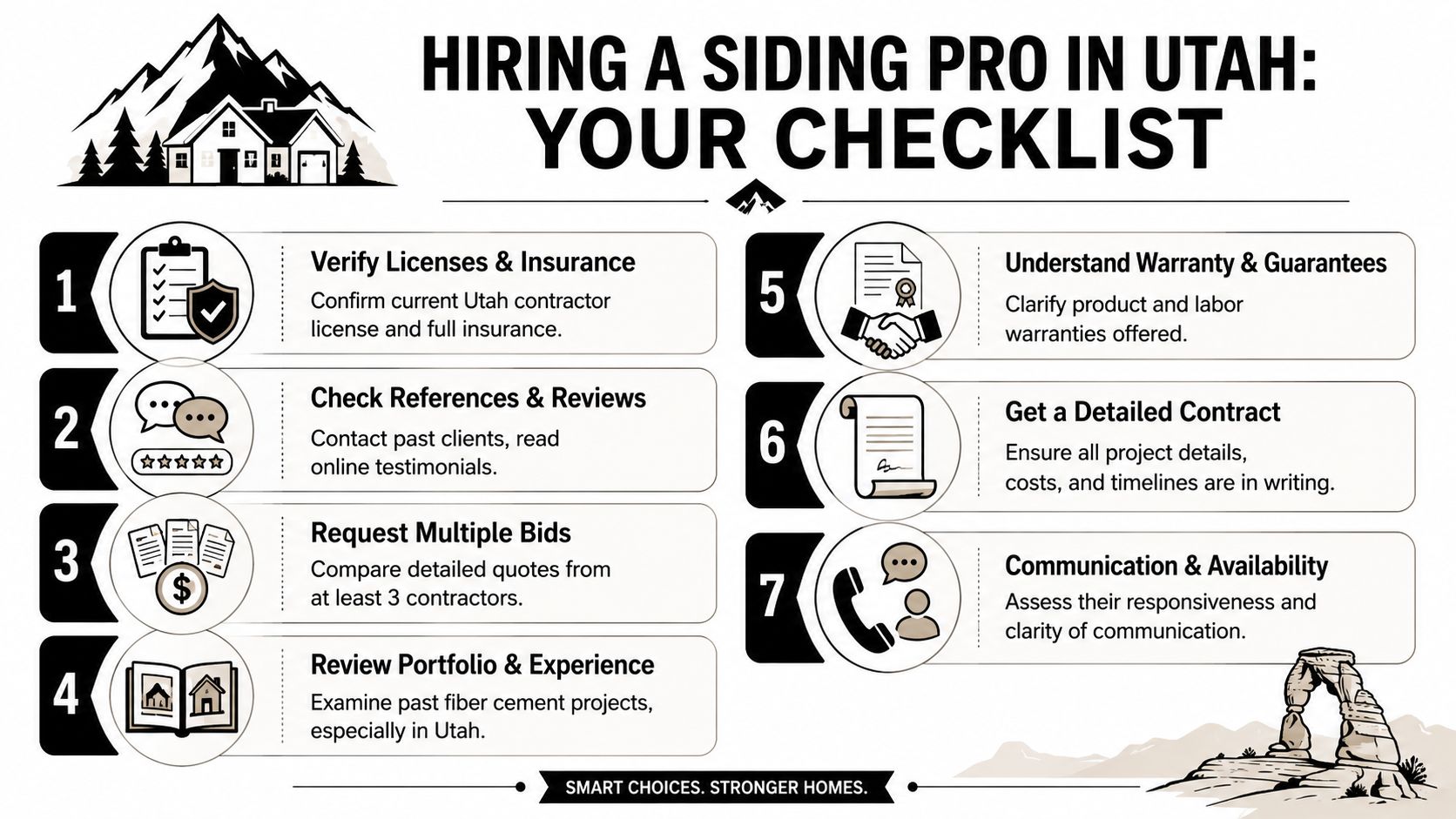
Hiring the right installer matters as much as choosing the material. Utah climate puts extra pressure on detailing, especially around snow melt paths, roof-to-wall transitions, and sun-exposed elevations. A contractor who knows the product but not the local failure points can still leave you with a weak assembly.
Questions that tell you a lot fast
Ask these and listen for specific answers:
- How do you handle flashing at rooflines and window heads? A good contractor should describe details, not just say “we flash everything.”
- What happens if tear-off reveals bad sheathing or failed WRB? You want a clear process, not a shrug.
- How do you manage clearances above roofs, decks, and grade? These details affect long-term moisture performance.
- Where do you fasten and how do you lay out the siding? They should talk confidently about studs, joint layout, and proper spacing.
- Can you show local work that has already gone through Utah winters and summers? Local experience matters here.
What a strong bid should include
A useful proposal should be detailed enough that you can compare scope, not just price.
| What to look for | Why it matters |
|---|---|
| Tear-off and disposal scope | Prevents confusion about what's actually being removed |
| WRB and flashing language | Shows whether the wall system is being rebuilt correctly |
| Repair allowances or process | Tells you how hidden damage will be handled |
| Trim and accessory details | Prevents vague pricing that leads to change orders |
| Cleanup expectations | Important for occupied homes and finished landscapes |
Local experience beats generic promises
Utah homes have recurring pressure points. South and west elevations take hard sun. Snow and ice can load roof edges and dump meltwater where details are weak. Wind exposes sloppy trim and sealant work fast. Ask contractors how they build for those conditions specifically.
Also verify the basics. License status, insurance, references, written scope, and warranty terms all matter. But I'd put equal weight on communication. If a contractor can't explain how they'll protect the wall during fiber cement siding replacement, they probably won't explain surprises well either.
A careful homeowner should expect answers in plain language, not jargon used to avoid the question.
Frequently Asked Questions About Fiber Cement Siding
Can damaged fiber cement be repaired, or does it need replacement
That depends on what failed and why it failed.
A single cracked board from impact can often be replaced without redoing the whole wall. Small nail holes or a limited caulk joint issue can also be addressed as a repair. But bubbling paint, swelling, loose joints, or soft areas usually mean water got past the siding and sat where it should not. In Utah, that problem gets worse once moisture goes through repeated freezing and thawing. In those cases, full board replacement, and sometimes opening a larger section of wall, is the safer fix, as explained in this guidance on how to fix damaged fiber cement siding.
Is fiber cement a good choice for Utah weather
Yes, if it is installed for Utah conditions.
Fiber cement holds up well against strong sun, dry heat, wind, and the seasonal moisture swings we see along the Wasatch Front. It also gives better fire resistance than many siding products and does not attract insects. The catch is installation. If the clearances are wrong, the flashing is sloppy, or the cut edges and joints are handled poorly, even a good product can have a short life.
Will new fiber cement siding lower my energy bills by itself
Fiber cement itself is not the part of the wall that changes efficiency much.
The bigger gains usually come from what happens behind it. Air sealing around penetrations, better weather-resistive barrier detailing, and any insulation upgrades matter more than the siding panel alone. Homeowners usually notice fewer drafts and more even indoor temperatures when those parts of the job are done well.
What should I expect during tear-off
Tear-off is the part many homeowners underestimate.
Once the old siding comes off, the wall tells the truth. On older Utah homes, I often see failed kickout flashing, brittle house wrap, window trim rot, missing head flashing, and sheathing damage near roof lines or bottom courses where snow and splashback have been hitting for years. Some homes only need localized repair. Others need sections rebuilt before new siding goes on. A good contractor plans for that possibility, documents what is found, and explains the repair scope before covering anything back up.
Is a specific brand worth paying more for
Sometimes. The product line can matter, especially for board consistency, finish options, and warranty terms.
Still, brand is only part of the result. A premium board installed over weak substrate prep or poor moisture detailing is still a bad exterior job. I would put more weight on layout, flashing, fastening, clearance details, and whether the installer has real experience with Utah sun, wind, and freeze-thaw exposure.
If you're considering fiber cement siding replacement and want a clear assessment of what's happening behind your current siding, Superior Home Improvement offers Utah homeowners consultations for siding, roofing, windows, and other exterior upgrades. The useful next step is a site visit that focuses on wall condition, flashing details, and whether your project is a straightforward re-clad or a broader envelope repair.