
You've probably had this moment already. A sales rep finishes the quote, you look at the total for replacing old drafty windows, and your brain immediately starts negotiating with itself. Maybe do the front windows now. Maybe wait another winter. Maybe patch the worst one and hope the rest hold on.
That's usually the expensive choice, not the smart one.
In Utah, worn-out windows don't just look dated. They leak heat in winter, let in too much sun in summer, and make rooms harder to keep comfortable. If your home has multiple failing units, dragging the project out often means you keep living with the same comfort problems while costs keep stacking up. Window replacement financing exists to solve that exact problem. It lets you fix the house when the house needs fixing, then match the payment plan to your real monthly budget.
Why Smart Financing Is Key to Your Window Project
Sticker shock is normal. Whole-home window replacement is a major purchase, and most homeowners don't keep that kind of cash sitting around for a single exterior upgrade. That doesn't mean the project is out of reach. It means you need to pay for it the right way.
I'll be blunt. Financing is no longer some fringe option for people who can't plan ahead. It's become a standard part of how homeowners buy big-ticket improvements. One industry analysis says companies that offer financing see a 40% increase in close rates, a 35% increase in average project size, and that 75% of homeowners view payment options as a critical factor when choosing a contractor. The same analysis says 68% of homeowners would replace all windows at once if financing were available, which tells you exactly how people think when the payment barrier comes down (BuyFin industry analysis).
What homeowners usually get wrong
A lot of people ask, “Can I afford new windows?”
That's the wrong question. Ask, “What's the smartest way to pay for a project I already know I need?”
Replacing one or two windows now and the rest later can feel safer. In practice, it often creates mismatched products, repeated installation disruption, and a home that still underperforms because the weakest windows are only part of the problem.
Practical rule: If several windows are failing at the same time, evaluate the full project first and the payment method second. Don't let payment structure force a bad scope decision.
Why financing changes the math
Financing turns a large upfront bill into a planned monthly expense. That matters because windows affect your day-to-day life immediately. You feel the draft. You hear the street noise. You watch one room stay too hot while another stays too cold.
The homeowners who make the best decisions usually treat financing as a tool, not a verdict on their finances. They use it to get the whole project done correctly, on a timeline that fits the home, instead of waiting until another season of utility waste and comfort complaints pushes them into a rushed choice.
Exploring Your Primary Financing Paths
Not all financing is equal. Some options are built for convenience. Some are built for low borrowing cost. Some are only smart if you're disciplined enough to pay them off fast.
The main split is simple. Secured borrowing uses your home as collateral. Unsecured borrowing does not. That's why home equity loans and HELOCs typically come with lower pricing, while personal loans usually cost more because the lender is relying on your credit profile instead of the property. That's the core tradeoff noted in Andersen's financing overview.
Window replacement financing options at a glance
| Financing Type | Typical Interest Rate | Best For | Key Consideration |
|---|---|---|---|
| Contractor financing | Varies by program | Homeowners who want simple application and project-based payment plans | Read the promo terms carefully |
| Personal loan | Typically higher than equity-based options | Homeowners without usable equity or who want fast unsecured approval | Monthly payment may be higher |
| Home equity loan | Generally lower than unsecured options | Homeowners with equity who want fixed payments | Your home secures the debt |
| HELOC | Generally lower than unsecured options | Staged projects or homeowners wanting flexible draws | Rate structure may change over time |
| Credit card | Varies widely | Small partial projects or very short payoff plans | Dangerous if balance lingers |
Contractor financing
This is often the easiest path for window projects because it's tied directly to the job. You choose the product, approve the scope, and apply for a payment plan through the contractor's financing partner.
That convenience matters more than people admit. You're not trying to piece together one loan for windows, another for trim work, and a separate card for surprise carpentry. You're keeping the project under one umbrella.
Contractor financing is usually a good fit if you want:
- A simpler process: You'd rather handle the quote and payment plan together.
- Project-specific terms: Promotional periods or fixed monthly payments can be easier to budget around.
- Speed: You want the work moving soon, not after weeks of bank paperwork.
Personal loans
A personal loan is the cleanest unsecured option. No home equity required. No property lien. No need to risk the house for the project.
That simplicity comes at a price. Because the loan isn't backed by collateral, lenders usually charge more than they would for equity-based borrowing. If your credit is strong and the project size is moderate, a personal loan can still make sense. If the project is large, the monthly payment can get heavy fast.
Home equity loans and HELOCs
These are the strongest options when your priority is borrowing efficiency.
A home equity loan gives you a lump sum and a fixed repayment structure. It works well when your project scope is clear and you want payment predictability.
A HELOC is more flexible. It can help if your window work is part of a broader exterior upgrade and you need room for scope changes. That said, flexibility can tempt homeowners into loose budgeting.
If you're comparing structures and want a plain-English resource to understand second charge mortgages, that guide is useful because many homeowners confuse home equity borrowing with refinancing when they're very different decisions.
Secured borrowing usually wins on cost. Unsecured borrowing usually wins on speed and simplicity. Pick the one that matches your actual constraint.
Credit cards
For most full window projects, I don't recommend them.
A card can work for a small partial replacement, a deposit you'll clear quickly, or a short-term bridge if you already have cash arriving. It's a poor fit for a whole-home project if you don't have a reliable payoff plan. One missed assumption and you've turned windows into revolving debt.
My recommendation
Use this order of operations:
- Start with contractor financing if you want the most direct, least complicated process.
- Compare it against a home equity loan if you have solid equity and care most about long-term borrowing cost.
- Use a personal loan if you need unsecured funding and want a straightforward fixed payment.
- Avoid relying on credit cards unless the balance will disappear quickly.
Decoding Sample Payments and Project Budgets
Loan terms matter more than most homeowners expect. The window package may stay the same, but your monthly obligation can look completely different depending on the structure you choose.
Here's a visual example built around a $15,000 whole-home project.
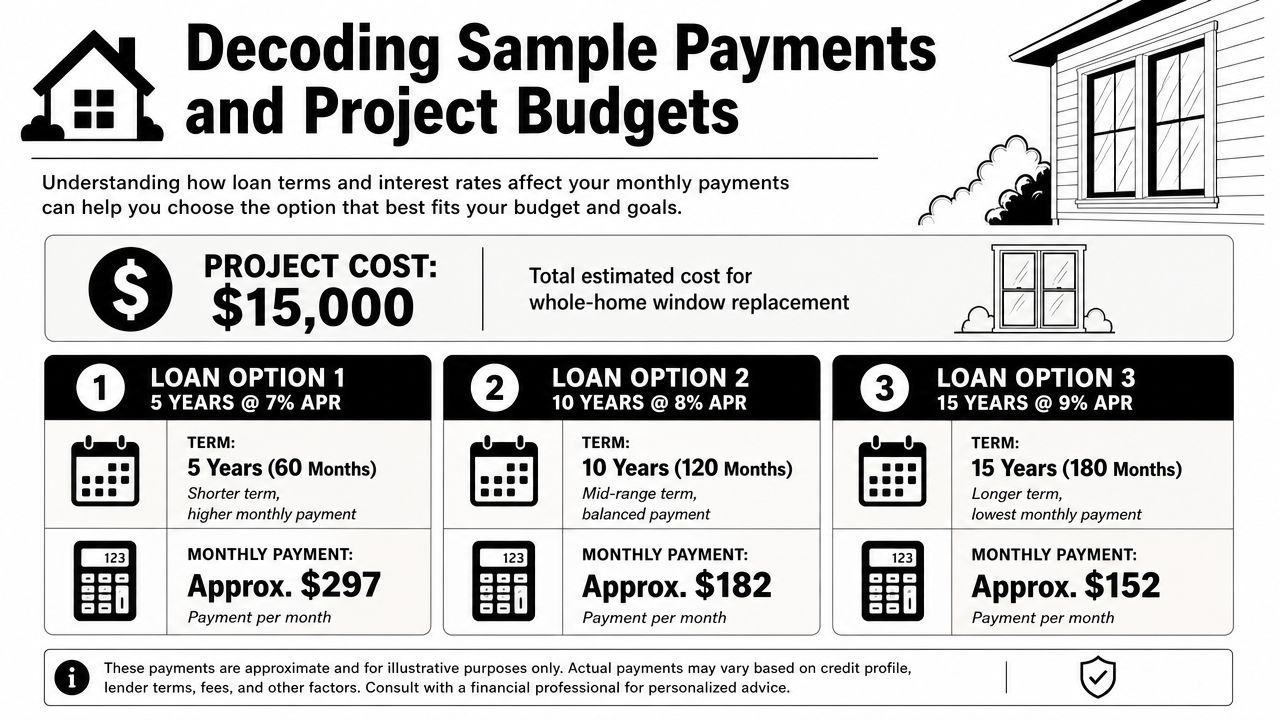
What shorter terms really do
A short term gives you a higher monthly payment, but you get out of debt faster and pay less in finance charges. That's why a same-as-cash offer can be powerful if you already know the money is there to wipe out the balance before the promo window closes.
Industry examples show exactly that tradeoff. A 12-month same-as-cash option minimizes finance charges, while longer fixed-APR terms such as 60 months at 6.99% or 180 months at 11.99% lower the payment but raise the total repaid over time (Energy Swing Windows financing examples).
How to choose the right payment structure
Don't pick the lowest monthly payment by default. Pick the payment you can sustain comfortably without stretching the rest of your budget thin.
Use this filter:
- Choose the shortest term if your income is steady and you want the cheapest path overall.
- Choose a mid-range term if you need breathing room but still want to control total borrowing cost.
- Choose a long term only if cash flow is the main issue and the lower payment solves a real budget problem.
A better way to budget the project
Individuals often make one of two mistakes. They either focus only on the monthly number, or only on the total cost. You need both.
Build your budget around these questions:
- Can I handle the payment during a high-utility month?
- Will this term still feel manageable if another home expense pops up?
- Am I using a long term because it helps, or because I didn't shop enough options?
If you answer those truthfully, the right loan usually becomes obvious.
How Rebates and Tax Credits Lower Your Loan Amount
The smartest financing plan often starts before the loan paperwork. If you can reduce the amount you need to borrow, every payment decision gets easier.
That's where incentives matter. For qualifying products, the federal Energy Efficient Home Improvement Credit can cover 30% of the cost of eligible window replacements, with the window portion capped at $600 per year, and it's available through 2032 for windows that meet specific ENERGY STAR requirements (Ridgetop Exteriors credit summary). That's not a side note. It directly affects how much of the project you may need to finance.
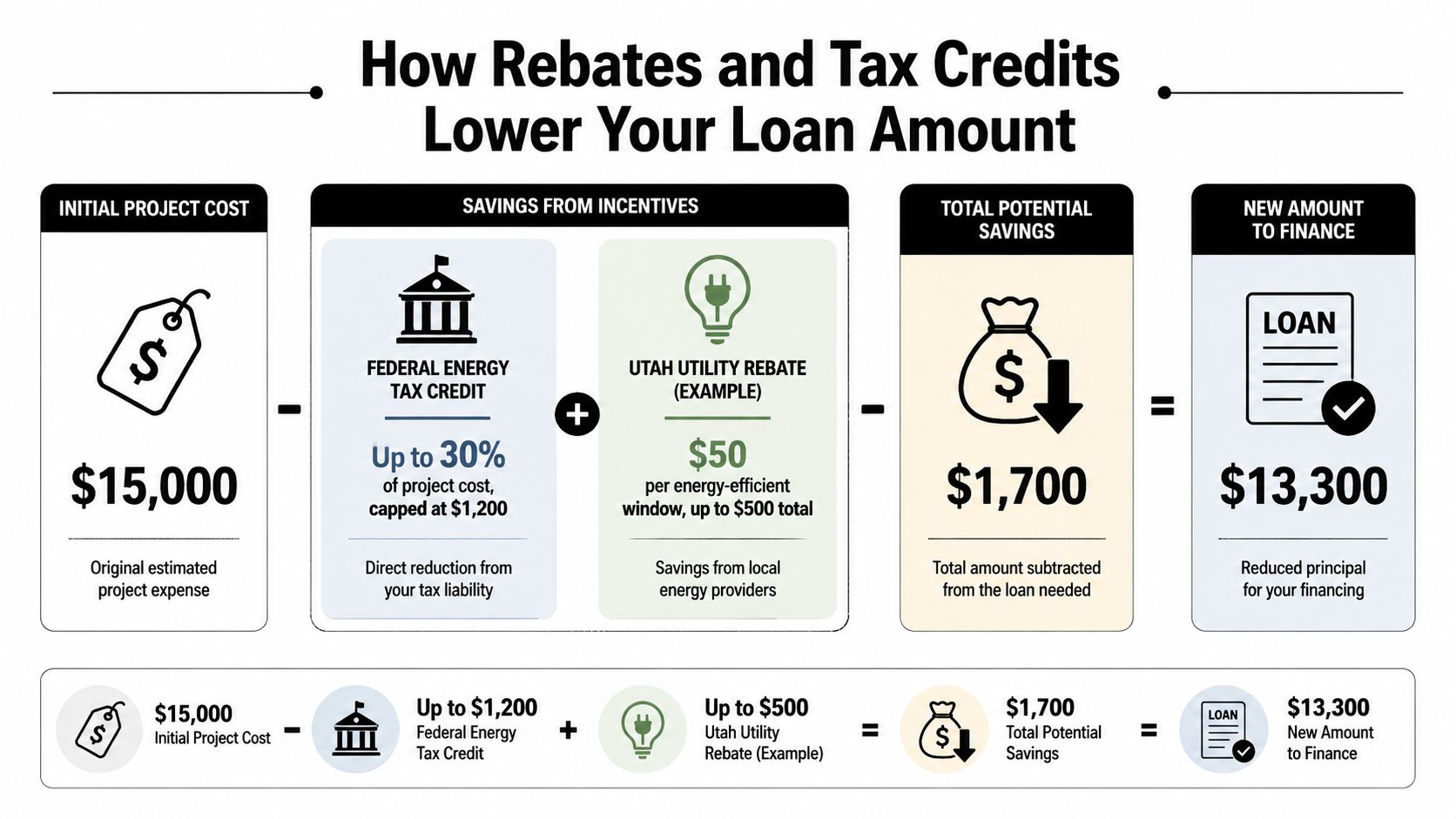
Start with the federal credit
Here's the practical takeaway. If your windows qualify, the credit can reduce your net out-of-pocket cost after tax treatment. For a homeowner financing a project, that matters because you're not waiting only on long-term energy savings to justify the job. You may have a near-term tax benefit changing the economics sooner.
That same source also notes projected energy savings can reach up to $465 per year, which can help offset monthly loan payments when the project is financed instead of paid in one lump sum.
Be careful with rebate assumptions
You'll hear people talk about state rebates, local utility incentives, seasonal manufacturer offers, and utility-company promotions. Some may exist at a given time. Some may not. Some apply only to certain products or income-qualified programs.
I'm not going to invent a Utah rebate chart just to make the article look complete. The practical move is better than that.
Use this checklist before you sign:
- Ask for the exact product certification so you can confirm ENERGY STAR eligibility.
- Request model numbers in writing if you plan to claim a tax credit.
- Verify current utility incentives directly with the provider before building them into your budget.
- Finance the net realistic amount, not the hopeful amount. If a rebate isn't confirmed, don't count it yet.
Borrow against what you know, not what you assume. Tax credits and rebates are useful only when the product, timing, and paperwork all line up.
My recommendation for Utah homeowners
Treat incentives as a principal-reduction strategy.
If your quote is already near the top of your comfort range, don't ignore available credits and then borrow the full amount out of habit. Build the project around qualifying energy-efficient products, understand what documentation you'll need, and structure the financing around your likely real cost after legitimate incentives are considered.
That's how you keep window replacement financing from becoming more expensive than it needs to be.
Your Application and Approval Checklist
Getting approved isn't mysterious. Most financing delays happen because homeowners apply before they've gathered the documents or before they understand the project scope.
The fastest approvals usually come from people who look organized on paper. Lenders want to see that you know what you're buying, what it costs, and how you'll repay the debt.
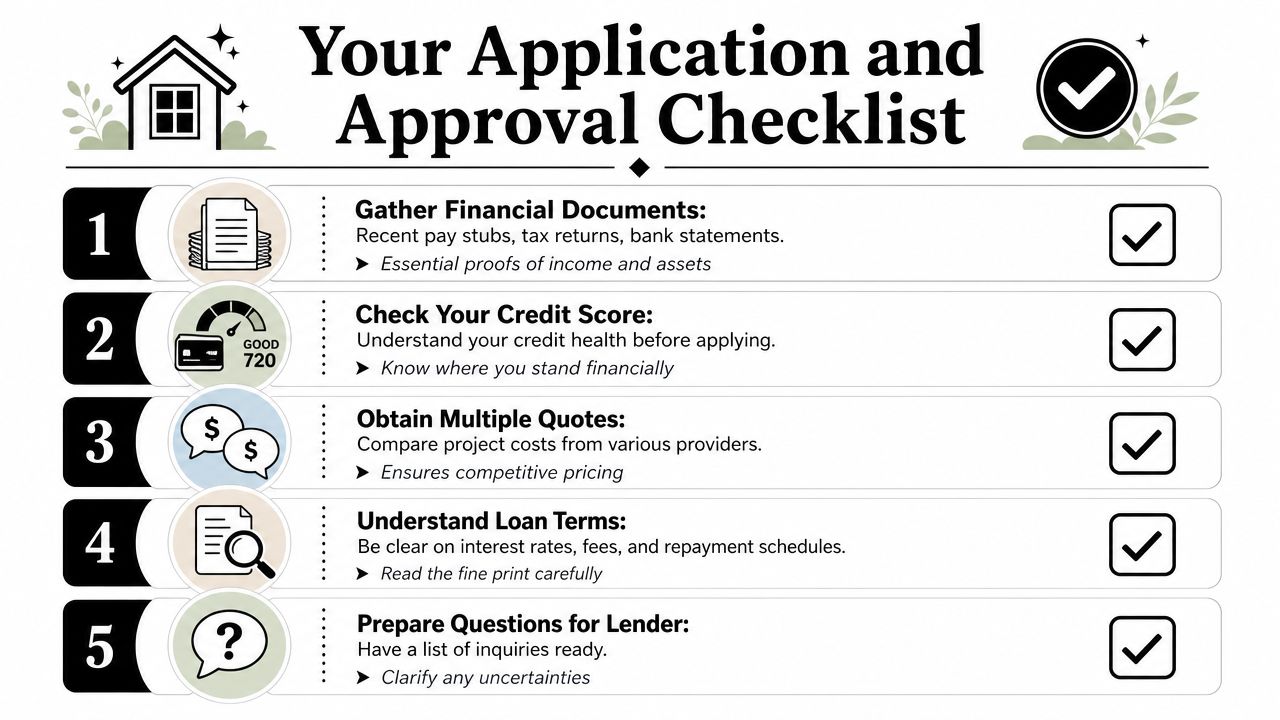
What to gather before you apply
Bring the basics together first:
- Income records: Recent pay stubs, tax returns, and any other proof of consistent income.
- Bank information: Enough account history to show reserves and payment reliability.
- Property details: Your address, ownership information, and mortgage information if equity borrowing is on the table.
- A real project quote: Not a rough verbal estimate. Get a line-item proposal that explains what's being installed.
A detailed quote does more than satisfy the lender. It protects you. It forces clarity on product scope, installation method, and project boundaries before you lock in payments.
Questions you should ask the lender
Don't stop at monthly payment. Ask better questions.
- Is the rate fixed for the full term, or can it change?
- Are there fees, deferred-interest clauses, or payoff penalties?
- What happens if installation timing shifts?
- How long is the approval valid?
A low payment can hide an expensive loan. Read the repayment rules, not just the headline offer.
Approval mistakes I see all the time
Homeowners hurt their own financing odds by doing simple things badly.
The common problems are:
- Applying too early: They don't yet have a final scope, so the numbers are shaky.
- Applying everywhere at once: That creates unnecessary confusion.
- Ignoring the full contract: They focus on product upgrades and skim the financing terms.
- Shopping payment, not value: They chase the cheapest monthly number without looking at installation quality or warranty protection.
If you want smoother approval, get organized first, then compare offers with a calm head.
The Superior Home Improvement Advantage in Utah
Financing only makes sense if the project itself holds up. That's the part too many homeowners skip. They compare lenders and monthly payments, but they don't spend enough time asking whether the windows, installation, and warranty support the debt they're taking on.
That question matters even more in Utah. Our homes deal with hot summer sun, winter cold, dry air, and wide temperature swings. A weak installation or mediocre product can turn a financed project into a long-term headache.
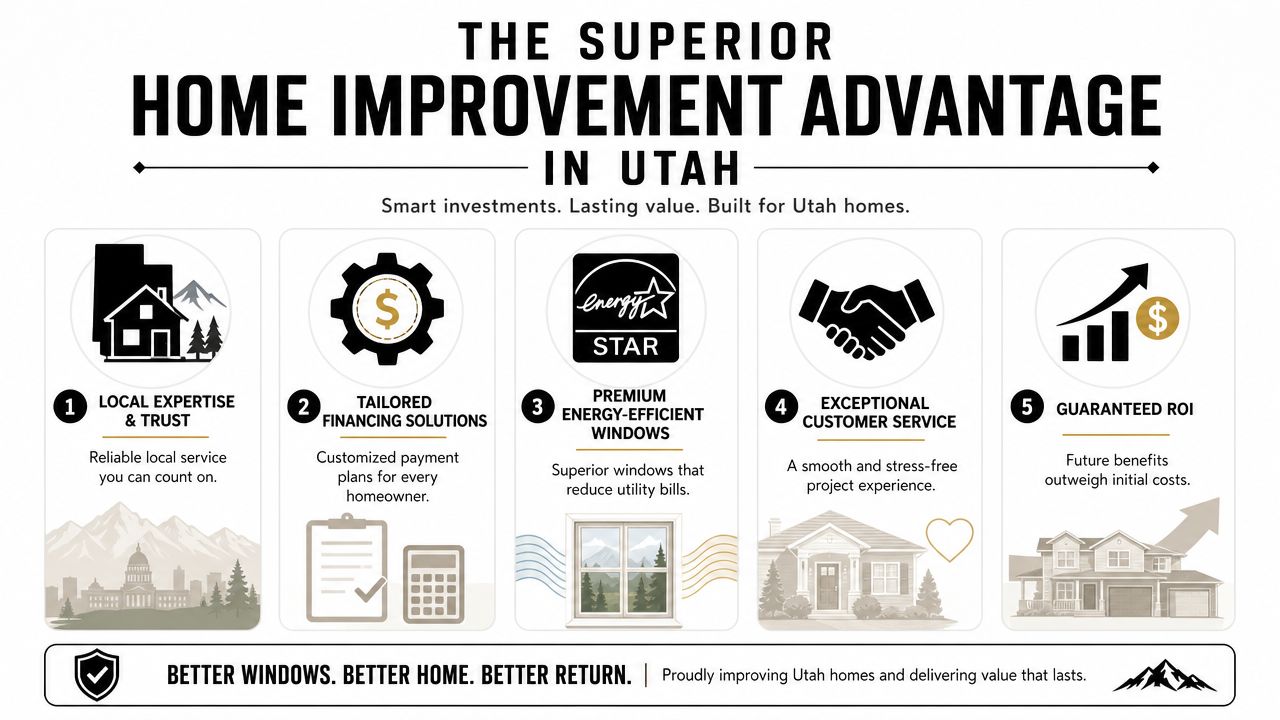
Why written performance matters
One of the biggest unanswered questions in window replacement financing is whether the project will really pay you back through lower utility bills. Industry guidance points out that the U.S. Department of Energy recognizes potential comfort and efficiency gains, but actual savings depend on climate, window type, and installation quality. That same guidance makes an important point: a contractor's written guarantee on energy reduction can provide the clear financial payback homeowners want when deciding whether financing is just a cash-flow tool or something closer to a self-liquidating investment (Glass Doctor discussion of financing payback).
That's why I care about guarantees and warranties more than glossy brochures.
What makes the financial decision stronger
Superior Home Improvement is one Utah option that matters in this conversation because its published company information describes an Energy Conservation Program with utility savings guaranteed in writing and product selections built for Utah's climate, along with lifetime warranty coverage on exterior products (Superior Home Improvement). If a contractor puts performance expectations in writing and backs the installation over the long haul, financing becomes easier to justify.
Here's my opinion. If you're borrowing for windows, don't borrow for uncertainty.
Look for:
- Written energy-performance commitments: Verbal promises don't help once payments begin.
- Strong warranty coverage: A financed product should be protected for the life you expect to own it.
- Utah-specific installation knowledge: Climate matters. Sun exposure matters. Air sealing matters.
My bottom-line view
A loan by itself is never the value. The value is a durable installation that improves comfort, controls operating costs, and doesn't leave you paying for callbacks.
If you can pair the right financing structure with a contractor who stands behind performance in writing, that's when window replacement financing starts to look less like a burden and more like a disciplined home investment.
Frequently Asked Questions About Window Financing
Can I finance only part of a window replacement
Yes. You can finance a partial project if that's what fits your budget or addresses the most urgent failures first. Just be careful. Partial replacement solves a short-term problem, but it can leave older weak windows dragging down comfort and efficiency in the rest of the home.
Does financing change my window warranty
The loan itself usually doesn't create the warranty. The product manufacturer and installer do. Read both documents carefully so you know what's covered, how labor is handled, and whether transfer rules apply if you sell the home.
What happens if I sell my house before the loan is paid off
That depends on the loan type. Unsecured loans generally stay with you personally. Equity-based loans are tied more directly to the property and sale process. Ask this question before signing, not after listing your home.
Is window replacement financing worth it if energy savings are uncertain
Yes, if you're using financing as a cash-flow tool for a project the home already needs. No, if you're assuming utility savings alone will automatically erase the loan cost. The smart move is to evaluate comfort, urgency, product quality, and warranty protection together.
If you're comparing window replacement financing in Utah and want a quote tied to real product specs, written scope details, and a payment strategy that fits your budget, talk to Superior Home Improvement. A clear estimate and the right financing structure can turn a delayed project into a practical upgrade you can move on now.