
You walk outside, look up at your house, and wonder whether the siding still has life left in it or whether you're throwing money at repairs that won't hold. That question comes up a lot in Utah, especially after a stretch of hard sun, winter freeze-thaw, and wind-driven storms that hit the same walls year after year.
Siding rarely fails all at once. More often, it gives you a trail of clues first. Some are obvious from the street. Others stay hidden until moisture, pests, or air leaks have already pushed the problem past a simple patch. Knowing when to replace siding isn't about chasing cosmetic perfection. It's about figuring out when the exterior is no longer protecting the structure and no longer helping the house perform the way it should.
Red Flags You Can See From the Curb
Start with a slow walk around the house. Stand back first, then move in close. The big goal is simple: separate isolated wear from signs that the siding system is breaking down across large areas.
Cracks, gaps, and loose panels
A single cracked vinyl panel after a storm doesn't always mean full replacement. Localized impact damage can often be repaired. What changes the decision is pattern.
If you see cracking in multiple areas, loose sections, holes, or missing pieces on more than one elevation, the material may be getting brittle and unreliable. Once siding opens up in several places, the wall assembly is exposed to water, wind, and pests.
For homeowners handling a very small vinyl issue, this guide on Bulls Eye Repair for siding fixes is useful for understanding what a true spot repair looks like. It also helps you see when a repair is just a stopgap.
Warping, buckling, and distorted lines
Warped siding is one of the easiest problems to spot from the curb. Look along the wall line. If the courses look wavy, bowed, or pushed outward, that usually means something deeper is wrong.
Sometimes poor installation causes buckling. In other cases, moisture behind the siding swells the substrate and forces panels out of plane. Either way, warped siding isn't just a cosmetic defect. It means the system isn't lying flat and sealing correctly.
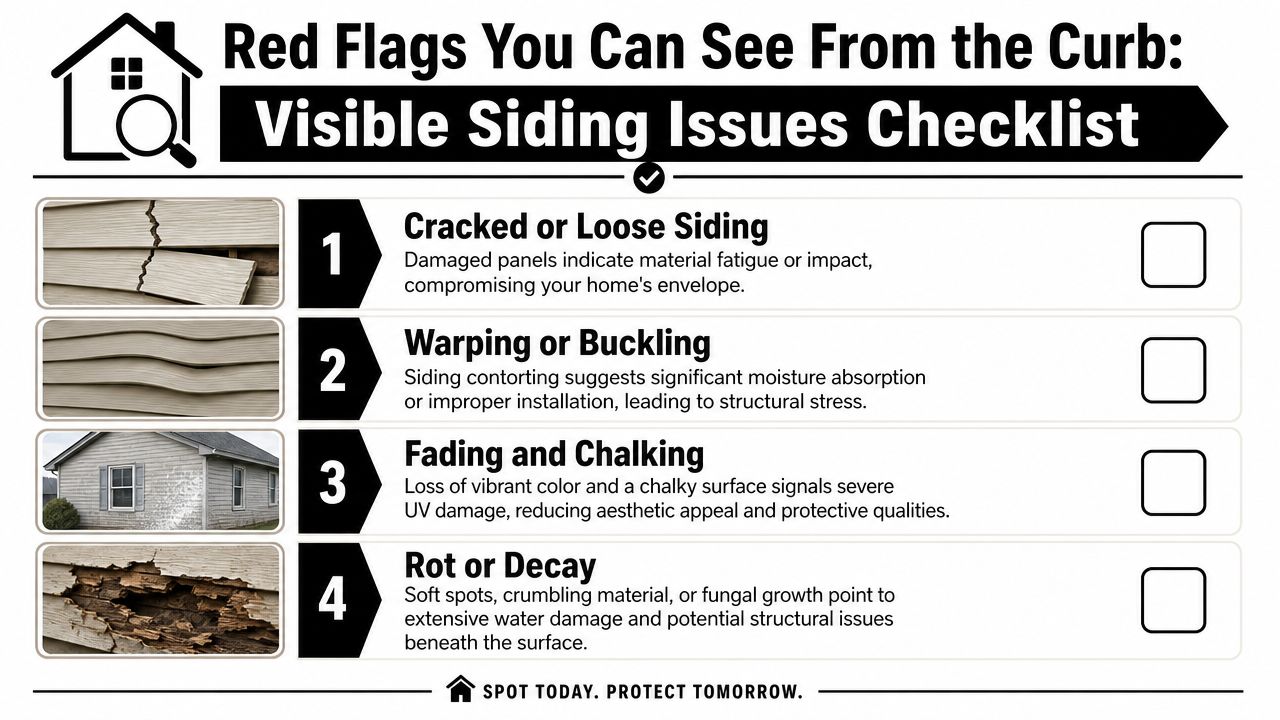
Fading, chalking, and surface breakdown
Utah sun is hard on exterior finishes. A house that looks washed out, uneven in color, or leaves a chalky residue on your hand is telling you the surface protection has worn down.
Fading by itself doesn't always force replacement. But when fading comes with brittleness, cracking, or recurring seam issues, it usually means the siding has aged past the point where it can keep doing its job. What homeowners often call "just old siding" is often the early stage of broader failure.
Practical rule: Cosmetic damage stays on the surface. Functional damage opens the wall to water, air, or pests.
Rot, soft spots, and visible decay
Wood and composite products often telegraph trouble around lower walls, trim, corners, and openings. If you see swollen edges, peeling finishes, fungal staining, or crumbly sections near the ground, assume moisture has been active for a while.
A hands-on check matters here. If any area feels soft, spongy, or crumbles under pressure, moisture has already penetrated the surface layer and compromised the underlying structure, which points to replacement rather than patch repair according to Energy Home Improvements' siding guidance. The same source notes that when rot, buckling, and pest entry show up together across large sections, repairs have usually run their course.
The Hidden Dangers Lurking Beneath Your Siding
The siding itself is only the outer skin. What matters more is what it's protecting. Once that outer layer fails, the damage usually moves inward before a homeowner sees it.
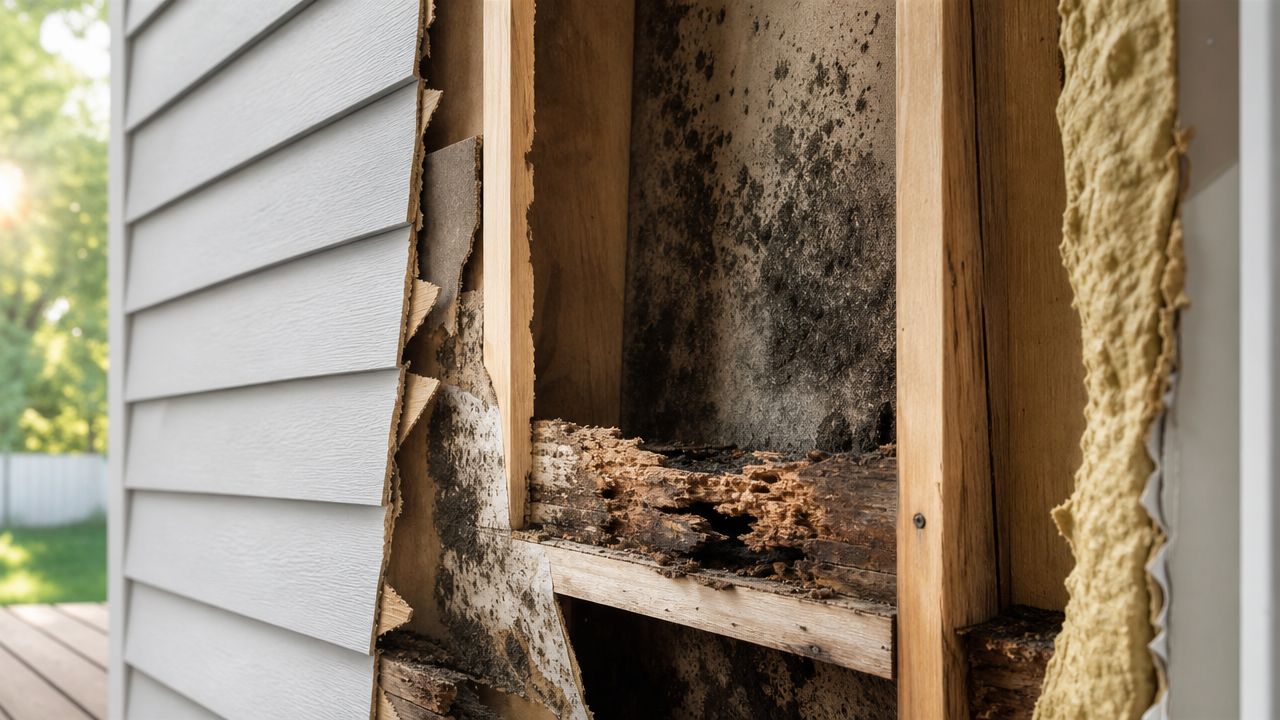
Moisture doesn't stay where it enters
Water rarely announces itself at the entry point. It slips behind a loose joint, around a failed seam, or through a damaged panel, then travels along sheathing, framing, and insulation. By the time you see a stain indoors, the wall may have been wet for a long time.
That matters in Utah because homes cycle through snow, spring runoff, summer heat, and freeze-thaw conditions that stress any weak spot. Wet materials expand, contract, and break down faster under those swings.
One technical threshold is worth knowing. Siding should be replaced immediately when moisture content in the wood substrate exceeds 19% by weight, measured under ASTM D4444 standards, because that indicates substrate compromise and possible sheathing or framing rot, as outlined by the National Siding Authority on repair versus replacement.
Energy loss starts in the wall assembly
Homeowners often notice the utility bill before they notice hidden wall damage. Failing siding creates pathways for outside air to move into the wall cavity and for conditioned air to leak out. Wet insulation also loses effectiveness.
That doesn't mean siding alone does all the insulating. It doesn't. But the siding, housewrap, flashing, and substrate all work together as part of the home's exterior envelope. When one part fails, the whole wall performs worse.
If you're trying to understand how non-obvious problems can hide behind finished surfaces, thermal imaging can be useful for detecting hidden electrical issues and other concealed anomalies. The same general idea applies to exterior diagnostics. Surface clues often point to deeper conditions you can't see with the naked eye.
Pests use small openings
Insects and rodents don't need much of a gap. Once siding pulls away, cracks, or develops holes, pests use those openings to get into the wall cavity. Then the repair stops being about a panel and starts being about the condition of the assembly behind it.
Water damage behind siding often costs more to correct than the visible siding problem that allowed it in.
A quick visual overview helps homeowners understand how hidden wall issues develop after exterior failure:
Siding Lifespan by Material and Utah Climate
If you're trying to decide whether age alone should concern you, the answer is no. Age is a benchmark, not a verdict. But it is a very useful benchmark.
What the lifespan ranges actually mean
Most siding types last 20 to 40 years, depending on the material and local weather conditions. Vinyl siding typically lasts 20 to 30 years, while fiber cement can extend to 40 years with proper care according to Window World Philadelphia's guidance on replacement timing. In the same source, a common contractor benchmark for replacement is when damage affects roughly 20% to 25% of the total surface area.
Those ranges matter in Utah because local climate pushes materials differently than a mild coastal market would. Intense UV exposure can dry out finishes and increase brittleness. Wind stresses seams and edges. Freeze-thaw cycles test anything that already has a moisture pathway.
Material choice isn't just about appearance
Vinyl works well for homeowners who want a lower-maintenance exterior and clean appearance. The trade-off is that older or heavily sun-exposed vinyl can become brittle. Once that happens, spot repairs may continue, but matching color and maintaining integrity gets harder.
Fiber cement is a strong option when durability is the priority. It handles weather exposure well when installed correctly and maintained properly. The trade-off is weight, installation precision, and the need for a contractor who knows how to manage flashing, clearances, and cuts correctly.
Composite systems sit in a middle ground for many homes. Performance depends heavily on the specific product, installation quality, and exposure. In Utah, the best results usually come from pairing the siding choice with good moisture management details around trim, windows, roof intersections, and grade lines.
Siding Material Lifespan & Performance Comparison
| Material | Typical Lifespan (Years) | Maintenance Level | Average Installed Cost (per sq. ft.) | Best For |
|---|---|---|---|---|
| Vinyl | 20–30 | Low | Qualitatively varies by product, installer, and wall conditions | Homeowners who want low upkeep and straightforward replacement |
| Fiber cement | Up to 40 with proper care | Moderate | Qualitatively varies by product, installer, and wall conditions | Homes exposed to tough weather and owners prioritizing durability |
| Composite systems | Qualitatively varies | Moderate | Qualitatively varies by product, installer, and wall conditions | Owners balancing appearance, performance, and maintenance |
In Utah, the same siding product can age very differently on a shaded north wall than on a west-facing wall that takes afternoon sun and wind.
A practical way to use lifespan data is this:
- Know the install year: If the siding is approaching the expected end of life, inspect more aggressively.
- Look at exposure, not just age: South- and west-facing walls usually show trouble first.
- Track recurring repairs: If the same elevations keep failing, the house is telling you the issue isn't isolated anymore.
The Financial Case for Siding Replacement
A siding project is never just about looks. The real financial question is whether you're spending money to solve a problem once, or spending money repeatedly while the underlying problem grows.
Repairs are cheaper until they aren't
Patch repairs make sense when damage is isolated and the surrounding material is still sound. They stop making sense when a contractor keeps returning to the same walls, when color matching is poor, or when each repair exposes more deterioration underneath.
The hidden cost isn't always in the visible panel. It's in wet sheathing, damaged trim, compromised insulation, and labor that keeps stacking up without restoring full protection. Waiting can turn a controlled exterior project into a broader wall repair.
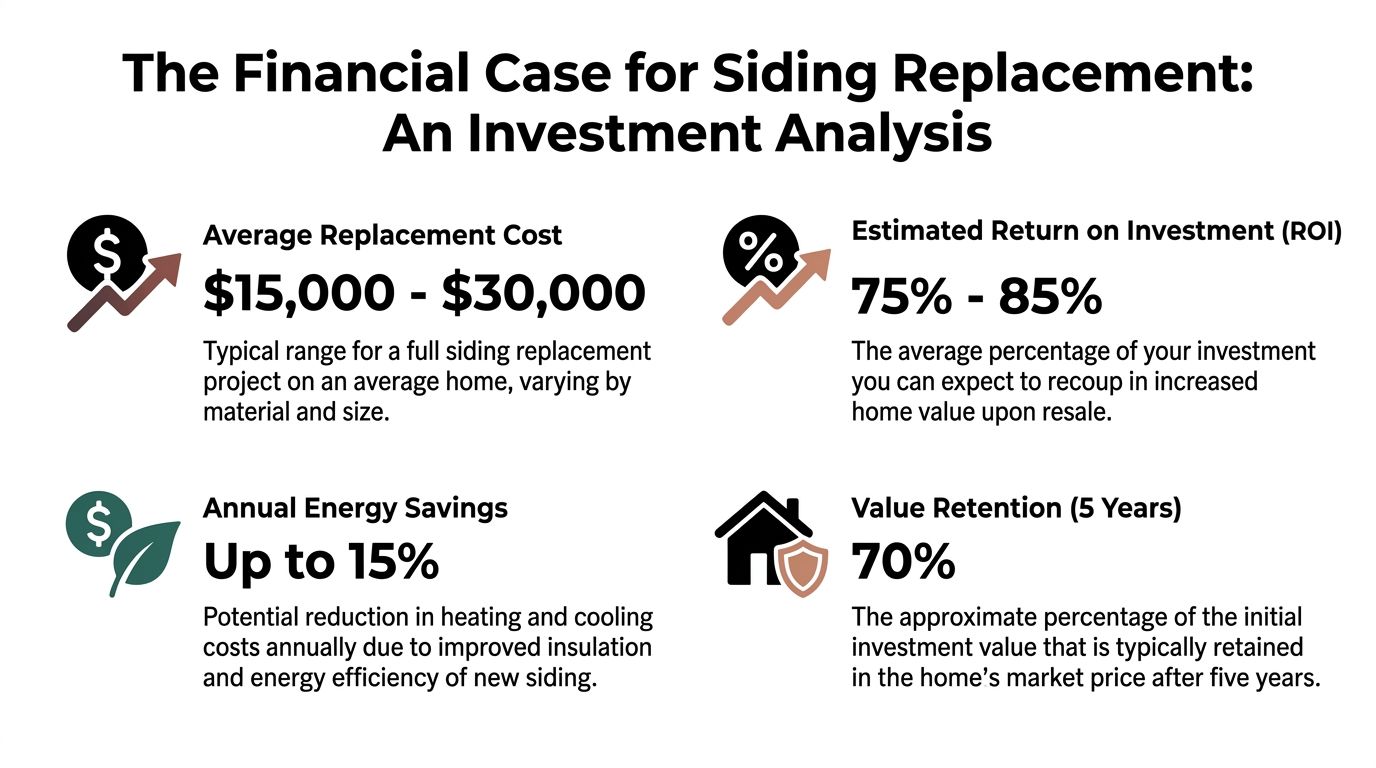
Where the value actually comes from
Homeowners usually evaluate siding through three lenses:
- Protection of the structure: New siding restores the wall's ability to shed water and resist weather.
- Reduced maintenance burden: A full replacement stops the cycle of chasing scattered trouble spots.
- Exterior presentation: Fresh siding changes how the house reads from the street and during resale conversations.
The energy side matters too, but it's important to be precise. Better siding systems help when they are installed as part of a properly sealed exterior assembly. The gains come from tighter detailing, better weather barriers, and correcting failures behind the cladding, not from the panel alone.
Why Utah homeowners often feel the difference
On many Utah homes, older siding isn't just worn out. It's paired with dated trim details, tired sealants, and exterior gaps that let wind and temperature swings work on the wall assembly all year.
That means replacement often solves several problems at once:
- It removes compromised material before moisture reaches framing in a bigger way.
- It gives the installer access to the wall so damaged sections can be corrected.
- It improves the envelope when flashing, wrap, and transitions are rebuilt properly.
If your "repair" doesn't restore the weather barrier, it isn't really a repair. It's a delay.
The strongest financial argument is usually simple. If the siding has stopped protecting the home and the same problem areas keep coming back, replacement isn't an upgrade decision anymore. It's an asset-protection decision.
How to Plan Your Siding Replacement Project
Once you've decided replacement is the right move, the next step is planning the job so the installation quality matches the investment. Good projects don't happen by accident. They happen because the homeowner asks the right questions before tear-off starts.
Choose the season carefully
In Utah, stable weather matters. Installers need workable conditions for tear-off, substrate inspection, flashing, trim integration, and final sealing. Moderate temperatures are usually easier on materials and field conditions than extreme heat or deep winter cold.
Ask the contractor how weather affects their sequencing. A good crew should be able to explain how they protect exposed walls, what they do if moisture is found, and how they handle interruptions.
Coordinate with adjacent exterior work
Siding doesn't live alone. It meets roofing edges, window flanges, doors, trim boards, soffits, and foundations. If you're already planning exterior improvements, bundling them can make the wall assembly more coherent and reduce rework later.
A coordinated approach is especially useful when any of these are on your list:
- Window replacement: This allows the installer to tie flashing and trim details together cleanly.
- Roof work: Roof-to-wall intersections and kickout flashing should be evaluated at the same time.
- Trim replacement: Fascia, corner boards, and water-table details often need attention with new siding.
Review the paperwork before materials arrive
A reliable siding contract should tell you more than the total price. It should explain scope, product line, trim details, disposal, substrate repair allowances, warranty terms, and who is responsible for permits.
Ask for clarity on these points:
- Manufacturer warranty coverage: Know what is covered by the product and what depends on installation.
- Labor warranty terms: This should be separate from the material warranty.
- Permit responsibility: The contractor should explain what local approvals are required.
- Change-order process: If concealed damage appears after tear-off, there should be a defined approval path.
The best time to talk about hidden damage is before the old siding comes off, not after the dumpster is already in the driveway.
Expect a real wall inspection
A professional replacement project should include inspection of the layers behind the old siding once they are exposed. That's where decisions get better. If sheathing is wet, trim is rotted, or flashing is missing, you want that corrected before the new cladding covers it up.
Homeowners often feel more comfortable once they understand the sequence. Tear-off, inspection, repairs, weather barrier work, flashing, siding installation, detail work, and cleanup should all be spelled out in plain language.
Hiring the Right Siding Contractor in Utah
The contractor you choose matters as much as the product on the wall. Good siding installed badly will still fail. Average siding installed with disciplined flashing, moisture control, and finish work will usually outperform expectations.
What to verify before you sign
Start with the basics, but don't stop there. A contractor should be properly licensed where required, carry liability coverage, and carry workers' compensation insurance. They should also have local project experience that matches Utah weather conditions.
Then look at how they estimate. Vague lump-sum bids create problems. A better proposal breaks out materials, trim scope, removal, disposal, wall prep assumptions, and what happens if concealed damage is uncovered.
For homeowners who want a broader framework for vetting service providers, this outside guide offers practical advice for homeowners hiring. It's useful as a checklist while you compare bids.
The estimate should answer real questions
Ask the contractor to walk you through the proposal line by line. You want to hear direct answers about product brand, housewrap approach, flashing details, corner treatment, caulking strategy, and cleanup.
A strong contractor should also be able to explain:
- How they handle moisture discoveries once old siding is removed
- Who supervises the crew on site
- What local references they can provide
- How warranty service works if an issue appears after completion
Local knowledge shows up in the details
Utah isn't a forgiving climate. Contractors who understand local exposure patterns build differently. They pay attention to sun-hit elevations, snow splash zones, drainage near grade, and wind-stressed corners.
That's the difference between a bid that sells siding and a bid that solves the wall assembly.
Key Questions Before You Commit to Replacement
Can I replace siding on just one wall
Sometimes, yes. If the damage is clearly isolated and the rest of the house is still in good shape, one-wall replacement can be reasonable. The trouble is matching profile, color, age, and thickness.
If the damaged wall is the first visible sign of wider aging, a partial replacement may only postpone the larger project. Ask whether the remaining elevations are still sound or haven't failed yet.
Will insurance cover siding replacement
That depends on the cause of damage and your policy terms. Sudden storm or impact damage may be treated differently than long-term wear, moisture intrusion, or neglected maintenance. A contractor can document visible conditions, but coverage decisions belong to the insurer.
Read the policy language carefully and ask your adjuster how matching issues are handled if only part of the exterior is approved.
Can new siding go over old siding
Sometimes local conditions and product rules allow overlay methods, but that doesn't make it the best choice. Installing over old siding can hide moisture issues, preserve uneven walls, and make flashing corrections harder.
If there is any sign of substrate damage, rot, or trapped moisture, full tear-off is the safer path. You want the installer to see the sheathing and rebuild the weather barrier correctly.
How do I know whether repair is still worth trying
Use a simple test:
- Repair makes sense when the issue is isolated, recent, and surrounded by healthy material.
- Replacement makes sense when problems repeat, spread, or involve moisture and structural concerns.
- Inspection is mandatory when the surface looks manageable but the wall feels soft, drafts are noticeable, or interior staining has appeared.
What should I ask during the first appointment
Keep it practical. Ask what material you have now, what visible signs suggest replacement, whether they expect hidden damage, and how they would detail the wall for Utah weather.
Also ask one question many homeowners skip: what doesn't need to be replaced yet? A trustworthy contractor can identify urgency without turning every flaw into a sales pitch.
If you're weighing repairs against a full exterior upgrade, Superior Home Improvement can help you assess the true condition of your siding, explain the trade-offs clearly, and build a replacement plan that fits Utah weather, your home's energy goals, and your budget.