
You're probably looking at the biggest sheet of glass in your home and thinking about the same problems most Utah homeowners run into. The blinds get dusty fast. Someone bends a slat. The sun bakes the room in July, then the glass feels cold in January. And if the patio door faces west or southwest, the afternoon glare can make that whole side of the house harder to live in.
That's why built-in blind patio doors have become such a practical upgrade. When they're chosen well, they solve a real maintenance problem and can improve comfort at the same time. When they're chosen poorly, or installed without enough attention to Utah's climate swings, they become an expensive feature that doesn't deliver much beyond convenience.
The best patio doors with built in blinds aren't automatically the ones with the longest feature list. In this market, the better choice usually comes down to four things: a stable frame, a strong glass package, a reliable blind control system, and installation that keeps the whole unit square and weather-tight through hot summers, cold winters, wind, and high-altitude sun.
| Patio door type | Best for | Main strength | Main trade-off | Utah takeaway |
|---|---|---|---|---|
| Vinyl sliding door with integrated blinds | Budget-conscious homeowners who want low maintenance | Good value, solid thermal performance, easy upkeep | Can feel less rigid on larger openings | Strong fit for many standard openings |
| Fiberglass sliding door with integrated blinds | Homeowners prioritizing long-term stability | Handles temperature swings well, durable frame | Higher upfront cost | Often the better long-term pick in Utah |
| Magnetic slider blind controls | Simplicity and low-tech operation | Fewer user complications, intuitive use | Feel varies by brand | Good for everyday reliability |
| Battery-operated cordless controls | Clean look and convenience | Easy operation, modern feel | More components to service over time | Best only when the service path is clear |
Why Choose Patio Doors with Integrated Blinds
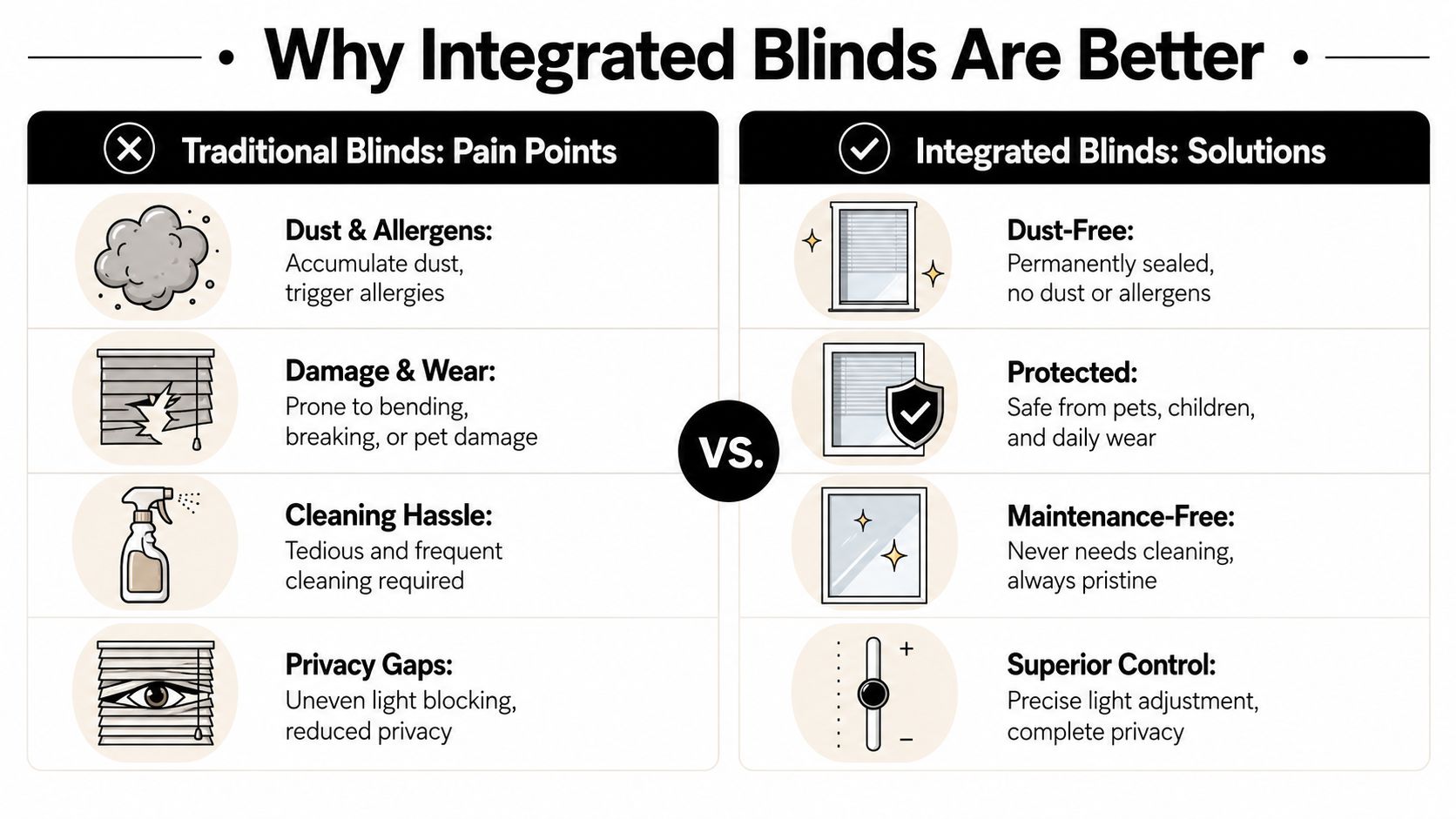
On a January morning in Utah, the patio door gets opened ten times before lunch. Kids head out back, the dog scratches at the glass, cold air rolls in, and the blind hanging over the door takes another hit. By the end of a couple seasons, the usual problems show up. Bent slats, a crooked bottom rail, dust packed into places nobody wants to clean.
Built-in blinds solve a very specific problem. They move the blind system out of the traffic path and seal it inside the glass, where daily use, pets, and wind from an open slider cannot beat it up. For a busy household, that usually matters more than style.
The practical benefits show up fast
In the field, the biggest advantage is reduced wear. Standard blinds at a patio door are exposed to constant movement, strong sunlight, and accidental impact. In Utah, high-altitude UV adds another layer of punishment. It fades finishes faster, dries out cheaper plastic parts, and shortens the life of blinds that would last longer in milder climates.
Cleaning is simpler too. Since the slats are sealed between the panes, they do not collect the same dust and cooking residue that exposed blinds do in a kitchen, great room, or family room. Homeowners who are tired of wiping slats or replacing damaged vanes usually notice the value right away.
There is a trade-off. If the blind mechanism ever fails, you are dealing with a door glass component, not a cheap off-the-shelf blind from a box store. That is why product quality and warranty support matter more here than they do with basic window coverings.
Practical rule: If the old patio door blind failed because people kept hitting it, another exposed blind usually creates the same repair cycle.
Why they fit active homes
Built-in blinds tend to make the most sense in homes with:
- Children and pets: No hanging cords or slats in the main traffic area.
- Frequent patio use: The blind stays protected when the door opens and closes all day.
- Dust or allergy concerns: The sealed design cuts down on surfaces that collect debris.
- Large open rooms: The door looks cleaner, and the glass opening stays visually simpler year-round.
They also pair well with outdoor spaces that get used hard, especially on south- and west-facing elevations where sun control matters in summer. If you are planning the patio and the door together, Woodstock Furniture's outdoor living guide is a useful reference for arranging furniture, shade, and traffic flow around the opening.
A good integrated-blind patio door is not a luxury add-on. In Utah, it is often a durability decision. It cuts maintenance, protects the blind system from daily abuse, and gives the opening a cleaner look without adding another fragile piece to one of the busiest spots in the house.
Decoding the Technology Behind Built-In Blinds
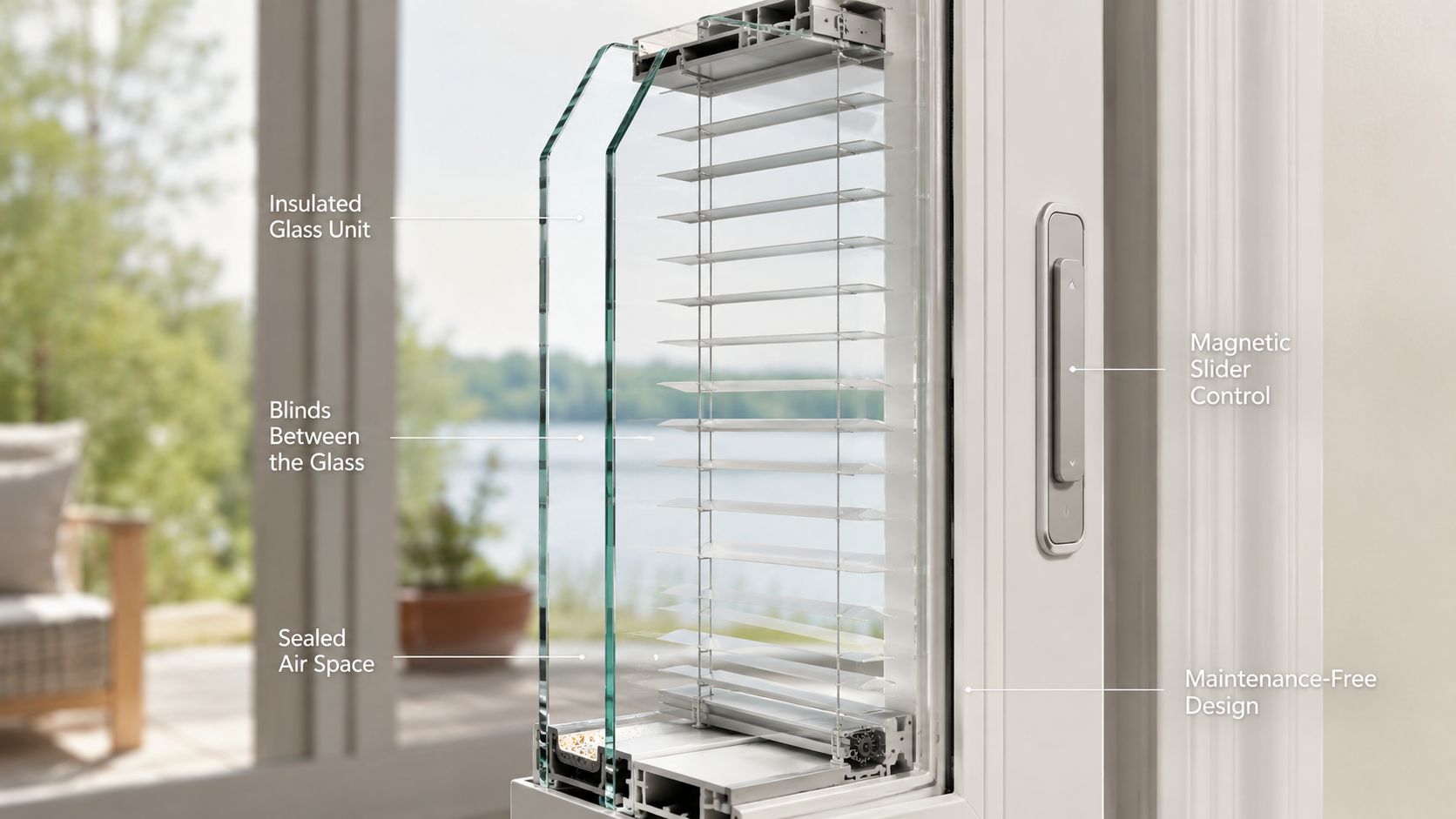
The core system is called blinds-between-the-glass, often shortened to BTG. Once you understand that assembly, it gets much easier to judge which patio door is worth buying and which one is mostly marketing.
What's inside the glass unit
In a BTG patio door, the blind mechanism is sealed inside an insulated glass unit, or IGU. Pella explains that this configuration places the blinds within the sealed glass assembly and uses Low-E glass coatings on the outer panes to reflect infrared heat, which is especially useful in climates with four distinct seasons, as described in its article on between-the-glass blind construction.
That sealed placement does three important jobs at once:
- Protects the blind system from dust, humidity, and physical contact.
- Preserves the look of the door because the blinds can't get twisted or crushed.
- Works with the glazing package instead of acting like a separate add-on.
That last point matters in Utah. You don't want a patio door that's just visually appealing. You want one where the frame, glass, weatherstripping, and shading all support comfort through winter cold and summer sun.
Why the engineering matters
Tempered glass is standard in this category because patio doors need a safer, stronger glazing setup. The blind itself is protected within the cavity, so the common failure points in ordinary door blinds, such as rail binding and cord wear, aren't exposed to daily abuse.
For homeowners comparing integrated blinds with room-side shades, it helps to understand how automated room-side treatments work too. If you're weighing that option, discover seamless automated window treatments for a useful look at how motorized systems differ from sealed in-glass blinds.
A short visual overview helps clarify how these units are assembled and operated:
What to inspect before you buy
When reviewing the best patio doors with built in blinds, don't stop at the brochure photo. Ask about:
- Glass type: Tempered glass is a baseline requirement for this application.
- Low-E package: This is a major part of thermal performance.
- Control method: Simpler systems are often easier to live with long term.
- Serviceability: If the glass unit fails, find out whether the IGU can be replaced without replacing the full door.
The technology is good. The quality depends on how well the manufacturer integrates all the parts.
Comparing Door Materials and Blind Control Systems
Material choice changes how a patio door ages in Utah. A lot of national buying guides treat frame material like a style decision. It isn't. In this climate, it affects expansion, contraction, seal integrity, and how solid the door feels after years of use.
Patio Door Material Comparison
| Feature | Vinyl | Fiberglass |
|---|---|---|
| Insulation | Strong thermal performance | Strong thermal performance |
| Movement in temperature swings | More prone to noticeable expansion and contraction | More dimensionally stable |
| Maintenance | Low maintenance | Low maintenance |
| Surface durability | Good for everyday residential use | Better long-term resistance to wear and distortion |
| Appearance | Clean, practical, often simpler profiles | Usually feels more substantial and upscale |
| Cost | Lower upfront cost | Higher upfront cost |
| Best use case | Standard-size sliding patio doors | Homes prioritizing longevity and climate stability |
Vinyl works well in many homes
Vinyl is still a solid option for many replacement projects. On standard-size sliding patio doors, a good vinyl unit can deliver strong value, low maintenance, and good thermal performance. If the opening isn't oversized and the manufacturer has a decent track record, vinyl often gives homeowners the most practical price-to-performance balance.
Where vinyl can become less appealing is on large openings with strong solar exposure. Utah's intense sun and wide temperature swings can stress cheaper vinyl frames more than homeowners expect. That doesn't mean vinyl is a bad material. It means cheap vinyl is.
Fiberglass usually wins on long-term stability
Fiberglass tends to be the better choice when long-term frame stability matters more than initial price. In a climate with cold snaps, hot afternoons, and significant UV exposure, a stable frame helps the moving panel stay aligned and helps weather seals keep doing their job.
That's one reason many professionals lean fiberglass for premium replacements. The frame generally feels tighter, more rigid, and less likely to develop operational issues over time.
If the opening gets strong afternoon sun, I'd rather have a better frame than an extra decorative feature. Homeowners live with operation every day.
Blind control systems matter more than they look
Most integrated blind patio doors use one of two control approaches. The first is a magnetic slider system, where you move an exterior control along the glass area or frame to raise, lower, or tilt the blind. The second is a battery-operated cordless system, which offers a clean user experience but adds another layer of components.
Here's the trade-off in plain terms:
- Magnetic slider controls: Usually simpler. Less flashy, but often easier to trust over the long haul.
- Battery-operated systems: Cleaner interface and easier movement for some users, but you need a clear plan for maintenance and future service.
- Households with heavy daily use: Simpler control systems often hold up better because there's less to troubleshoot.
- Owners prioritizing convenience: Powered systems can be a good fit if the door brand has dependable support.
Matching the frame to the control system
The best combinations are usually straightforward:
- Vinyl plus magnetic controls: Good value, low complexity, practical for many family homes.
- Fiberglass plus magnetic controls: Strong long-term durability, especially in exposed locations.
- Fiberglass plus powered controls: Better for homeowners who prioritize convenience and are comfortable with a more complex assembly.
What doesn't work as well is buying on appearance alone. A sleek control system won't make up for a weak frame. And a premium frame won't feel premium if the blind controls are awkward or unreliable. The best patio doors with built in blinds balance both.
Evaluating Energy Performance and Security
Step into a west-facing Utah family room at 5 p.m. in July and the wrong patio door shows itself fast. The glass throws heat, the floor near the opening gets hot, and the room never feels balanced no matter how often the blinds are adjusted. That is why energy performance needs to be judged as a full system issue, not a style decision.
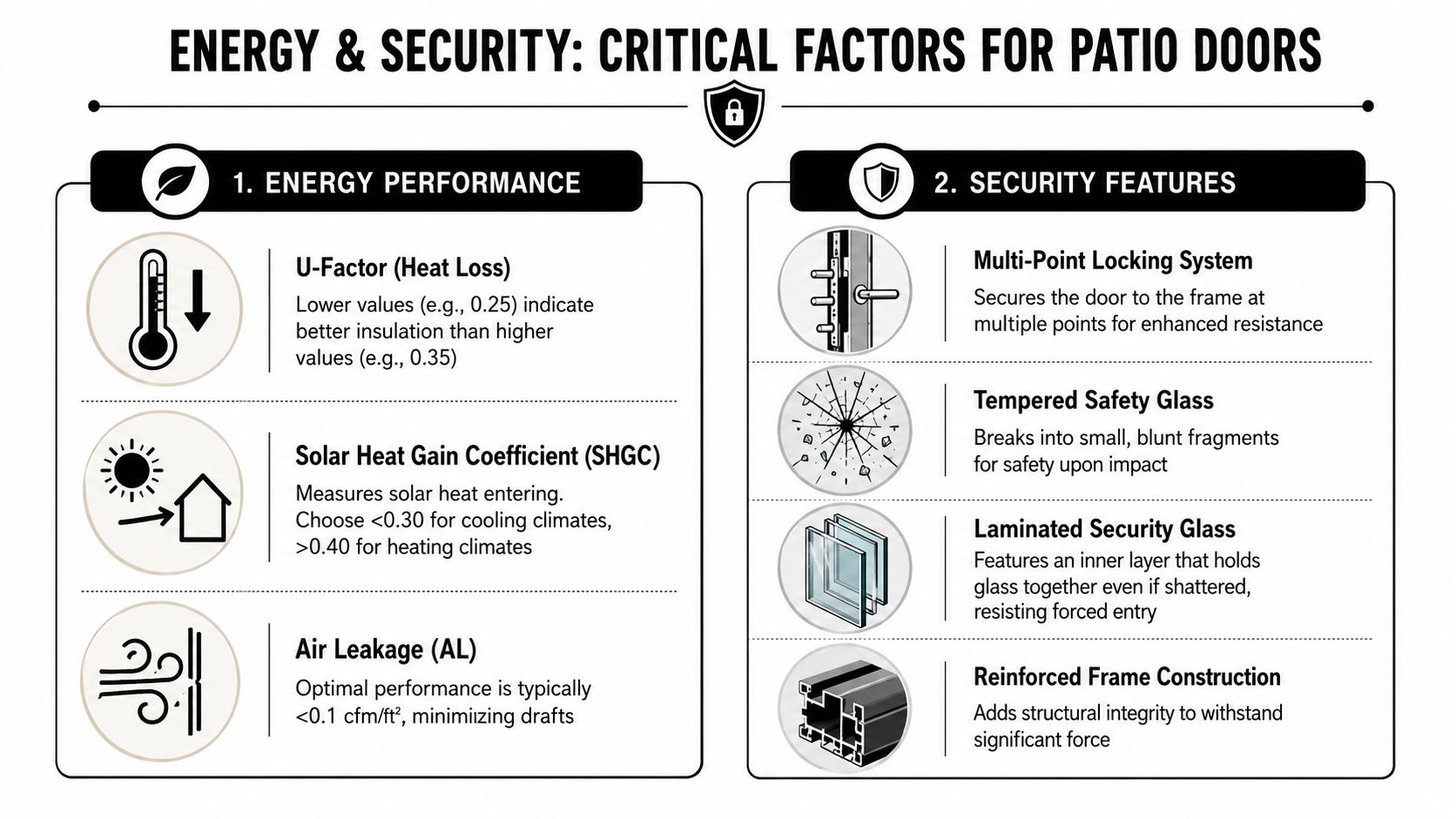
For Utah homes, the two ratings that matter most are U-factor and Solar Heat Gain Coefficient (SHGC). U-factor measures how much heat moves through the door. Lower numbers help in winter, which matters in a four-season climate with cold nights and snow season. SHGC measures how much solar heat the glass allows in. In high-elevation Utah sun, especially on south and west exposures, SHGC often has a bigger day-to-day effect on comfort than homeowners expect.
Stanley Door Products says high-performance patio doors with built-in blinds commonly fall in the 0.25 to 0.30 U-factor range and highlights the safety value of sealed tempered glass construction in its review of patio doors with built-in blinds.
Utah buyers should pay close attention to SHGC
A low U-factor helps retain heat in winter. A well-chosen SHGC can make the bigger difference in summer comfort on exposed glass.
Brennan Corp reports that some sliding doors with built-in blinds can reach SHGC values as low as 0.24 in its analysis of sliding doors with built-in blinds. For homes along the Wasatch Front with strong afternoon sun, that can mean less glare, less overheating near the glass, and more consistent room temperatures through the day.
High-altitude UV adds another layer. Utah sun is hard on interiors, and large patio door openings can accelerate fading on flooring, furniture, and rugs. Built-in blinds help with light management, but the glass package still does the heavy lifting.
Built-in blinds help. The glass still matters more.
This is the part many product pitches blur together. Integrated blinds are protected, clean, and convenient, but they sit inside the sealed glass unit. They improve privacy and light control. They do not block solar gain the same way an exterior product does before the sun reaches the glass.
That trade-off matters on harsh exposures. If a patio door faces west, built-in blinds should be treated as one layer in the system, alongside low-E coatings, gas fill, spacer quality, and frame construction. Homeowners who want another way to cut glare on difficult openings can also review this guide to tinted screens for homeowners.
A good rule is simple. Buy built-in blinds for convenience, cleanliness, and protected operation. Buy the glass package for real thermal performance.
Security starts with construction quality
The blind does not make the door secure. The frame, glass, lock area, and installation do.
Tempered safety glass is the baseline. Stronger frames hold alignment better over time, which matters in Utah where freeze-thaw cycles, wind, and slab movement can expose weak assemblies. A patio door that drags, flexes at the meeting rail, or rattles during a windstorm is not just annoying. It usually points to weaker long-term security and weather performance.
When I evaluate a patio door for security, I focus on these points:
- Tempered safety glass: Required for an exterior glazed door and better for impact safety
- Frame rigidity: Important at the lock side, roller track, and corners
- Lock hardware quality: Multi-point or better-built locking hardware usually gives a more secure feel than a basic latch
- Panel alignment: A door that stays square is harder to force and easier to lock properly
- Privacy control: Integrated blinds let homeowners block visibility without adding loose coverings that leave gaps
A secure patio door feels planted when it moves. It should slide or swing with control, latch cleanly, and stay tight during wind. In Utah, those details usually separate a door that lasts from one that becomes a service call every season.
Understanding Costs and Professional Installation
Built-in blind patio doors usually cost more than comparable units without integrated blinds. That premium is real, and it's justified only when the rest of the door is built to the same standard. If the frame is mediocre or the install is sloppy, the homeowner pays more and gets very little in return.
Stanley Door Products describes BTG doors as carrying a higher initial cost premium, while also calling them an ideal solution for door window coverings because they eliminate hanging-cord hazards and mismatched add-on hardware, and it notes the value of their sealed tempered glass construction for impact resistance in demanding conditions, as covered earlier in the article.
What actually drives the price
The biggest variables are usually straightforward:
- Frame material: Fiberglass generally costs more than vinyl.
- Door size and configuration: Larger openings and specialty layouts raise cost.
- Glass package: Better performance glass usually adds cost.
- Blind control system: Simpler controls are often less expensive to buy and service.
- Brand and dealer network: Some manufacturers price in broader support and warranty infrastructure.
What I'd avoid is shopping by base price alone. A cheap patio door replacement can become expensive once drafts, water intrusion, or panel alignment issues show up.
Why installation decides whether the upgrade pays off
A patio door is only as good as its install. If the unit isn't square, shimmed correctly, and sealed properly at the opening, the homeowner can lose the comfort benefit that justified the purchase in the first place. Rollers don't track right. Locks stop lining up. Air leakage becomes the complaint nobody expected.
This matters even more in Utah, where wind and freeze-thaw cycles expose bad installs quickly.
Installer check: Ask who handles flashing, sill support, perimeter sealing, and final panel adjustment. Those details decide whether the door performs like a premium product or a callback.
If you're trying to reduce glare and heat on adjacent windows too, a separate guide to tinted screens for homeowners can help you compare another shading strategy before you finalize the whole project.
How to Select the Best Patio Door for Utahs Climate
Utah changes the buying equation. High-altitude sun is harsher. Temperature swings are wider. Wind is more of a factor than many national guides admit. A patio door that works fine in a milder climate can feel disappointing here within a few seasons.
That's why I wouldn't choose the best patio doors with built in blinds based on style first. I'd choose them based on how the full assembly handles Utah conditions.
Start with the frame and glass package
For many homes, fiberglass deserves a hard look because it tends to stay more stable through heat and cold. Vinyl still makes sense in many standard openings, but frame quality matters. This is one category where bargain products often reveal themselves later through operation problems.
The glass package should match exposure. On hard west-facing or southwest-facing patio doors, lower SHGC is often the smarter pick because summer heat and glare become the daily complaint. On more protected exposures, balance matters more.
Don't confuse convenience with maximum insulation
Blindsgalore points out that internal blinds sit inside the thermal envelope and may provide minimal resistance to heat transfer compared with external shades that block solar gain before it hits the glass, which is an important distinction for Utah homeowners focused on major utility reduction in its article on patio sliding door options. That's the key local lesson.
If your main problem is broken blinds, dust, and privacy, built-in blinds are a strong answer. If your main problem is aggressive solar heat, then built-in blinds should be paired with the right glazing strategy, and in some homes, additional shading outside the glass may still be worth considering.
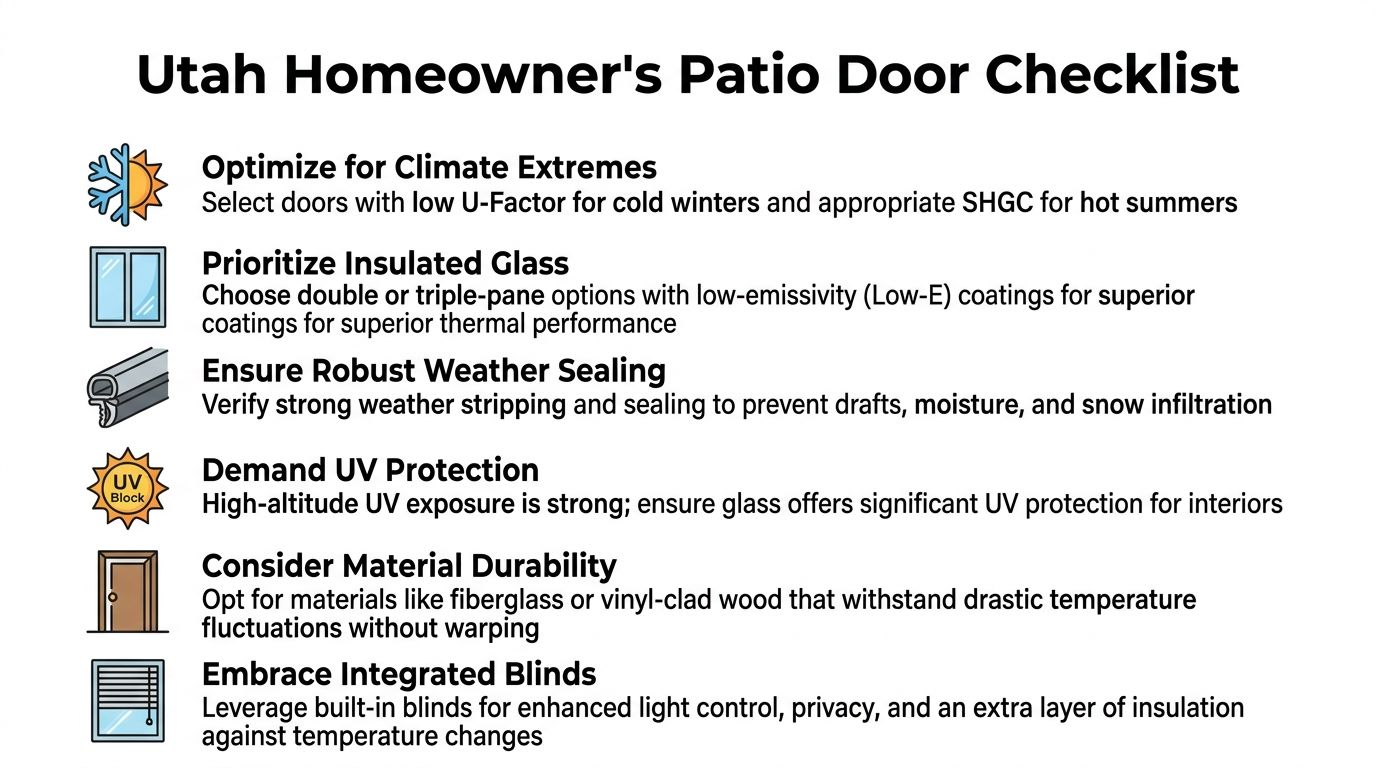
A Utah-specific buying checklist
Use this filter before you sign anything:
- Prioritize frame stability: Especially on sunny exposures and larger sliding panels.
- Check SHGC carefully: West-facing glass usually needs more solar control.
- Look at U-factor too: Winter comfort still matters in the Wasatch Front.
- Ask about wind and weather sealing: A smooth slider isn't enough if it leaks air.
- Choose simple controls when in doubt: Reliability beats novelty.
- Think about UV exposure: High-altitude sun can be tough on interiors and materials.
The right door for Utah is the one that still operates cleanly, seals tightly, and keeps the room comfortable after years of sun, snow, and wind.
Frequently Asked Questions
What happens if the blinds fail inside the glass?
In most cases, the blind system is part of the insulated glass unit, so service often involves replacing the glass assembly rather than repairing the blind in place. That's why warranty terms and local service support matter before you buy.
Are built-in blinds hard to maintain?
No. That's one of their strongest advantages. Because the blinds are sealed within the glass unit, they don't need the regular dusting and cleaning that exposed patio door blinds do.
Are patio doors with built-in blinds good for homes with pets and kids?
Yes. They remove the hanging cords and exposed slats that usually get bent, tangled, or damaged near a high-traffic door.
Which is better for Utah, vinyl or fiberglass?
It depends on the opening and budget, but fiberglass is often the better long-term choice when temperature swings and direct sun are intense. Vinyl can still be a strong choice for standard openings if the product quality is good.
Do built-in blinds make a patio door more energy efficient?
They can be part of an efficient door system, especially when paired with a strong glass package. But they shouldn't be treated as the only energy feature that matters. In Utah, the full package matters more than the blind alone.
Should I choose a sliding patio door or hinged patio door with built-in blinds?
For most replacement projects, sliding doors are the more practical fit because they save floor space and are easier to integrate into existing openings. Hinged doors can work well, but they need the right swing clearance and weather exposure conditions.
If you want expert help narrowing down the right patio door for your home, Superior Home Improvement offers Utah-focused guidance on energy-efficient patio doors, climate-appropriate glass packages, and certified installation that's built around real performance, not showroom hype.