
You're standing at the kitchen table with two window quotes spread out in front of you. Both say “energy efficient.” Both look polished. One will keep more of Salt Lake City's winter heat inside, cut summer glare from that west-facing room, and resist mountain wind better. The other may look fine in a showroom, but it might not do much once January hits.
That's why window performance ratings matter. The label tells you how a window behaves, not how nice it looks on paper. Once you know how to read it, you can compare products by insulation, solar control, air tightness, and condensation resistance, instead of guessing from a sales brochure.
For a Utah home, that matters more than you might think. Cold winters push heat out. Strong summer sun pushes heat in. Wind finds every weak spot around the frame. A good window is part glass, part frame, part installation, and the ratings help you sort out which piece is doing what.
Why Window Performance Ratings Matter for Your Home
A homeowner in Sugar House can line up two replacement-window quotes and see the same frame color and the same grid pattern. The NFRC labels may tell a very different story. One window may hold heat better during a January cold snap, cut unwanted solar gain on a bright July afternoon, and resist condensation on a frosty morning. The other may only look similar from across the room.
That is the value of window performance ratings. They move the choice from showroom appearance to actual performance. The NFRC label gives you a standardized way to compare windows, doors, and skylights, and ENERGY STAR uses that label on certified products, so you are not forced to rely on sales language alone. The main numbers on the label point to U-Factor, SHGC, and Condensation Resistance, which show how the window behaves in a home (ENERGY STAR on the NFRC label).
What the ratings tell you in plain English
U-Factor shows how well the window keeps indoor heat from escaping. SHGC shows how much sun-powered heat passes through the glass. Condensation Resistance shows how well the window resists interior moisture buildup, which matters on cold Utah mornings when indoor air meets a chilly pane. A lower U-Factor helps a home hold warmth. A lower SHGC helps keep summer sun from loading up a south- or west-facing room. Condensation resistance matters because a window that sweats can fog, drip, and leave you with damp sills or a chilly draft near the glass (ENERGY STAR on the NFRC label).
Practical rule: If two windows look identical in the showroom, the one with the better ratings usually gives you the better year-round result.
For a Salt Lake City home, the tradeoffs are straightforward. Winter pushes heat out through weak glass and frames. Summer sun can turn a room into an oven if the glass lets in too much solar heat. Mountain wind looks for any gap around the frame, so a good label needs to be paired with a good install. The ratings tell you what the product is designed to do. The installation tells you whether the window can do it once it is in your wall.
A solid quote should let you see, at a glance, whether the window is built more like a winter helper, a summer shield, or a middle-ground option that handles both. Once you know what each number means, the NFRC sticker stops being a mystery and starts acting like a buying tool.
The Five Ratings on Every NFRC Label Explained

The NFRC label reads like a dashboard. You do not need a building science background to use it well. You just need to know what each rating does to a home, especially in a place like Salt Lake City where cold winters, strong sun, and mountain wind all push on the window in different ways.
Start with U-Factor and SHGC
U-Factor is the first number I check. It measures how much heat flows through the whole window assembly, and the NFRC label rates it from 0.25 to 1.25 Btu/h·ft²·°F, with a lower U-Factor meaning better insulation (ENERGY STAR on the NFRC label). A low U-Factor works like a thicker winter coat. It helps the house hold onto indoor heat when the temperature drops.
SHGC, or solar heat gain coefficient, tells you how much solar heat gets through the glass. A higher SHGC lets more of that heat in. A lower SHGC blocks more of it. That matters in Salt Lake City because the same sun that feels welcome on a winter morning can overheat a west-facing room by afternoon. The right SHGC depends on the wall, the season, and how much direct sun that window gets.
Don't ignore the other numbers
Visible Transmittance, often called VT, shows how much daylight gets through. A higher VT usually means a brighter room, but brighter does not always mean better. A north-facing room can often use more daylight because the light is softer and steadier. A west-facing room can feel too sharp if the glass admits too much sun and glare.
Air leakage is separate from U-Factor. It measures how much outside air sneaks through the window unit itself. Energy-code guidance says whole-window air leakage can be limited to 0.3 cfm per ft², which is why a window can test well on paper and still feel drafty if the frame, sash, or surrounding wall is not sealed correctly (energy code guidance on fenestration). That is the part many shoppers miss.
Condensation Resistance is scored from 0 to 100 on the NFRC label. Higher scores mean better resistance to interior condensation (An infographic explaining the five NFRC performance ratings for windows, including U-factor, SHGC, VT, AI, and condensation resistance.). In a Utah winter, that matters because a cold pane can pull moisture out of indoor air and leave you with fog, drips, or damp trim.
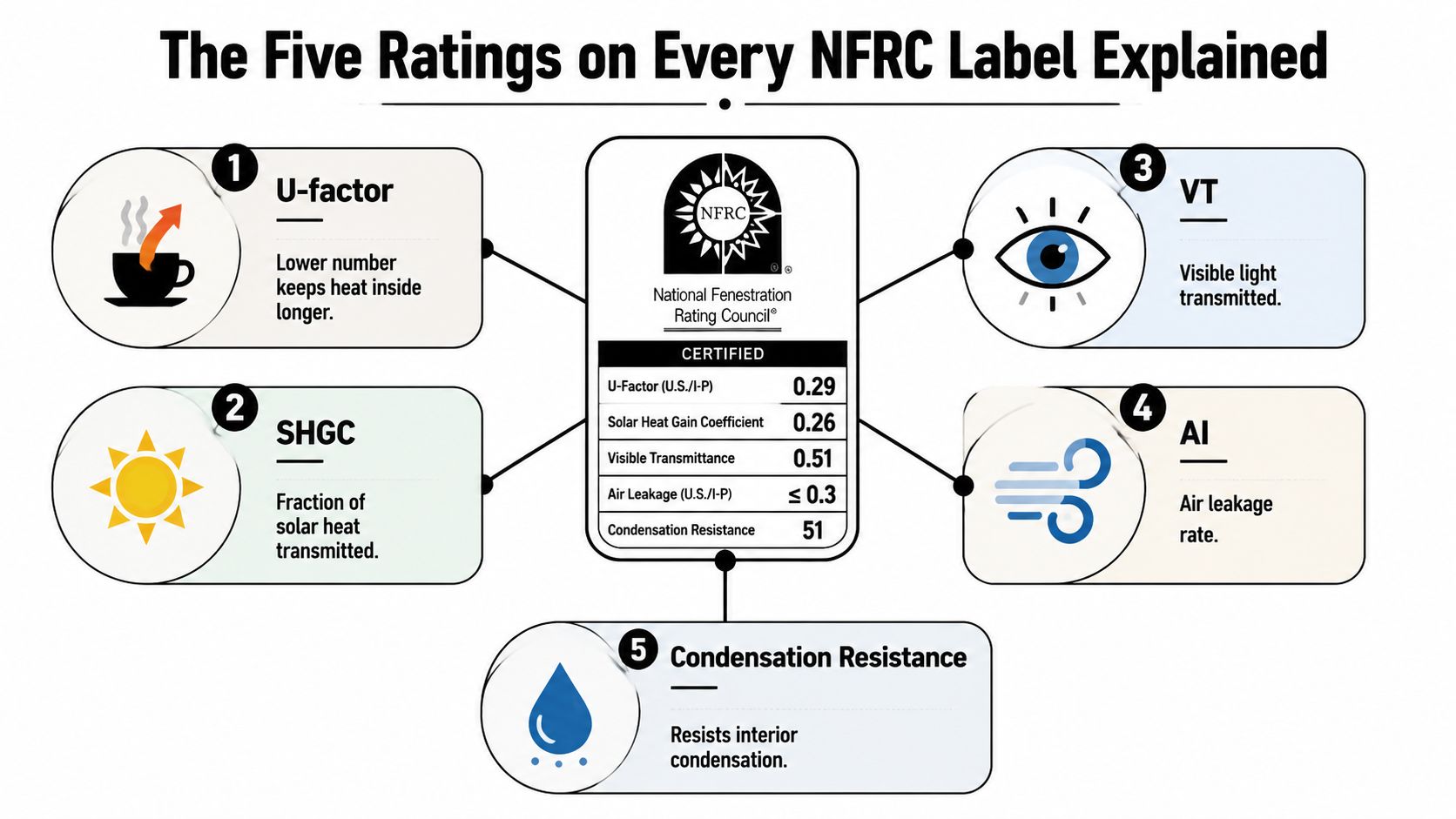
Simple takeaway: The better window is not always the one with the lowest U-Factor. It is the one that balances insulation, sun control, daylight, air tightness, and moisture control for the room it serves.
If you can read those five pieces, the NFRC sticker stops looking like a code sheet and starts acting like a practical buying tool.
What ENERGY STAR and Energy Code Require in the Salt Lake City Climate
A Salt Lake City window choice has to work in two directions at once. Winter heat loss is part of the picture, and the summer sun can still turn a room uncomfortable if the glass is not matched to the exposure. That is why U-Factor and SHGC both matter, and why the same window rarely belongs on every side of the house. A north wall and a west wall do not ask the same thing from the glass.
The easiest way to read the requirements is to think in terms of use, not just labels. ENERGY STAR groups performance by climate zone, and efficient-window guidance shows why colder or mixed climates still need low U-Factor, while sun-heavy exposures need tighter SHGC control. In practical terms, many high-performance double-pane windows sit around 0.28 U-Factor or lower, and triple-pane products are often around 0.21 (ENERGY STAR window ratings guidance).
A quick comparison for the showroom
| Tier | U-Factor Target | SHGC Target | Air Leakage |
|---|---|---|---|
| Meets code minimums | Varies by product and code path | Varies by product and code path | Often up to 0.3 cfm per ft² under energy-code requirements |
| ENERGY STAR certified | Climate-zone specific | Climate-zone specific | Check the NFRC label and product documentation |
| High-performance option | Often around 0.28 or lower for double-pane, or about 0.21 for triple-pane (ENERGY STAR window ratings guidance) | Selected by façade and climate needs | Lower is better, but confirm the tested number |
A window can meet a minimum and still miss the job. A bedroom on the shaded side may be comfortable with one spec, while a west-facing family room may need stronger sun control and a tighter thermal package. That is why the label should be read like a fit check, not a pass-fail stamp.
Air leakage also deserves a look, because the glass rating alone does not tell the whole story. Energy-code guidance for fenestration ties air leakage to the whole window assembly, and the limit is commonly expressed as 0.3 cfm per ft², which is why a window can test well and still feel drafty if the frame or installation details are weak (energy code guidance on fenestration). The label helps, but the seal around the unit matters just as much.
Certified replacements are also where the savings claims come from. ENERGY STAR's own materials point to average utility-bill savings of 13% for certified windows, not for any product that merely clears a code minimum (ENERGY STAR window ratings guidance). That is the difference between a window that just passes inspection and one that is suited to a Salt Lake City home.
For homeowners who care about daylight and trim protection too, the surface treatment matters alongside the numbers. A product built for glass clarity and protection can help keep the window easier to live with day after day, especially where strong sun and snow glare both show up in the same year.
How Double-Pane, Triple-Pane, and Coatings Move the Ratings
The numbers on the label come from the hardware behind the glass. Two windows can both be certified, but the one with better engineering will usually feel quieter, warmer at the glass surface, and steadier when the temperature swings.
What changes the score
A double-pane window with a single low-E coating is the common baseline for many replacement projects. A triple-pane unit adds another layer of glass and another airspace, which usually drives the U-Factor down. Add two low-E coatings and an argon or krypton gas fill, and the unit can perform better in a heating-heavy climate because the extra layers slow conductive heat transfer. That's why a triple-pane product often costs more, even when both windows carry the same certification category.
Low-E coatings matter because they help reflect interior heat back into the room in winter and reduce unwanted solar transfer when the sun is strong. Gas fills add another layer of resistance between the panes. Warm-edge spacers help the edge of the glass stay less cold, which can support better condensation performance around the perimeter. Frame material matters too, because vinyl, fiberglass, wood, and composite all change the final thermal behavior and edge temperatures.
Installer's note: The glass package sets the ceiling, but the frame and spacer system decide how close the window gets to that ceiling.
Why two certified windows can still feel different
A budget-certified window and a premium-certified window can both qualify because the label only proves they met a performance threshold. It doesn't mean they're built the same way. One may use lighter-duty components, a simpler spacer system, or a less sturdy frame. The other may use more advanced glass coatings, stronger framing, and a better moisture profile.
That difference is why I tell homeowners not to shop by sticker alone. Ask what glass package is inside the unit, what gas fill was used, and what the frame is made of. If you're comparing products and want to understand how coatings and glass protection affect the view itself, a resource on glass clarity and protection from APEX NANO – Titan Coatings can help you think through the surface side of the conversation too.

A $200 window and a $700 window can both be “ENERGY STAR certified” because the sticker says they meet a standard. The engineering under that sticker is what separates a decent upgrade from a window that is well-suited for a Utah winter.
Matching Ratings to Each Side of Your House
The biggest mistake homeowners make is buying one glass package for every wall. A house isn't uniform. The north side, south side, east side, and west side all get hit differently by cold, sun, and wind.
Use the façade, not just the room, to choose
North-facing windows in Salt Lake City usually don't get much direct sun, so low U-Factor matters most there. You want to hold onto indoor heat and avoid a cold pane that chills the room. South-facing windows can sometimes tolerate a slightly higher SHGC because winter sun can help with passive heat gain, especially when the room needs daytime warmth.
West-facing glass is the trouble spot in many Utah homes. Late-day summer sun can turn a living room into an oven right when the family wants to relax. Those openings usually do better with a lower SHGC, even if that means giving up some winter solar gain. East-facing windows often sit between those two extremes, so the right balance depends on how the room is used.
Rule of thumb: Keep U-Factor low on every side, then vary SHGC by orientation and room use.
Don't forget daylight
Visible transmittance matters most where daylight is limited. A north-facing room can feel dim if the glass is too restrictive, so the goal is often to keep enough daylight while still controlling heat loss. That's a good example of why window performance isn't one number, it's a balance.
If you want a parallel from other exterior materials, the same idea applies in deck choices, where surface look, heat, and durability all have to work together. The comparison in TimberTech vs Trex from Utah Deck Supply makes that tradeoff easy to see.

A smart window package often mixes ratings by elevation. That's not overcomplicating it. That's tailoring the glass to how the house lives through a Utah year.
Why Installation Can Beat a Perfect Label
A window can carry excellent ratings and still underperform if the opening is handled poorly. I've seen homeowners pay for high-end glass, then lose the benefit because the rough opening was not treated as a system.
The opening matters as much as the unit
The North American Fenestration Standard, or NAFS, sorts products by performance class. In the U.S. multifamily guidance, classes run from R up to AW, and the limits get tighter as you move up. Maximum allowable air leakage is 0.30 cfm/ft² for R, LC, and CW, then it tightens to 0.10 cfm/ft² for AW. Minimum water test pressure starts at 2.92 psf for R and rises to 8.15 psf for AW, while the required minimum percentage of design pressure for water testing increases from 15% to 20% at AW (PNNL guidance on window performance grades and installation details).
Those numbers help, but they do not replace careful installation. The same guidance recommends connecting the wall and window control layers and field-verifying installed windows with ASTM E1105 water testing. If flashing is wrong, sealant is incomplete, or insulation gets crushed, a rated product can still leak air and water. That is how a window with a good label ends up acting like a weaker one.
Think in layers
A proper rough opening is a connected stack of parts, not just a hole with a window in it. Sheathing, flashing tape, shim space, sealant, the window frame, and the interior air seal all need to tie together. If one layer breaks, air and moisture look for that gap first.
That is why a field-verified install matters. You are not only buying the product, you are also relying on the installer to preserve that product's rating once it is in the wall. A top-tier window with sloppy integration can underperform a mid-tier window installed with care, and the difference usually shows up at the corners, the sill, and the trim line.
If you want a broader home-efficiency example outside windows, Purified Air Duct Cleaning's energy guide shows the same basic lesson. The equipment matters, but the way it is installed and tied into the house determines how much of that performance you get.
From Ratings to Real Savings and Comfort
A window label turns into real value when the house starts feeling different on a cold morning or a hot afternoon. Lower U-Factor numbers help slow winter heat loss, so rooms near the glass stay steadier and the thermostat does not have to work as hard. Lower SHGC matters on south- and west-facing glass in Salt Lake City, where strong sun can load up a room fast and push the AC harder than it should.
ENERGY STAR and the energy guidance you may have seen earlier both point to the same practical idea. Better-rated windows can lower utility costs and reduce the amount of heating and cooling energy your home uses to fight heat loss and heat gain, as explained in ENERGY STAR window ratings guidance. The label is not a promise by itself, but it gives you a clear starting point for choosing glass that fits the climate.
The numbers also show up in day-to-day comfort. A room with better-performing windows usually has fewer cold edges around the seating area, less condensation on the inside of the glass, and less of that cold-radiating feeling that makes a chair by the window unpleasant in January. In summer, the same window choices can help keep afternoon rooms from overheating after the sun has been hitting the glass for hours.
Comfort is part of the return
Utility bills matter, but the feel of the house matters too. Homeowners notice drafty spots by the living room window, foggy panes on cold mornings, and surfaces that feel cold to the touch long before they study the label. Those are signs that the window is affecting comfort, not just the energy bill.
A better window can also help when the house is on the market. Buyers may never talk about U-Factor or SHGC at the kitchen table, but they do notice a home that feels dry, balanced, and easier to live in. If you want to keep learning how envelope details affect comfort and energy use, Purified Air Duct Cleaning's energy guide is a useful companion because it keeps the focus on how equipment and building performance work together.
The label matters most when the glass, frame, and installation all line up. A strong rating loses value if the window is installed poorly or tied into the wall in a sloppy way. When the product and the install both match the climate, the house feels the difference every day.
Your Pre-Installation Checklist for Verified Ratings
Ask for the exact NFRC label on the quoted model. Confirm the U-Factor and SHGC fit your climate and your window's orientation. Check the NAFS performance class, request the air leakage number in cfm/ft², ask which low-E coating and gas fill are in the unit, and make sure the contract spells out the flashing, sealing, and post-installation water-test plan.
If you want a window quote that's tied to Utah climate reality instead of showroom language, Superior Home Improvement can walk you through the NFRC label, the install details, and the product choices that affect comfort in Salt Lake City homes. Visit Superior Home Improvement to talk through your windows, compare options for your façade, and get a plan that treats installation as seriously as the glass.