
You wake up on a cold Utah morning and find water pooled on the sill, damp wood around the frame, and a fogged bedroom window that was clear the night before. Wiping it down helps for the moment, but it doesn't explain why one window is dripping while another across the room stays dry.
The reliable way to solve window condensation prevention is to stop treating every wet window as a humidity problem. Condensation is a battle between the dew point of your indoor air and the temperature of the coldest window surface. Once you identify which side is losing, the right repair becomes much easier to choose.
Why Your Windows Get Wet in the First Place
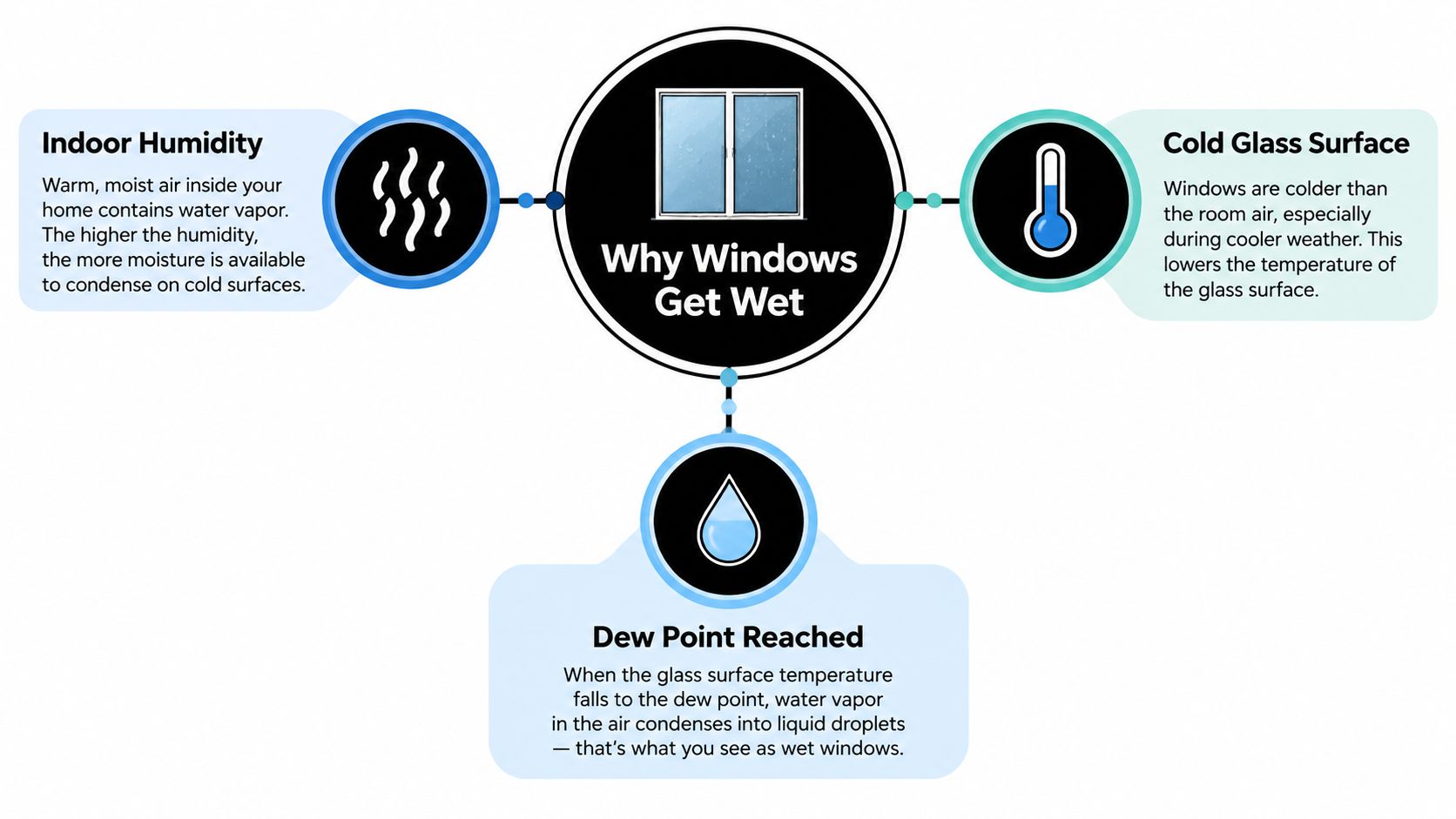
A window gets wet when its interior glass or frame surface falls below the dew point of the air inside your home. Dew point is the temperature at which the moisture already in the air turns into liquid water. The room can feel warm, yet the glass can still be cold enough to collect droplets.
Think of the air as carrying an invisible load of moisture. Heating the room raises its temperature, but it doesn't automatically remove that moisture. When the air touches a colder surface, it cools, reaches its dew point, and releases water onto the glass, spacer, or frame.
The Canadian National Research Council guidance on condensation identifies two fundamental prevention strategies: lower the indoor air's dew point or raise the window surface temperature. That distinction matters in Utah, where cold winter nights create a sharp difference between indoor and outdoor conditions. A room can have moderate humidity and still produce condensation if the frame or edge of the glass stays cold.
The two levers homeowners can control
Lowering the dew point means reducing moisture from showers, cooking, indoor clothes drying, and stagnant air. Raising the surface temperature means improving glazing, sealing drafts, addressing thermal bridges, and allowing warm room air to reach the window.
NRC guidance gives a useful benchmark. At 21°C indoor temperature and 30% relative humidity, a window needs a temperature index of 0.60 to prevent condensation. That example shows why “the house isn't that humid” doesn't settle the question. The glass still needs adequate thermal performance.
Storm windows and insulated glass have long been practical ways to keep interior surfaces warmer, as the same NRC guidance explains. If you're also concerned about how persistent moisture affects painted surfaces and surrounding materials, a resource on mold risk from indoor humidity can help you understand the broader damage pattern.
Key takeaway: Drying the air helps, but it won't fix a cold frame or spacer by itself. Find the coldest surface first.
How to Diagnose Your Condensation Pattern
Start with observation, not replacement quotes. Record which rooms show water, whether it appears after sleeping, cooking, or bathing, and whether it sits in the center of the pane, along the edge, or on the frame.
A digital hygrometer gives you indoor temperature and relative humidity in the same room. Place it near, but not directly beside, the problem window, heater, or supply vent. Compare the reading with the timing of the moisture. In Utah homes, a bedroom window that wets overnight points to a different pattern than a kitchen window that fogs during cooking.
Read the location before choosing the repair
Center-of-glass condensation usually indicates a cold pane, high indoor moisture, or both. Moisture concentrated along the lower edge points more toward the spacer or edge-of-glass area. Wet corners and frames suggest a thermal bridge, an air leak, or weak frame performance.
A cold sash or trim can confirm the pattern. Drafts cool a surface below the dew point even when the center glass performs reasonably well. Condensation between panes is different. It usually indicates a failed insulating seal, not ordinary room humidity.
| Pattern You See | Likely Cause | Check Next |
|---|---|---|
| Moisture across the center of the pane | Indoor moisture or cold glazing | Check room humidity and pane temperature |
| A wet strip around the glass edge | Cold spacer or edge bridge | Ask about spacer construction and edge performance |
| Water on corners, sash, or frame | Cold frame, air leakage, or thermal bridge | Inspect weatherstripping and frame joints |
| Condensation between sealed panes | Failed insulating seal | Have the sealed unit assessed |
| Moisture mainly in bedrooms | Limited overnight airflow and added indoor moisture | Check bedroom humidity and air circulation |
| Moisture after cooking or bathing | Localized vapor not exhausted | Test the kitchen or bathroom exhaust path |
NFRC's condensation-resistance guidance notes that condensation behavior depends more on individual component performance than on U-factor alone. Multiple glazing, low-e coatings, thermally broken frames, and warmer edge details can help keep interior surfaces above the dew point. Diagnose the coldest wet component first, because better center glass will not correct a cold frame, spacer, or leaking joint.
Quick Daily Habits That Reduce Window Moisture Fast
You can often reduce morning moisture without buying a new window. The first job is to stop adding water vapor faster than your exhaust and airflow can remove it.
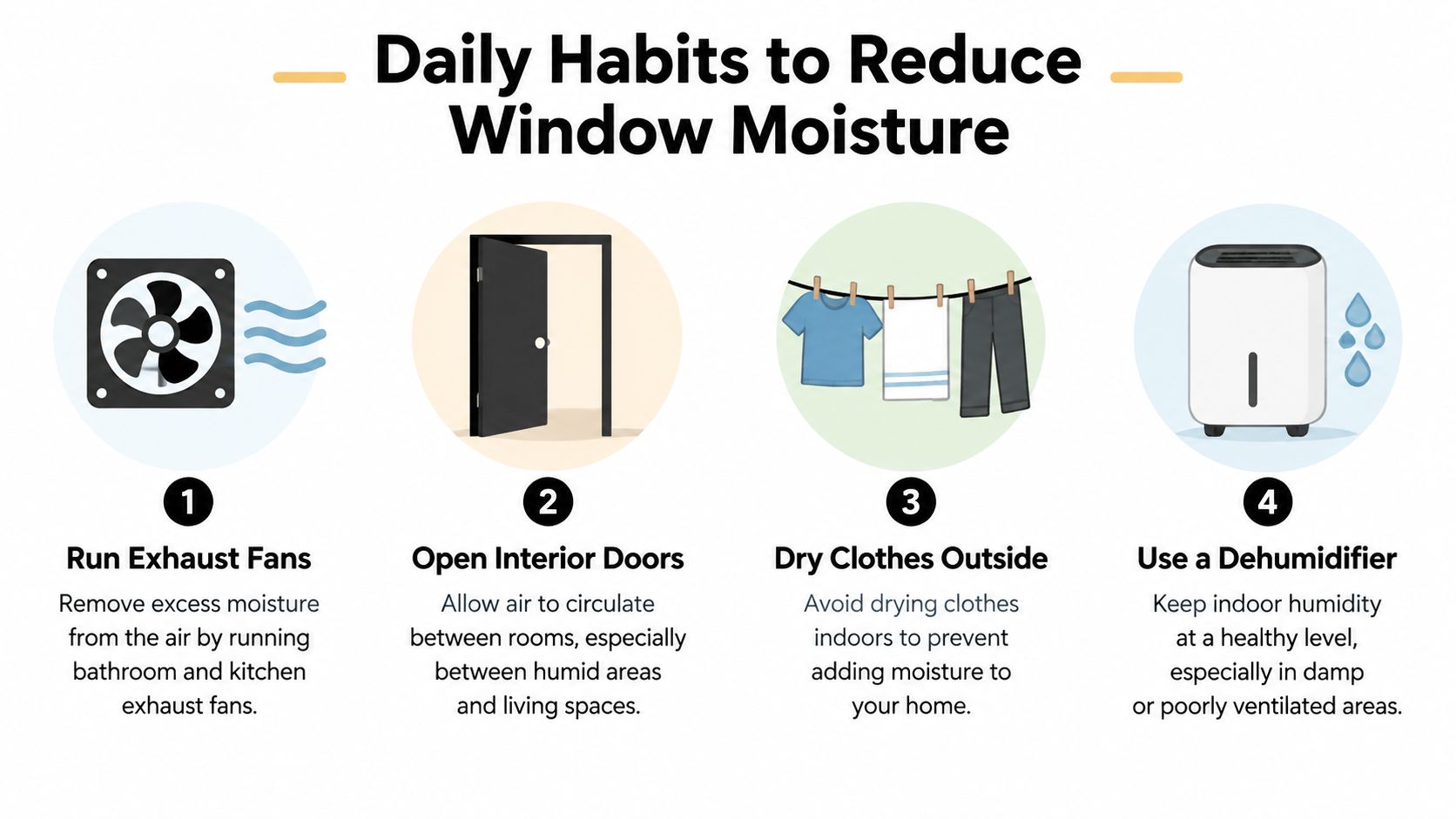
Run the bathroom exhaust fan during a shower and keep it operating after the shower ends. Close the bathroom door while the room is steamy so moisture doesn't migrate into bedrooms and living areas. Use the kitchen exhaust whenever you boil water or cook without a lid, especially if the hood vents outdoors.
Change the airflow around the glass
Keep blinds and curtains open enough for warm room air to reach the pane. Furniture pushed tight against a window can also block circulation at the lower frame. Open interior doors between rooms when practical, particularly if one room stays noticeably colder than the rest of the house.
Brief ventilation can remove damp air without leaving windows open for long periods. A short cross-flow through opposite openings is more useful than leaving one window cracked all day while losing heat. In a tight home, though, random opening isn't a substitute for properly designed ventilation.
A hygrometer helps you avoid overcorrecting. Field-oriented building guidance commonly uses 30–50% relative humidity as a practical operating band, with the lower end preferred during very cold weather (BC Building Science's window condensation guidance). Utah homes already become uncomfortably dry in winter, so forcing humidity as low as possible can irritate skin and airways without solving a cold surface.
Try this evening routine:
- Capture shower moisture: Keep the bathroom door closed and use the exhaust fan during and after bathing.
- Control cooking vapor: Cover simmering pots and run the range hood instead of allowing steam to spread.
- Move laundry moisture outside: Use a vented dryer or dry clothes in a space with deliberate exhaust.
- Clear the sill: Wipe standing water so it can't soak wood, paint, drywall, or sealant.
- Keep air moving: Open interior doors and leave space between furniture, curtains, and the window.
- Measure before dehumidifying: Use a hygrometer to decide whether the room needs moisture removal or a warmer surface.
For bathroom-specific moisture habits, this guide to trapped moisture solutions from Modern Bathrooms offers useful advice on keeping vapor contained and exhausted.
Here's a short visual walkthrough of practical moisture-control habits:
Mid Term Upgrades That Keep Glass Warmer Longer
Once daily moisture is under control, improve the window's surface temperature. Start with small envelope repairs before assuming replacement is the only answer.
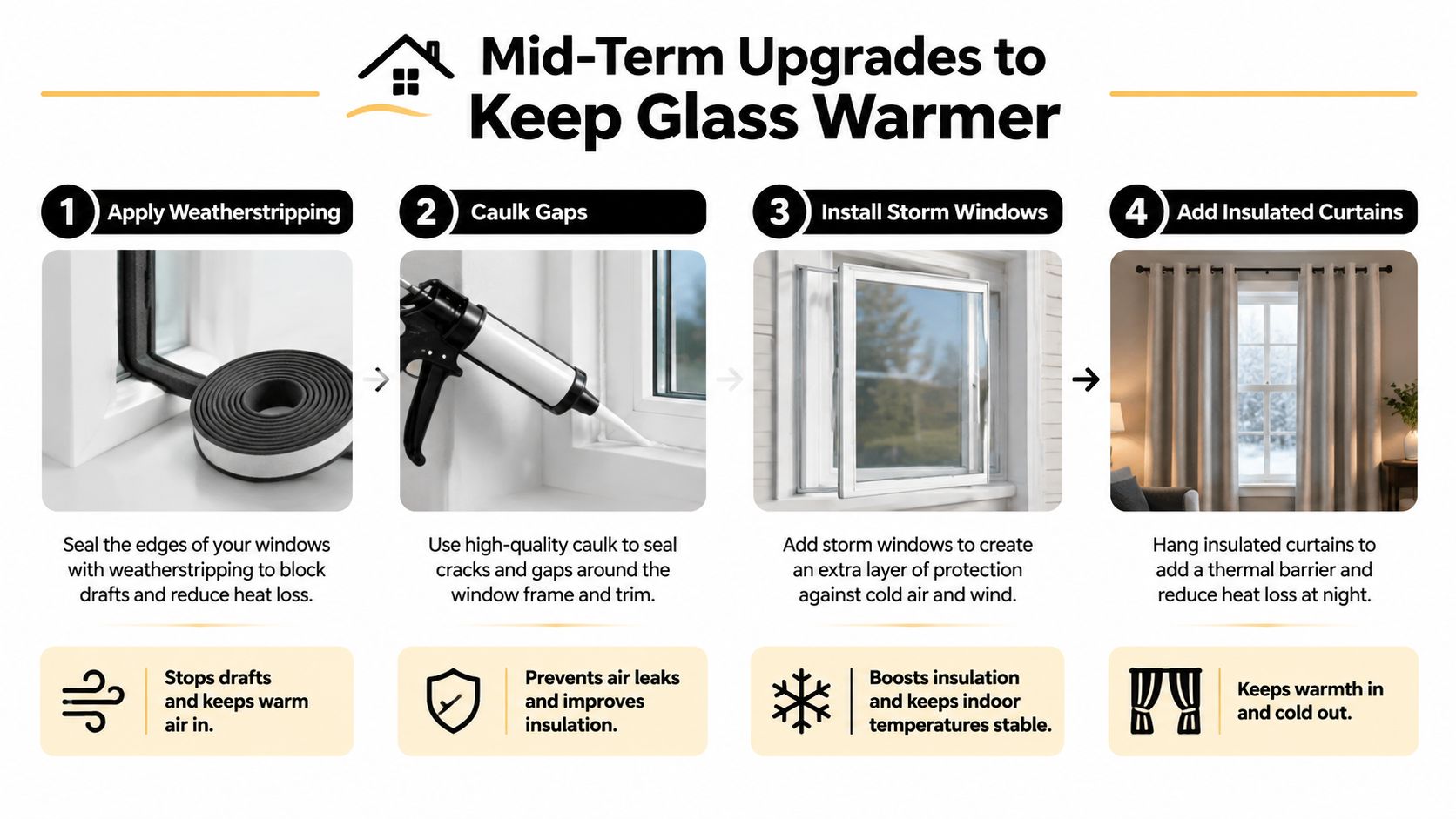
Weatherstripping belongs on movable sash edges where the seal compresses during closing. Caulk belongs at fixed joints, such as the connection between the window frame and surrounding trim, where a visible gap allows cold air into the assembly. Don't use caulk as a substitute for damaged weatherstripping, and don't bury a drainage path that the window needs to shed water.
Prioritize the coldest part of the assembly
Homeowners often focus on the center of the glass because that's the largest visible area. In practice, the frame and spacer can be colder than the center pane, and that coldest component controls where condensation starts.
A 2017 spacer study found that a thermally improved spacer prevented condensation at outdoor temperatures 4.2°C to 15.7°C lower than a conventional spacer (the study in Energies). That range demonstrates why edge-of-glass design isn't a cosmetic detail. A good center pane can still have a wet perimeter if the spacer conducts heat away too efficiently.
Ask a window professional to inspect, in order:
- The frame: Look for conductive metal sections, damaged vinyl, gaps, and cold corners.
- The spacer: Check whether the edge system creates a thermal bridge.
- The sash and seals: Verify compression, alignment, and air leakage.
- The surrounding opening: Inspect insulation continuity and trim joints.
- The room airflow: Confirm that curtains, furniture, or blocked registers aren't keeping warm air away.
Storm windows can add another insulating layer to older units. Properly fitted insulated curtains may also help, but leave enough room for warm air to circulate and don't trap damp air against the pane. Improving insulation around the rough opening, attic edge, or adjacent wall can reduce cold spots that make the window perimeter fail.
Low-e coatings can improve condensation resistance by reducing heat transfer. They also introduce a counterintuitive exterior issue. Research on high-performance glazing found that lowering a window's U-value can increase the duration and quantity of exterior condensation because the outer glass remains cooler for longer, while very low-emissivity coatings can significantly reduce those condensation hours. The same peer-reviewed research notes a practical lower emissivity limit for current coatings of about 0.15 to 0.20 and projects more frequent exterior condensation as conditions warm (the 2018 study on exterior condensation).
That outside moisture isn't the same failure as water on the room-side frame. It can indicate that the glazing is retaining indoor heat effectively, but it still deserves attention if it blocks visibility or creates an exterior maintenance issue.
When to Repair Upgrade or Replace Your Windows
Repair is appropriate when the frame remains sound and the failure is localized. Replace worn weatherstripping, reseal fixed exterior joints, correct sash alignment, or replace a failed insulated glass unit when the surrounding frame still performs well.
Replacement makes more sense when the frame stays cold, seals fail repeatedly, the sash is warped, or interior condensation and ice continue after moisture control and air-sealing work. Peeling paint, swollen wood, staining, or recurring mold around the opening show that moisture is affecting the assembly, not just the pane.
Compare performance, not just the label
A low U-factor can indicate lower heat loss, but it does not identify the coldest surface. Ask about condensation resistance, frame construction, spacer type, glazing layers, and thermal breaks. NFRC guidance identifies multiple glazing, low-e coatings, thermally broken frames, and surfaces kept above the dew point as relevant controls.
NFRC's condensation-resistance fact sheet explains that condensation behavior depends more on individual component performance than on U-factor alone. Glass, frames, and spacers can create different surface temperatures within the same window. The practical question is what happens at the edge and frame, not only in the middle of the pane.
A professional assessment is warranted when moisture appears between panes, ice forms indoors, water damages the sill, or mold returns despite controlled indoor humidity. For Utah homeowners comparing replacement approaches, Superior Home Improvement's Energy Conservation Program pairs triple-pane, weather-tight windows with insulation strategies and focuses on maintaining warmer interior surfaces.
Start with the coldest surface. A wet morning may reflect a high indoor dew point, poor room airflow, a failed seal, or a cold frame and spacer. Identify that limiting factor before choosing between a repair, a component replacement, or a complete window replacement. This approach prevents a new pane from being installed while the frame remains the part that reaches the dew point first.
Your Window Condensation Prevention Plan That Lasts
A durable plan follows the order that saves the most wasted effort:
- Reduce moisture at the source. Control shower steam, cooking vapor, indoor laundry, and other local moisture loads.
- Improve exhaust and airflow. Use fans correctly, keep air moving across glass, and monitor rooms with a hygrometer.
- Raise surface temperature. Seal drafts, repair weatherstripping, improve insulation around the opening, and address the coldest component.
- Upgrade the window when needed. Specify glazing, frames, spacers, and thermal breaks together.
- Consider whole-house mechanical ventilation last. Airtight homes benefit from balanced ventilation, but the equipment shouldn't be the first response to a single cold frame or an unvented bathroom.
Before winter, inspect seals, caulk joints, curtains, sills, exhaust fans, and the areas around the rough openings. During cold weather, record which windows get wet, when the moisture appears, and whether the pattern changes after you adjust ventilation or room airflow.
Window condensation prevention isn't about making the home unnaturally dry. It's about keeping the vulnerable surfaces above the indoor dew point consistently.
If the same frame remains wet after you control indoor moisture and repair air leaks, stop guessing and have the assembly assessed. A surface-temperature check can reveal whether the problem is the glass, spacer, frame, or surrounding installation.
Superior Home Improvement offers window replacement and energy-efficiency consultations for Utah homes, with attention to glazing, frame performance, weather-tight installation, and insulation around the opening. Visit Superior Home Improvement to request a free consultation and discuss a practical condensation solution for your home.