
On a cold Salt Lake Valley morning, frost clings to a single-pane window while a draft curls across the floor. The furnace clicks on again, yet the room near the glass still feels chilly. If you've wondered, how do energy efficient windows work, the answer starts with a simple idea: they control how heat moves through the entire window assembly, not just through the glass.
The most effective designs combine multiple panes, sealed air or gas spaces, low-emissivity coatings, insulated frames, warm-edge spacers, and careful air sealing. Each part addresses a different path for heat loss or heat gain. Understanding those paths makes it easier to compare window labels, choose ratings for Utah's climate, and avoid upgrades that look impressive on paper but perform poorly after installation.
Why Your Window Matters More Than You Think
On a winter evening in Utah, the room can feel coldest beside the window even when the thermostat shows a comfortable temperature. The glass may not leak air at all, yet your body still loses radiant heat toward its colder surface. If a draft is present too, the window can become the weakest thermal link in an otherwise insulated exterior wall.
That discomfort points to a larger issue. Window performance depends on the whole assembly, including the center of the glass, the edges, the frame, and the joint between the window and the wall. A single upgrade rarely corrects every path heat can take.
Cold glass changes how a room feels
Radiant heat exchange explains why a calm room can feel chilly near an old pane. Your warm body sends infrared energy toward the colder glass, while the pane draws heat from nearby surfaces. The thermostat measures air temperature, not how quickly the window surface pulls heat from you.
Air leakage creates a separate problem. Worn weatherstripping, gaps around the sash, or an imperfect frame connection can let indoor air escape and outdoor air enter. The moving air produces the familiar draft near the floor, and the heating system must condition that replacement air.
A high-performing window addresses both effects. Multiple panes create insulating spaces, while Low-E coatings control infrared radiation across those spaces. Gas fills slow heat movement within the cavity, and frame materials limit conduction around the glass. Installation seals the connection between the window and the wall, so a well-designed glazing package is not weakened by an open perimeter joint.
Practical rule: Judge a window as a complete assembly, not as a pane of glass with a few upgrades attached.
The fix is layered
The components support one another:
- Better glazing: Multiple panes slow heat transfer through the center of the window.
- Low-E coatings: These reflect long-wave infrared heat while allowing visible light through. The coating is one part of a system, not a substitute for sound framing or installation.
- Gas fills: Argon or another insulating gas occupies the sealed space between panes and reduces heat movement through the cavity. The seal must remain intact over time, because gas-fill performance depends on retaining that space.
- Warm-edge spacers: These reduce heat flow around the perimeter of the insulated glass unit. That edge detail can affect both surface temperature and the window's resistance to condensation.
- Insulated frames and air seals: These limit conduction through the frame and prevent the installation gap from undoing the glass package.
Window replacement also fits into a broader energy saving home plan. The practical payoff is steadier comfort near the glass, less heat lost through the assembly, and a lower chance of interior surface sweating. Performance labels matter, but the way their parts interact matters just as much.
The Physics of Heat Moving Through a Window
A thermos offers a useful comparison. It keeps a drink hot or cold by slowing several kinds of heat movement at once. An energy-efficient window uses the same basic strategy, although it must also admit daylight, withstand weather, open and close when required, and remain sealed for years.
Conduction moves through solid materials
Conduction is heat traveling through a material. In a window, that material may be glass, a metal spacer, a frame, or the wall surrounding the opening. Glass conducts heat more readily than an insulating gas space, while an aluminum component can create a particularly direct path unless the design includes a thermal break.
During winter, indoor heat conducts toward the cold exterior. During summer, outdoor heat conducts inward. The direction changes, but the mechanism remains the same.
Convection moves through air or gas
Convection occurs when moving air or gas carries heat. In a single pane, room-side air warms against the glass, rises, and circulates. Cooler air falls, creating a continuous loop that transfers heat toward the outdoors.
A second pane creates a narrow sealed space that interrupts large-scale circulation. The space may contain air or an inert gas such as argon. The gas doesn't stop all heat transfer, but it slows movement through the cavity.
Radiation crosses the gap
Radiation is infrared energy traveling from a warmer surface to a colder one. It doesn't need direct contact or moving air. A warm interior pane can radiate heat toward a cold exterior pane across the sealed gap.
Low-E coatings target this pathway by reflecting much of that long-wave infrared energy back toward the warmer side. The result is a window that addresses conduction, convection, and radiation with separate but interacting features.
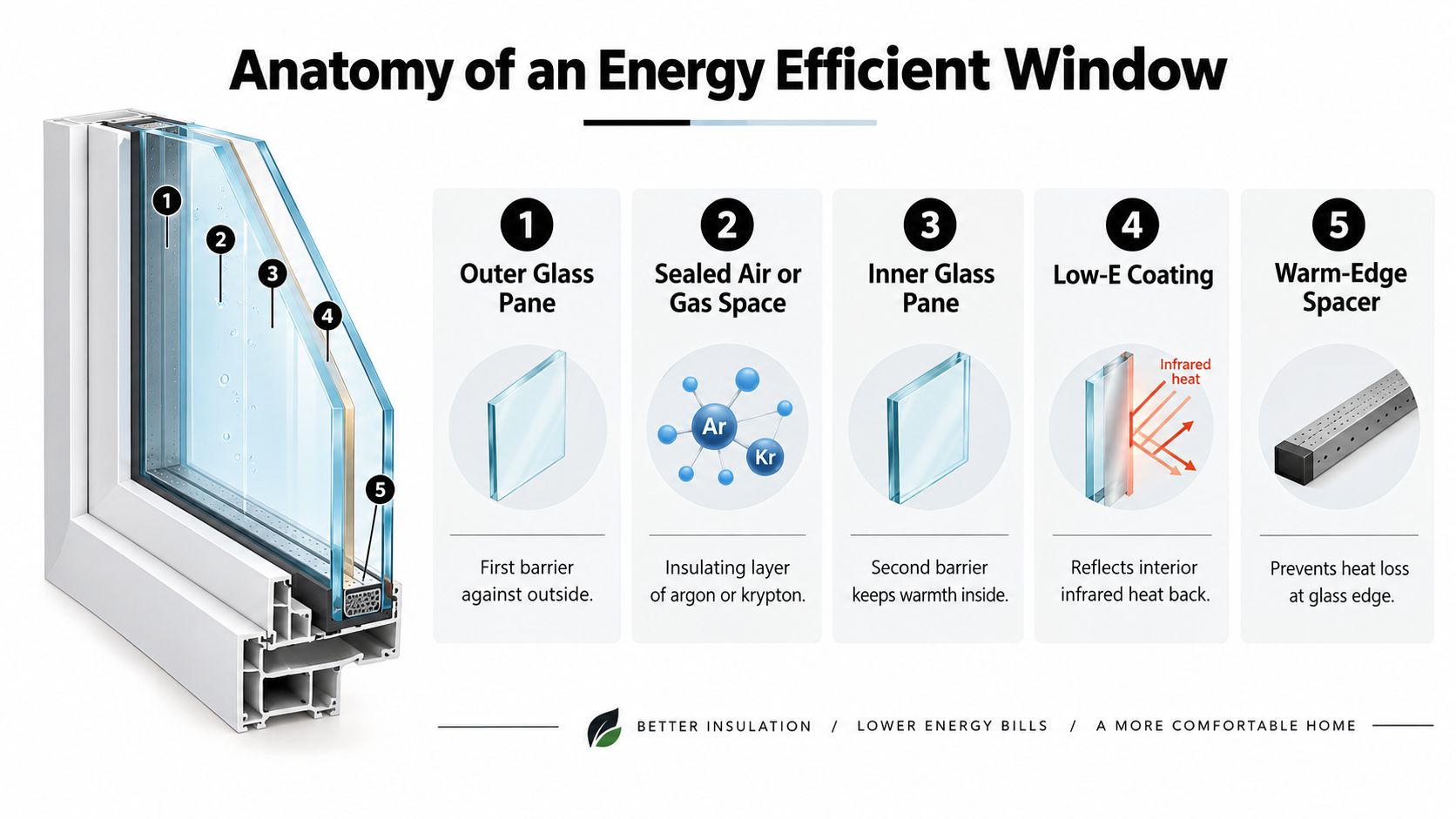
A single pane performs poorly because it offers little resistance to all three modes. Efficient glazing adds barriers in layers, then measures the resulting performance through the complete assembly. That's why the frame, edge, seals, and installation matter alongside the visible glass.
Anatomy of an Energy Efficient Window
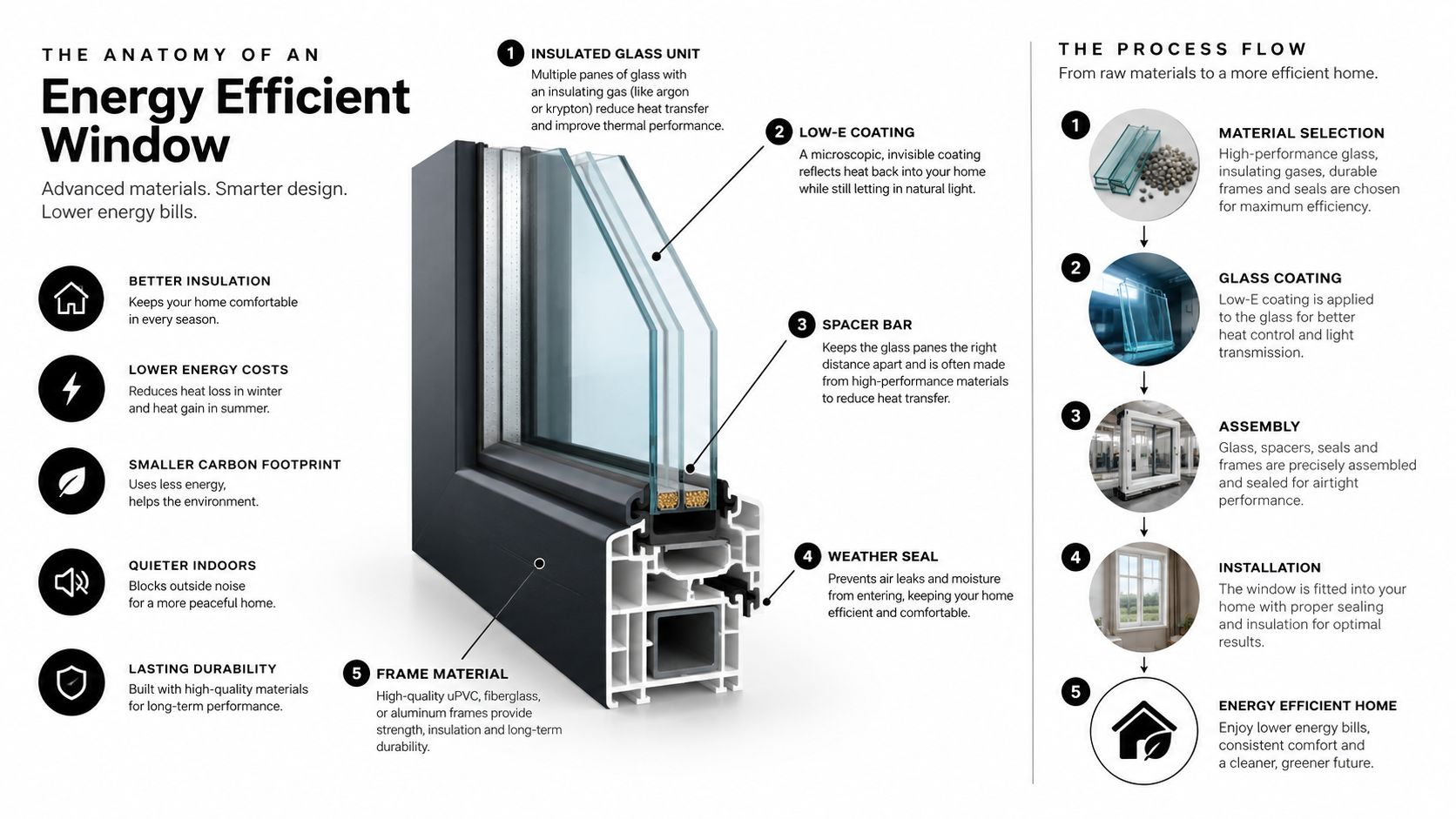
A cold Utah morning makes a window's construction easy to understand. The outer pane faces the weather, the inner pane faces the room, and the sealed cavity between them interrupts heat flow. The spacer, frame, coatings, and installation seal then determine how well that barrier performs over time.
Glass panes create separation
The outer pane is the first weather barrier, while the inner pane forms the room-side surface. Adding a second or third pane creates more surfaces and sealed spaces, so heat must cross additional boundaries instead of moving directly through one sheet of glass.
Pane count alone does not determine performance. The distance between panes, coating placement, seals, and frame connection all affect the complete window. A strong center-of-glass result can provide less benefit if the edge or frame conducts heat quickly.
The sealed cavity slows heat movement
The space between panes may hold dry air, argon, krypton, or a mixture of gases. Double-pane units commonly use argon. Triple-pane designs may use krypton or a krypton-argon mix when the cavity is configured for lower conductivity.
The spacer keeps the panes apart and helps preserve the seal. Many spacers also contain desiccant, which absorbs moisture and helps keep the cavity dry during normal service. If the seal fails, moisture can enter, causing fogging between panes. That visible haze signals that the insulating space is no longer working as designed.
Gas fill also deserves attention over the life of the window. A cavity can perform well when manufactured, yet seal deterioration may gradually reduce its gas content. The result is a long-term tradeoff: designs that limit heat flow must still preserve gas retention and condensation resistance at the edge.
Low-E manages infrared radiation
A low-emissivity coating is a thin metallic layer on a glass surface. It reflects long-wave infrared heat while allowing visible light through, so it controls radiant heat without making the window opaque. Its location within the glazing unit affects which direction heat is reflected.
Low-E technology appears in a large share of residential glazing and can reduce window energy use by roughly 30 to 40 percent, according to Lawrence Berkeley National Laboratory. That range describes the coating technology in the source's stated context, not every installed window.
Spacers and frames complete the package
A traditional metal spacer can form a conductive bridge around the glass edge. A warm-edge spacer uses a less conductive design, reducing that bridge and helping keep the perimeter warmer. This edge temperature influences both heat loss and the risk of interior condensation.
The frame can weaken an otherwise effective glass package. Vinyl, fiberglass, wood, wood-clad designs, and thermally broken aluminum manage conduction in different ways. The choice depends on the design, exposure, maintenance expectations, and installation. Weak seals or poor thermal continuity can still admit air and leave the interior edge cold.
Reading the Performance Numbers
A window label is a report card, but each line answers a different question. U-factor describes heat flow through the assembly, while the Solar Heat Gain Coefficient, or SHGC, describes how much solar heat enters. Energy Star and U.S. Department of Energy guidance use these ratings as a foundation for comparing efficient windows, as explained in the Department of Energy window guidance.
U-factor measures heat flow
The U-factor indicates how readily heat moves through the complete window assembly. Typical values range from 0.20 to 1.20. Lower values mean less heat loss, according to the Department of Energy guidance.
For a cold Utah home, a lower U-factor generally reduces winter heat loss. Use the whole-window value rather than only a center-of-glass number. The complete rating includes the frame and glass-edge effects, which are part of the product installed in the wall.
R-value describes insulation in the opposite direction. A window's R-value remains comparatively modest because glass, frames, seals, and edges do not behave like one continuous insulated wall. Comparing a wall R-value directly with a window label can therefore give a misleading impression.
The lowest U-factor is not automatically the best choice. A highly insulating design can have a colder exterior edge or require different spacer and frame choices, so condensation resistance belongs in the same conversation. Gas-filled units also depend on durable seals. If gas gradually escapes, the window may no longer perform like its original label.
SHGC controls solar heat gain
The Solar Heat Gain Coefficient ranges from 0 to 1. It describes the solar heat entering through the window, including energy transmitted through the glazing and energy absorbed by the window that later flows indoors. Lower SHGC values block more summer heat.
Cold-climate homeowners may place greater emphasis on a low U-factor. Hot-climate homeowners often give more weight to a low SHGC because it can reduce cooling loads. Orientation, shading, and the amount of glass in the room determine the better balance. A south-facing window with useful winter sun may call for a different SHGC than unshaded west-facing glass.
Other label fields still matter
Visible transmittance describes how much daylight passes through the glazing. Condensation resistance estimates how well the product resists interior condensation under test conditions. Air leakage addresses uncontrolled movement through the window, though it cannot replace careful installation and perimeter sealing.
| Rating | What It Measures | Typical Range | Good Value for Cold Climates |
|---|---|---|---|
| U-factor | Heat transfer through the whole window | 0.20 to 1.20 | Lower is generally preferred |
| SHGC | Solar heat entering as heat | 0 to 1 | Selected according to sun exposure |
| Visible transmittance | Daylight passing through | Varies by product | Balanced with glare and daylight needs |
| Condensation resistance | Resistance to interior surface condensation | Varies by product | Higher is generally preferred |
Cold-climate guidance has commonly targeted U-factors of 0.35 or lower. Some three-layer products reach 0.15, while low-solar-gain low-E coatings have often been associated with SHGC values below 0.25, according to the Department of Energy and Energy Star window guidance. These figures are reference points, not universal prescriptions for every Utah elevation, orientation, or window size.
Matching Windows to Utah's Climate
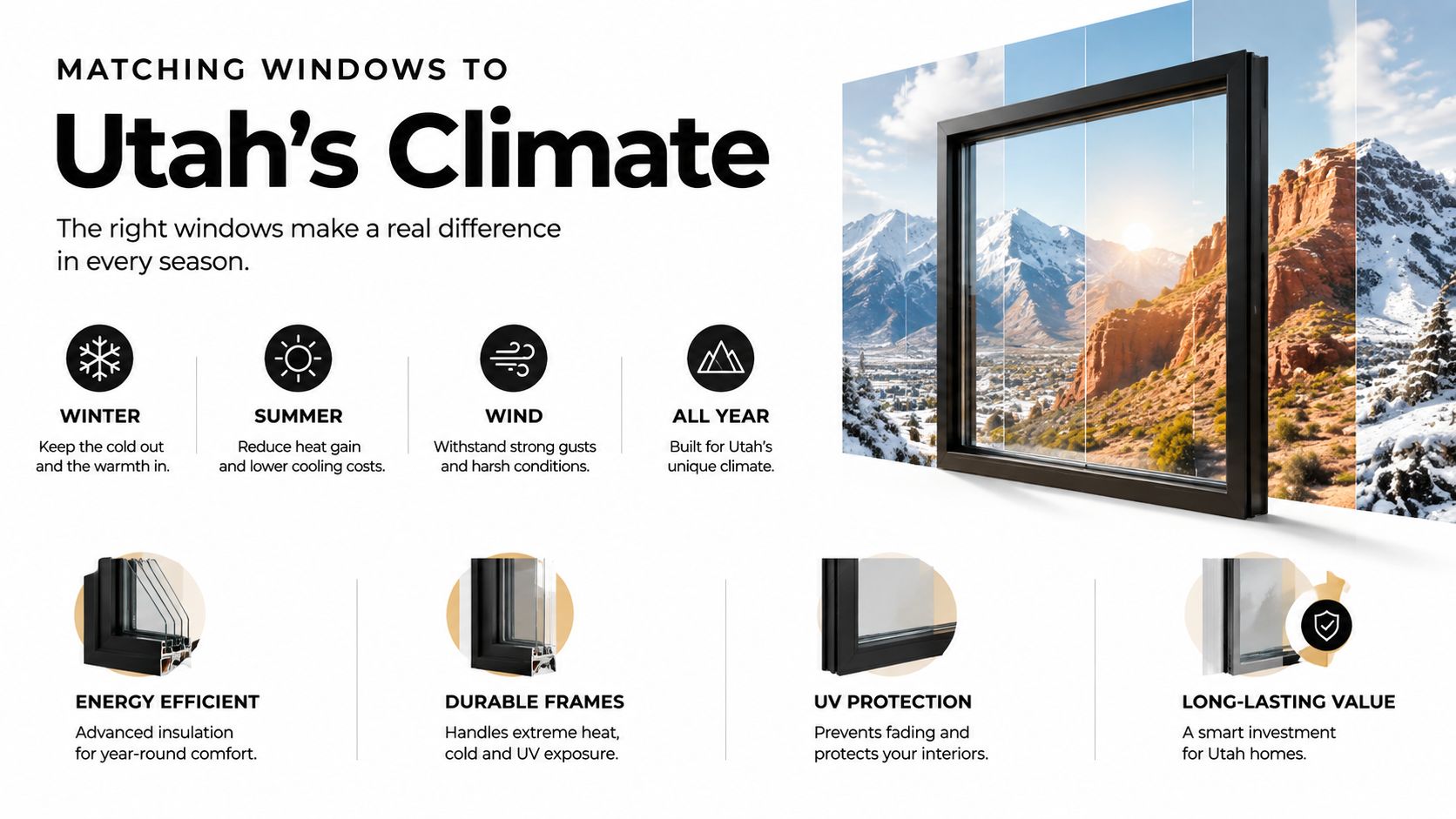
Utah doesn't have one single window strategy. A home in Park City faces a different heating and cooling balance than a home in St. George. Elevation, orientation, shading, window area, and building insulation all affect the right combination of ratings.
Mountain and high-desert homes
In Park City, Heber, and the Wasatch foothills, cold winters make low U-factor a central priority. The window needs to slow heat leaving the room and keep the interior glass warmer during cold weather. Triple-pane glazing may suit some projects because it adds another insulating cavity, although the complete product rating and frame design still matter more than pane count alone.
Summer solar gain shouldn't be ignored. A moderate SHGC can admit useful winter sunlight while avoiding excessive heat on exposed elevations. South-facing glass may benefit from exterior shading or carefully selected solar control, especially where large windows receive direct sun.
Lower-elevation homes
In St. George and Washington County, cooling conditions can dominate the design decision. A lower SHGC can reduce unwanted solar heat entering through sun-exposed glass, which may be more valuable than pushing U-factor to its lowest possible value.
That doesn't make U-factor irrelevant. Efficient windows still need to resist heat transfer, but the priorities shift. A product that performs well in a mountain winter may not be the most comfortable choice for a strongly sun-exposed lower-elevation room.
Orientation changes the answer
South- and west-facing windows usually receive more direct solar exposure than north-facing windows. Lower SHGC glazing can help on those elevations, particularly where overhangs, trees, blinds, or exterior screens don't provide enough control.
North-facing windows receive less direct sun and may tolerate a higher SHGC when the design goal includes daylight and useful passive solar contribution. The choice should follow the room's exposure rather than a blanket rule for the entire house.
Utah's high elevation can also increase concern about ultraviolet exposure and fading. Quality glazing and Low-E coatings can help manage solar radiation, but furnishings still benefit from shades, films, and sensible placement. The window should support the home's overall solar-control strategy.
The Real-World Benefits of Energy Efficient Windows
On a winter evening, the chair beside an old window may feel uncomfortable even when the thermostat shows the right temperature. The room-level benefit of an efficient window comes from several changes working together: less heat crossing the glazing, less radiant exchange with a cold interior surface, and fewer paths for outdoor air to enter around the frame.
Comfort changes before the thermostat does
A cold single-pane window leaves its interior glass at a lower temperature. That surface exchanges radiant energy with nearby people and furnishings, so occupants can feel chilled while the room air remains warm. A lower U-factor slows heat transfer through the assembly and can raise the interior surface temperature.
The effect is easiest to notice beside seating areas, beds, desks, and dining tables near exterior glass. Those zones become more usable in winter instead of feeling like cold pockets that people avoid.
Condensation depends on more than insulation
Warmer interior glass reduces the conditions that create room-side water or frost. The condensation-resistance rating, or CR, indicates how a product handles that risk under standardized conditions.
The lowest U-factor does not automatically provide the strongest condensation resistance. Independent analysis found that fourth-surface Low-E coatings can slightly improve thermal transmittance while reducing condensation resistance. One set of configurations showed CR falling from 67.7 to 52.7, with edge-of-glass temperatures reaching or dropping below the dew point in several cases, as discussed by Construction Specifier's analysis of fenestration performance.
Read the label as a set of tradeoffs: thermal insulation, solar control, and condensation behavior need to work together.
Energy performance can change over time
Argon can reduce heating demand without changing visible light transmission, provided the gas remains in the insulated glass unit and the seals continue to perform. One recent simulation reported annual heating demand falling by 20.38 percent versus its baseline with argon. Another study predicted a 92 percent probability that the argon fill rate could fall below 65 percent within two years under some conditions. Those findings appear in the JCEMI research summary, showing why seal durability matters alongside the initial specification.
Multi-pane construction can also reduce outdoor sound by adding separated glass layers. The result depends on glass thickness, spacing, frame construction, and installation, so pane count alone does not determine acoustic performance.
Managing solar radiation may reduce fading, but no window blocks every ultraviolet exposure pathway. A well-specified and properly installed assembly can make the interior more comfortable, quieter, and more stable over time. Its benefits come from the interaction of glazing, coatings, gas fill, frames, seals, and installation, not from one feature in isolation.
Choosing and Installing Windows the Right Way
A replacement window can have strong laboratory ratings and still perform poorly if it is measured or installed incorrectly. Begin by measuring the existing frame, checking the surrounding wall for moisture or damage, and deciding whether the project needs a full-frame installation or an insert. That choice affects glass area, access for insulation, flashing, and the continuity of the air seal.
Select the operating style and frame
Operating style changes how a window controls air movement. Casement windows usually close against a compression seal. Double-hung windows rely on movable sashes and interlocking seals. Fixed windows have no moving hardware, which can simplify air sealing, but they do not provide ventilation. Match the style to ventilation needs, cleaning access, emergency egress, and the opening's exposure.
Frame materials also affect heat flow, durability, and maintenance:
- Vinyl: Insulating and generally low-maintenance, with performance determined by the profile, reinforcement, and seals.
- Fiberglass: Stable through temperature changes and available in designs suited to demanding exposure.
- Wood or wood-clad: Provides a traditional interior appearance but requires careful moisture protection.
- Thermally broken aluminum: Uses an insulating separation within the frame to interrupt direct conductive paths.
Utah's freeze-thaw conditions increase the importance of drainage, seal quality, and compatible exterior finishes. A strong frame cannot compensate for water entering behind the trim or air bypassing the installation joint. The frame and wall connection must work as one assembly.
Verify the product, not just the feature list
Read the NFRC label for whole-window performance rather than judging the glass package alone. Check the U-factor, SHGC, visible transmittance, condensation resistance, and air-leakage information where available. ENERGY STAR certification can identify products that meet program efficiency requirements, but the climate zone and window orientation still determine whether those ratings fit the home.
For a Salt Lake City-area project, compare dual-pane and triple-pane products by whole-window U-factor and frame performance. In St. George, give more attention to SHGC in strongly exposed rooms while retaining suitable insulation. A lower U-factor can reduce heat flow, yet a design with colder interior surfaces may have a different condensation-resistance rating. Compare both values instead of assuming that more panes automatically produce the best result.
Treat installation as part of the window
A qualified installer should:
- Set the frame square and plumb: A distorted opening can hinder sash movement and compress seals unevenly.
- Integrate flashing with the weather-resistive barrier: Flashing should direct water outward, not trap it behind the trim.
- Use compatible low-expansion foam: The foam should insulate the gap without bowing the frame.
- Seal the interior continuously: Backer rod, sealant, and a continuous interior air seal limit leakage around the perimeter.
- Check operation and drainage: Sashes should move smoothly, locks should engage, and weep paths should remain open.
The laboratory rating describes a properly assembled unit. Poor installation can create thermal bridges, air leaks, and water-management failures that the label does not capture. Request installation documentation, product ratings, warranty terms, and a clear explanation of how the crew will protect the wall assembly.
Schedule work during moderate spring or fall conditions when practical. Ask how the crew will handle sealants, flashing, and exposed openings during temperature extremes. The written warranty should identify product and labor coverage, while the installation agreement should specify the exact window model and rated configuration.

Superior Home Improvement offers Energy Star certified window options, including triple-pane products and an Energy Conservation Program that combines window installation with broader efficiency measures. Compare that approach with other Utah solutions by visiting Superior Home Improvement and requesting a consultation focused on your home's ratings, orientation, frame condition, and installation details.